
Livraison le jour même ou le lendemain

Qualité garantie

Débloquez vos offres de bienvenue: Livraison GRATUITE | Jusqu'à -80 % | 30 jours d'essai gratuits à JoyPlus
Téléchargez l'application
Between dinner leftovers, lunch at the office, Sunday meal prep and squeezing food into an already-packed fridge, a food storage container needs to meet very real demands. Yet all too often, the purchase comes down to a promise of leak-proofing or an appealing colour.
Here are the most common pitfalls, the criteria that really matter, and a selection of containers suited to different uses.
A lid that simply sits on the container isn’t necessarily enough to prevent leaks or contain odours. For soup, sauce or a dish you’re carrying in a bag, it’s better to choose airtight containers with clips, a seal or a clearly described locking system.
Even a perfectly leak-proof container won’t work miracles if it’s closed badly, overfilled or stored on its side. When transporting liquids, always keep the container upright and stable.
A large container works for a family meal, but it often leaves far too much empty space around a single portion. Conversely, a small container will quickly feel limiting for a composed salad or meal prep in multiple portions.
A set of containers in different sizes makes it easier to organise your kitchen, portion food and stack them away. Rely on the volumes stated in millilitres rather than just the impression given by the dimensions.
Glass generally resists odours and stains well, but it’s heavier and can break if dropped. Stainless steel is sturdy and practical to carry, but it can’t go in the microwave. Plastic is lightweight, provided you check its compatibility with the dishwasher, freezer and reheating.
Also be wary of products labelled as “vacuum” – a vacuum storage bag designed for clothes is not suitable for food storage. Every product should be used only as the manufacturer intended.
Look for a precise description of the material used: borosilicate glass, 304 or 316L stainless steel, food-grade plastic, silicone, and so on. The mention BPA-free can be useful for some plastics, but on its own it doesn’t tell you about heat resistance or compatibility with all appliances.
For products sold in the UK, check the conformity information and the manufacturer’s instructions. The presence of a symbol doesn’t automatically mean the container can go in the oven, freezer and dishwasher.
For everyday use, a mix of small formats and containers from 800 to 1,600 ml is often more practical than a set of identical boxes. Containers of 150 to 370 ml are handy for sauces, side dishes or small portions. Larger formats are better suited to leftovers and pre-prepared meals.
A stackable or rectangular model makes better use of fridge space than a round container. Also remember to measure the height available between shelves – it’s the kind of detail that prevents nasty surprises when you come to put things away.
A lid that’s easy to take apart reduces the build-up of residue in the seals. Also check whether the different parts are dishwasher-safe and whether the manufacturer recommends a particular drying method.
For a lunch box or packed lunch container, consider the empty weight, whether it has compartments, and how sturdy the clips are. If you’re transporting liquids, always leave a little space and close the container on a flat surface.

Why this choice suits this profile: This set brings together 12 containers from 0.25 to 2 litres. A versatile foundation for starting to organise your pantry and fridge without buying lots of separate items.
The four available sizes stop you ending up with unsuitable formats. To maintain their airtight seal, the lids must be completely dry before closing.
BPA-free plastic, 12 pieces, airtight lids and cleaning stated as dishwasher-safe.

Why this choice suits this profile: With four containers of the same capacity, this set is ideal for batch cooking, families and anyone who prefers to standardise their organisation.
The product page states compatibility with the freezer and dishwasher. Stainless steel resists stains and odours, but must never be placed in the microwave.
316L stainless steel, four 1,600 ml containers, snug lids and rectangular shape designed for stacking.
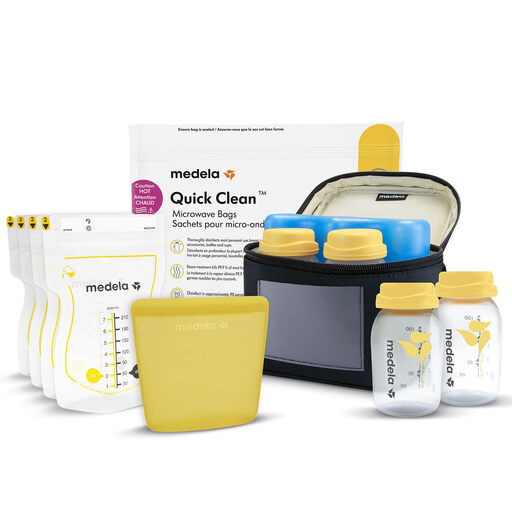
Why this choice suits this profile: This kit brings together 150 ml bottles, bags, a reusable pouch, an insulated bag and a microwave sterilising bag. A set designed to organise expressing and transporting breast milk.
The uses are clearly distinct: single-use bags must not be reused, and the sterilising bag is not for warming milk.
Four 150 ml bottles, materials stated as BPA-free and phthalate-free for food-contact parts, plus an insulated bag with ice pack.

Why this choice suits this profile: With eight capacities ranging from 150 to 1,040 ml, this set lets you portion out ingredients, individual servings and leftovers within a single range.
The variety of volumes stops you wasting space. However, always check the manufacturer’s instructions before using in the oven, microwave or freezer.
Borosilicate glass, eight rectangular sizes and removable lids suitable for storing food and taking lunch on the go.
For a typical lunch, a volume of 600 to 1,000 ml is usually suitable, depending on what the meal contains. A small extra container can hold a sauce, dessert or some fruit. For a family, formats of 1,000 to 1,600 ml are more practical for storing leftovers and batch-cooked meals.
An airtight container limits leaks and contact with air, but it doesn’t automatically extend how long food stays fresh. Follow the cold chain, recommended temperatures and the guidelines for each type of food. Cool cooked dishes quickly before storing them, and note the date when you’re keeping several portions.
It all depends on the use. Glass containers let you see the contents at a glance and resist certain odours better. Stainless steel containers are lighter than glass and practical to carry. No single material is compatible with every appliance or every recipe – always read the usage instructions before reheating a dish.