
Livraison le jour même ou le lendemain

Qualité garantie

Débloquez vos offres de bienvenue: Livraison GRATUITE | Jusqu'à -80 % | 30 jours d'essai gratuits à JoyPlus
Téléchargez l'application
Between dinner leftovers, prepped ingredients and dry goods bought in bulk, food storage containers have become a staple in many British households. But a pretty set you spot in a photo can quickly prove impractical in daily use: a lid that’s hard to close, awkward sizes, or boxes that simply won’t fit in your cupboard.
Here are the criteria to consider before buying, along with a selection of models suited to different needs.
A lid that stays in place doesn’t necessarily guarantee an airtight seal. When choosing airtight food containers, check for a silicone seal and make sure it sits correctly. A removable seal is easier to clean, but you need to put it back carefully to minimise leaks and unpleasant odours.
For dry foods, a good seal also reduces exposure to moisture and pests. However, it doesn’t replace the basics: respect use-by dates, store food at the right temperature, and let cooked dishes cool properly.
A twelve-piece set might look like a bargain, but the larger sizes won’t necessarily fit in every cupboard. Before ordering, measure the width and height available in your fridge, freezer or drawers.
Stackable food containers help you make better use of height, provided their base is stable and the lids stay firmly in place. In a small kitchen, a few well-chosen sizes will often be more useful than an overwhelming assortment.
This indication may refer to the container, the lid, or only certain parts. Glass, plastic and wood all react differently to heat and moisture.
Read the manufacturer’s instructions carefully: some lids should only go on the top rack, while a bamboo or wooden lid needs hand washing. Thorough drying is also essential, especially around silicone seals.
BPA-free plastic is lightweight and generally more resistant to everyday knocks. It’s ideal for cupboard storage or taking a meal on the go. However, check its usage limits: a container designed for storage isn’t necessarily suitable for the oven or microwave.
Borosilicate glass containers handle heat well and absorb little in the way of odours or stains. They are, however, heavier and can break if dropped. Even when a model is advertised as resistant to temperature changes, avoid thermal shock: never place a scorching hot container directly into the fridge or cold water.
A rectangular shape is often easier to fit in a fridge and reduces wasted space. Round jars for kitchen storage, on the other hand, are very practical on a worktop or for keeping ingredients visible.
Don’t assume compatibility based on the material alone. Check the specific instructions for the oven, microwave, freezer and dishwasher. When microwave use is allowed, the lid should generally be removed or left ajar.
For frozen liquids, leave enough space to allow for expansion. Regularly inspect the container, lid and seal: a crack, warping or a deep scratch are signs it’s time to replace the affected part.
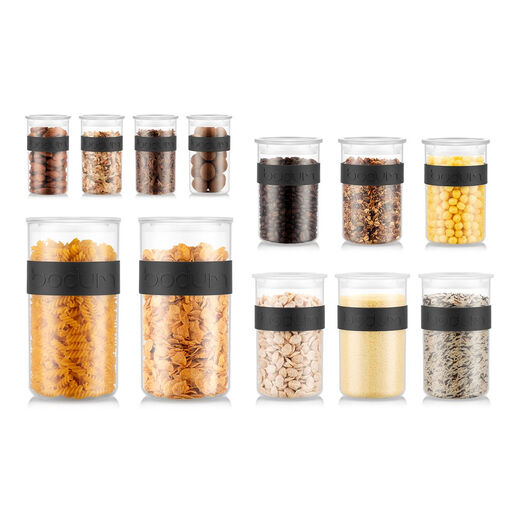
Why this choice suits this profile: This set offers four capacities, from 0.25 to 2 litres, giving you a good start on organising your cupboard, snacks and leftovers step by step.
The variety of sizes stops you storing a small amount in an oversized box. The airtight lids are stated as dishwasher safe.
12 BPA-free plastic containers, four capacities and lids suited to storing dry foods.

Why this choice suits this profile: Its family-sized format and borosilicate glass construction are ideal for meal prep, storing leftovers and dishes you want to take from fridge to reheating, according to the manufacturer’s instructions.
The removable silicone seal comes out easily for cleaning. The lid must be removed for microwaving, and the container should not be placed on a direct heat source.
2-litre capacity, borosilicate glass and stated compatibility with the freezer, microwave and dishwasher.

Why this choice suits this profile: This mid-range size is ideal for individual portions, leftovers and everyday meal prep. It is stated as compatible with the oven, microwave, freezer and dishwasher.
At 0.8 litres, it avoids wasting space on a standard portion. You still need to follow the instructions to prevent thermal shock and check the glass before each use.
Non-porous glass, stackable rectangular shape and a capacity suited to portions, leftovers and dishes to reheat.
We’ve put together a comprehensive, real-time updated list of products that fully meet these strict selection criteria and European safety regulations.
BPA-free plastic is lightweight and practical to carry. Glass suits those who prefer a non-porous surface and sometimes want to reheat their meal, provided the model is explicitly microwave-safe. However, you need to consider its weight and the risk of breakage.
No. An airtight seal alone doesn’t confirm this compatibility. Check the product instructions and leave room for liquids to expand. Also avoid direct transfers between the freezer and oven, or between a hot container and a cold surface.
Group containers by capacity, place the largest ones at the bottom and store lids vertically or in a dedicated box. Transparent models let you identify their contents quickly. For lasting kitchen organisation, choose the sizes you actually use rather than an overly large set.