
Livraison le jour même ou le lendemain

Qualité garantie

Débloquez vos offres de bienvenue: Livraison GRATUITE | Jusqu'à -80 % | 30 jours d'essai gratuits à JoyPlus
Téléchargez l'application
Leftovers from dinner, pre-prepared meals, flour, pasta or lunch on the go: food storage containers are useful for just about everything. But a hasty purchase can quickly turn into a headache – a lid that leaks, a container that won’t fit in the fridge, or a material that isn’t microwave-safe.
Before comparing sets of food containers, it’s worth looking beyond promises like “ultra-practical”, “airtight” or “all-purpose”. These phrases don’t tell you whether the container will actually work in your fridge, your cupboard or your meal-prep routine.
A lid simply placed on the container may be fine for storing dry goods. For a sauce, soup or a dish you’re transporting in a bag, the risk of leakage is very real. For a lunch box, choose a silicone seal, a clip system or a lid that is clearly described as airtight.
Also take a look at how the seal is maintained. When it’s removable, cleaning is easier; however, you must dry it thoroughly before putting it back to avoid odours and residual moisture.
The phrase “heat-resistant” doesn’t mean the container can go straight from the freezer to the oven without care. Glass, in particular, can crack under thermal shock caused by a sudden change in temperature.
BPA-free plastic containers are lightweight and practical for the pantry or meals on the go. However, they are not intended for the oven and, depending on the model, may also not be recommended for the microwave. Always check the manufacturer’s instructions before reheating food.
A large capacity doesn’t guarantee efficient storage. Containers that are too tall may not fit on a shelf, while awkward shapes that can’t be stacked quickly take over an entire cupboard.
In both the fridge and the freezer, rectangular shapes are generally easier to line up. For dry foods, transparent jars let you check the contents and the remaining level without having to open every lid.
Glass food containers are non-porous and generally retain fewer odours, stains and flavours. When designed for it, borosilicate glass can go in the fridge, freezer, oven and microwave. However, it is heavier and more prone to impact damage than a plastic container.
BPA-free plastic is a lightweight solution for storing food and for travel. It is particularly suitable for dry goods and already-cooled meals, within the temperature limits stated by the manufacturer. The “BPA-free” label does not, however, make the container suitable for the oven or direct heat.
A selection of several capacities stops you from filling a large container with a small portion, which takes up unnecessary space in the fridge.
Stackable food storage containers should sit on a stable base and have a lid that is flat enough. In a cupboard, transparent sides make inventory easy, while a wide opening makes filling and cleaning much more convenient.
Also check whether the container and its lid are dishwasher-safe. Removable seals deserve special attention: remove them regularly, wash them separately and let each part dry completely before reassembling the container.
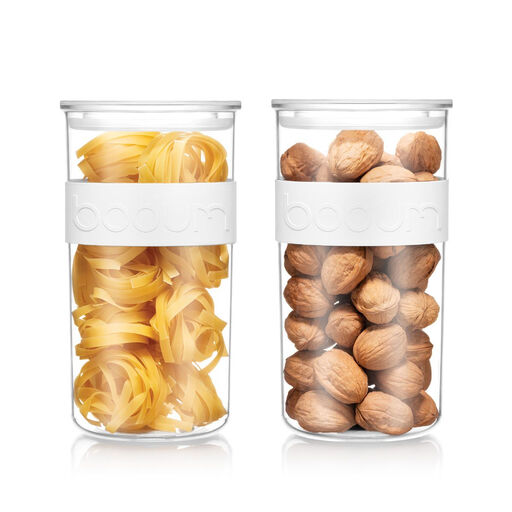
Why this choice suits this profile: With two 2 l containers, you have a simple starting point for organising leftovers or dry foods, without accumulating too many sizes.
The transparent bodies and airtight lids let you quickly identify the contents and reduce the risk of spills in the cupboard or fridge.
A 2 l size, plastic stated as BPA-free and a design suited to storing dry goods or cooled leftovers.

Why this choice suits this profile: Its borosilicate glass body and lid with a removable seal make it a versatile container, well suited to family meals.
The separate instructions for the oven, microwave, freezer and lid reduce the risk of misuse during temperature changes.
A 2 l capacity, borosilicate glass, a removable silicone seal, dishwasher-safe and a lid stated as BPA-free.
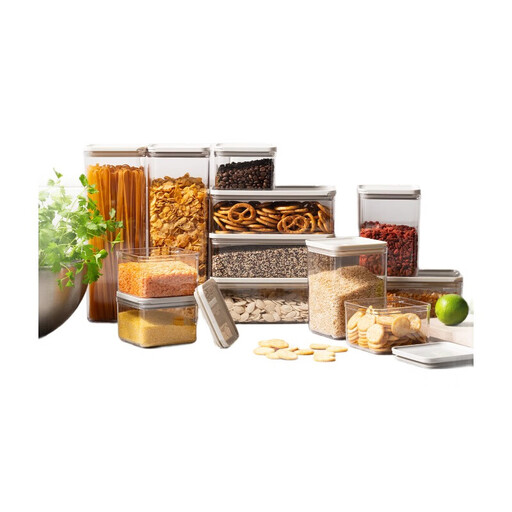
Why this choice suits this profile: The twelve sizes let you organise a family pantry with a container suited to cereals, pasta, rice, flour or dried fruit.
The different sizes prevent mixing small and large quantities, while the stackable lids make better use of the available height.
Twelve pieces of 0.5, 1, 1.2 and 2.6 l, plastic stated as BPA-free, transparent bodies and lids with silicone seals.
We’ve put together a complete, real-time updated selection of products that meet these demanding criteria as well as European safety regulations.
A container of 600 to 1,000 ml is generally suitable for an individual lunch, depending on what the meal contains. For a salad or a side dish, a smaller size may be enough. For a full meal, check the space available in your bag and make sure the lid is truly leak-proof.
It depends on the material and the manufacturer’s recommendations. Leave a small gap in the container when placing a liquid food inside: its volume increases as it freezes. With glass, avoid going straight from the freezer to the oven or pouring a hot liquid into the container to limit the risk of thermal shock.
Wash the containers promptly after use, then dry the container, lid and seal separately. Regularly inspect the whole set and replace any part that is cracked, warped or damaged. For glass jars with a wooden lid, hand washing is best and do not let the lid soak.