
Livraison le jour même ou le lendemain

Qualité garantie

Débloquez vos offres de bienvenue: Livraison GRATUITE | Jusqu'à -80 % | 30 jours d'essai gratuits à JoyPlus
Téléchargez l'application
Between cluttered cupboards, leftovers drying out and meals to transport without spilling half of them, food storage containers meet a host of needs. But a hasty purchase can leave you with containers that are a pain to clean, too bulky or not microwave-safe.
Here are the criteria to consider before putting together your collection of food containers, along with a selection tailored to French cooking habits.
A container described as airtight isn’t necessarily suitable for transporting soup or sauce. Instead, examine the closure system: clip-on lid, removable seal, number of locking points and how well the lid fits the container.
For dry foods, a well-fitting seal limits exposure to moisture and odours. For liquid preparations, go for airtight containers where the manufacturer clearly states the intended use and transport conditions.
Lids made up of several parts can trap residue in seals or hinges. A model that looks appealing at the time of purchase can quickly become a chore if every piece has to be dismantled after use.
Before ordering, check whether the various parts are dishwasher-safe. If there’s no clear indication, it’s best to wash them by hand. Bamboo parts, such as those on some bread bin lids, generally need separate care.
A large bundle isn’t necessarily right for every kitchen. Containers that are too tall can be tricky to fit in the fridge, while small boxes won’t be enough for family leftovers or dry ingredients.
To organise your pantry well, combine several sizes: small containers for spices and seeds, medium ones for rice or pasta, and large boxes for flour, cereals or batch-cooked meals.
Each material has its advantages and drawbacks:
Where stated, the BPA-free label means the material concerned does not contain bisphenol A. It does not replace the usage instructions or the compliance information relating to food contact.
For meal prep, stackable formats make better use of the available height in the fridge. Rectangular containers often use space more efficiently than round ones, especially in a drawer or lunch bag.
A compartment lunch box or bento box lets you separate carbohydrates, vegetables and sides. For a child or a desk lunch, this arrangement stops different textures from mixing. In the pantry, spice jars and labelled containers make it easier to identify contents and rotate stock.
Never put a container in the oven or microwave without explicit instructions. A glass container may withstand certain temperatures while its lid may not. As for metal, it must not be used in the microwave.
To keep food in good condition, let preparations cool before sealing the container tightly when the product instructions recommend it. Also remember to label dishes with their contents and preparation date so you can keep track of their storage in the fridge.
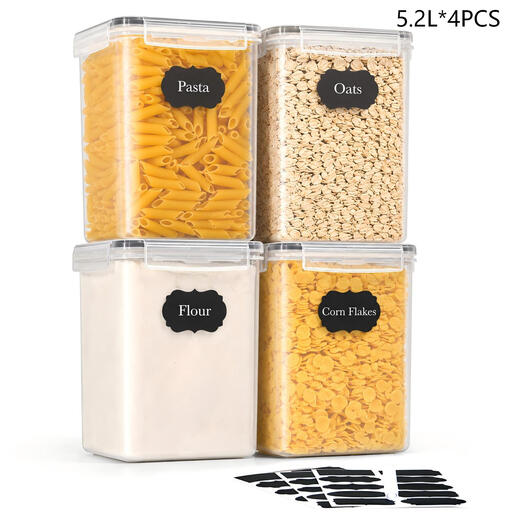
Why this choice suits this profile: This compact set lets you start organising your pantry gradually, without investing in a large bundle of food containers straight away.
The limited number of pieces simplifies choosing sizes and stops you filling a cupboard with containers that would go unused.
A set combining containers and spice jars, with labels and markers.

Why this choice suits this profile: With eight capacities ranging from 150 ml to 1,040 ml, this set covers individual portions, leftovers and meal prep alike.
The capacity of each piece is stated, so you can check before buying that the set really matches your needs.
Borosilicate glass, a rectangular shape and removable lids, according to the information supplied with the product.

Why this choice suits this profile: Its five compartments are ideal for desk lunches, picnics, children’s meals and preparing separate portions.
The product page states that the box is not microwave-safe and recommends hand washing, which reduces the risk of misuse.
316L stainless steel, five compartments, PP lid and four locking clips.

Why this choice suits this profile: With twelve containers across four capacities, this set is ideal for families who want to streamline the storage of dry goods and leftovers.
The quantities and capacities are detailed: four containers of 0.25 l, three of 0.6 l, three of 1 l and two of 2 l.
The product page mentions BPA-free plastic, airtight lids and dishwasher compatibility.
A bread bin serves a different purpose from a container intended for the fridge. The Bodum BISTRO Bread Box Large offers a stated capacity of 10 litres and a bamboo lid that can also double as a chopping board. The body is made from BPA-free plastic. The lid must be washed by hand, without soaking or putting it in the dishwasher.
For a perfectly organised kitchen, the 24-piece storage set, supplied with labels and markers, may suit those who regularly store pasta, rice, sugar or flour. The 16-piece set offers a middle ground between the four-piece kit and the larger collection.
We’ve put together a comprehensive, real-time updated list of products that meet these demanding selection criteria and the European standards applicable to food safety.
For a single portion, allow roughly 500 to 800 ml, depending on the contents. Larger formats, around 1 litre or more, are better suited to family dishes or batch cooking. Mixing sizes stops you using a big container for a small amount.
No. The glass may withstand heat, but the lid, clips or seals may have their own limits. Always check the product instructions and remove the lid if microwave use is only approved for the container.
Wash the boxes after each use, dry the seals thoroughly and avoid abrasive sponges. Don’t force a warped lid and replace any cracked parts. With stainless steel boxes, never use the microwave. For bamboo elements, opt for a damp wipe followed by thorough drying.