
Livraison le jour même ou le lendemain

Qualité garantie

Débloquez vos offres de bienvenue: Livraison GRATUITE | Jusqu'à -80 % | 30 jours d'essai gratuits à JoyPlus
Téléchargez l'application
Between dinner leftovers, packed lunches and dry goods bought in bulk, food storage containers need to adapt to a wide variety of uses. Yet the features highlighted on product pages aren't always enough to guarantee that a particular set will truly suit your daily routine.
Here are the criteria to consider before choosing a set of food storage containers, along with a selection tailored to different types of users.
A lid that clips on easily isn't necessarily capable of holding soup, sauce or a vinaigrette-dressed dish. For a leak-proof lunch box, check for a silicone seal, a complete locking system and, where available, the intended uses specified by the manufacturer.
A container designed for dry foods will work well for rice, pasta or cereals, without necessarily being suitable for liquids. So it's best not to interpret the term "airtight" as a guarantee that works for all types of food.
A set of twelve containers might seem like good value, but if the sizes are too similar to one another, they could end up languishing at the back of a cupboard. For pantry storage, go for a combination of small containers for seeds and dried fruit, medium-sized ones for sugar or cereals, and large formats for flour, pasta and rice.
Also remember to measure the depth of your cupboards. Stackable food containers can free up vertical space, provided their lids and bases fit together properly.
Borosilicate glass is prized for its resistance to thermal shock. That doesn't mean every container can go in the oven, freezer or microwave. The lid may have different limits from the container itself.
To avoid warping and cracking, always check the instructions. With some plastic containers, you also need to verify the maximum temperature they can withstand and the washing recommendations.
BPA-free containers can be a good choice for repeated use, especially for storing cold or dry foods. However, the absence of BPA doesn't tell you anything about the container's durability, its leak-proofing or its heat resistance.
Glass is particularly well suited to leftovers and retains very few odours. On the downside, it's heavier and can break. Food-grade plastic containers are generally lighter and more practical for the office or on the go. For each model, check the food-contact information and any usage restrictions provided by the manufacturer.
For containers for pasta, rice, flour and cereals, a capacity of 1 to 2.6 litres can be appropriate, depending on how much you consume and the size of the packaging. Smaller formats of 150 to 640 ml are better suited to sauces, toppings, dried fruit or individual portions.
A slightly recessed lid, a stable base and transparent walls make stacking easier and allow you to identify the contents at a glance. Clear kitchen storage jars also help you spot which items need restocking straight away.
A container that's easy to clean will naturally be used more often. Check whether both the container and lid are dishwasher-safe, or if only the receptacle is compatible. Silicone seals should be removed and dried regularly to prevent moisture from building up.
For lunch at the office, choose a size that fits in your bag and a lid with a clearly identifiable locking mechanism. For meal prep, several matching capacities make portioning much simpler.
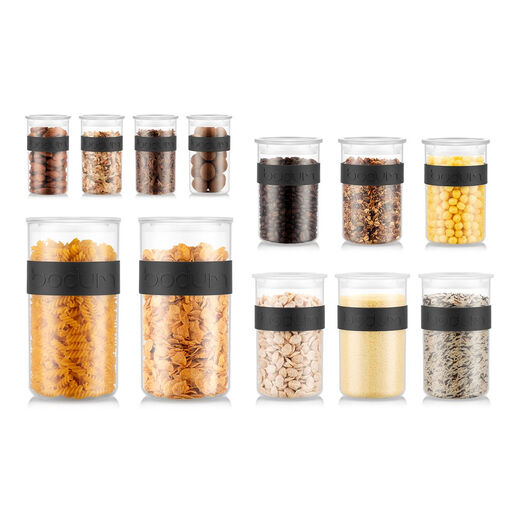
Why this suits this profile: This 12-piece set covers everyday needs, from small snacks to generous portions, without requiring multiple separate purchases.
The variety of capacities means you won't end up with only large containers, which are impractical for small portions.
12 pieces, four capacities from 0.25 to 2 litres, BPA-free plastic and airtight lids according to the product listing.
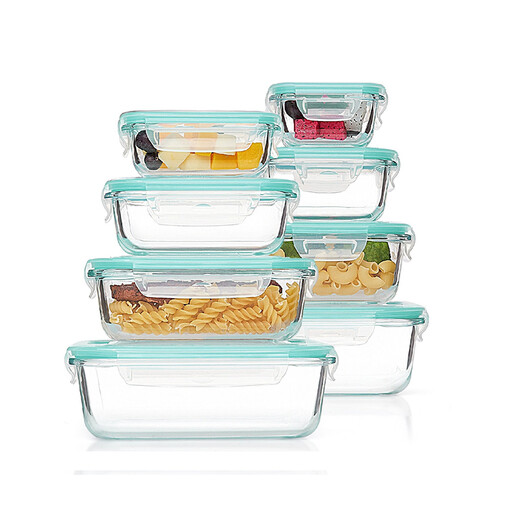
Why this suits this profile: The eight rectangular containers fit neatly into a well-organised kitchen, whether for portioning or transporting your lunch.
The graduated capacities, from 150 ml to 1,040 ml, prevent you from using an oversized container for every preparation.
Borosilicate glass, eight rectangular containers and removable lids according to the available description.

Why this suits this profile: This set brings together five large containers of 1,040 ml and five small ones of 370 ml — a well-thought-out combination for meal prep and separating portions.
Having duplicate sizes is practical for preparing several similar meals and avoids having to work with a mismatched assortment that's hard to organise.
10 pieces in borosilicate glass, clip-lock closure and a balanced split between two capacities.
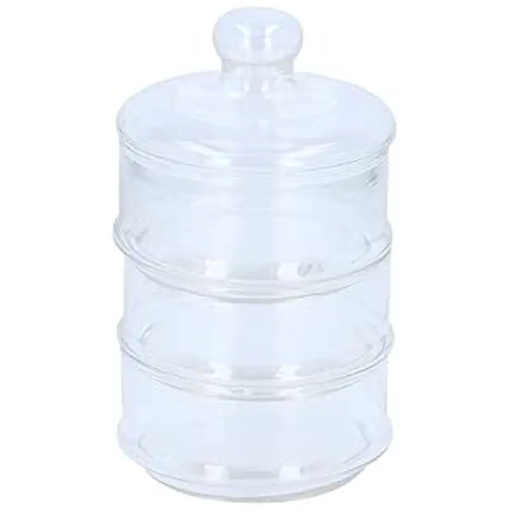
Why this suits this profile: This three-tier structure fits easily on a worktop or shelf, while keeping dried fruit, biscuits and sweets clearly visible.
With its 12 cm diameter and 23 cm total height, this storage solution gives you precise measurements to check available space before buying.
Three stackable glass jars, a lid included and glass components that are dishwasher-safe according to the product listing.
We've put together a comprehensive, real-time updated selection of products that meet these exacting criteria as well as European safety standards.
No. Compatibility depends on the material, the specific model and, sometimes, the lid. Always check the manufacturer's instructions before heating or freezing a container. A product described as airtight or BPA-free isn't automatically suitable for these appliances.
Its lifespan depends on how often it's washed, any knocks it takes, exposure to heat and the condition of the seal. Replace any container that has a crack, a warp, a persistent odour or a lid that no longer closes properly. Seals should also be inspected regularly.
Start by measuring your shelves, then group foods according to how often you use them. Place large formats at the back or on the bottom shelf, medium containers at eye level and small boxes in a drawer or on a dedicated shelf. Even with transparent containers, labelling is still useful for noting opening dates and distinguishing similar products.