
Livraison le jour même ou le lendemain

Qualité garantie

Débloquez vos offres de bienvenue: Livraison GRATUITE | Jusqu'à -80 % | 30 jours d'essai gratuits à JoyPlus
Téléchargez l'application
Between dinner leftovers, lunch at the office, dry cupboard staples and Sunday meal prep, food storage containers need to meet a wide range of needs. An unreliable seal, an unsuitable size or a material that is incompatible with heat can quickly turn a practical purchase into a poor choice.
Here are the key points to consider before choosing an airtight food storage container, a complete set or a container specially designed for the freezer.
A lid that clips on easily is not necessarily leakproof. When carrying soup, sauce or a meal in the car, check for a silicone seal, clips or a closure system clearly described by the manufacturer. Simple pressure in the centre may be enough for storing dry foods, but it generally provides less protection against leaks.
A set made up exclusively of large boxes takes up more space in the fridge and often leaves lots of air around small portions. Conversely, containers that are too small make it harder to store family meals and batch-cooked dishes. Stackable food containers in several sizes make better use of shelves and drawers.
A glass food container may be suitable for moving from the fridge to the microwave, but its lid may not withstand heat. Likewise, a freezer-safe container cannot always be placed directly in a preheated oven. The product listing should clearly distinguish between different uses: microwave, oven, freezer, dishwasher and contact with hot food.
A glass storage container generally offers good resistance to stains and odours. Where specified, borosilicate glass handles temperature changes better than some standard glass. However, thermal shock should still be avoided: do not place a cold container in a very hot oven, and do not pour cold water over a scorching-hot container.
A BPA-free plastic food container is often lighter and easier to carry. However, the ‘BPA-free’ claim should be accompanied by clearly defined usage instructions. If the box is intended for microwave use, also look for the relevant symbol or guidance. Plastic designed for cold storage is not automatically suitable for reheating.
For airtight kitchen storage, inspect the lid carefully: check the number of clips, the flexibility of the seal and whether it can be removed for cleaning. Food residue trapped in a groove can compromise the seal and encourage unpleasant odours.
Wash and dry every component thoroughly before putting it back together. When the manufacturer recommends hand washing, repeated dishwasher cycles can speed up wear to the seal or finish.
For an individual portion, a capacity of approximately 500 ml to 1 litre is generally easier to store. 2 litre models are better suited to family salads, large quantities of leftovers or ingredients prepared in bulk. Large 4 litre containers are more suitable for storing pasta, flour or cereals.
In the freezer, always leave some room when storing a liquid or food with a high water content. As it freezes, the contents expand and may put pressure on the lid or container.
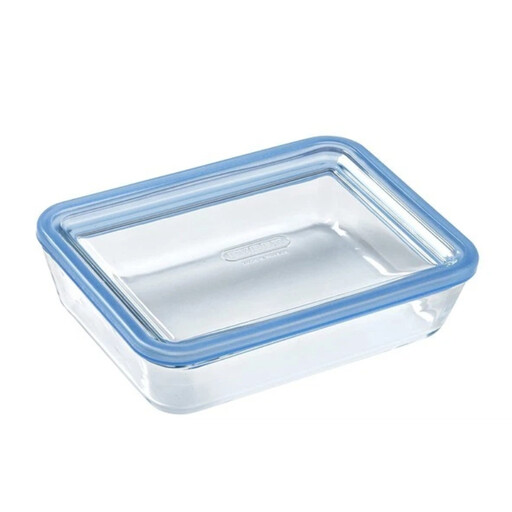
Why this choice suits this profile : With its 0.8 litre capacity, this container is suitable for individual portions, leftovers and takeaway meals. The transparent glass lets you identify the contents quickly without opening the box.
The container is described as stackable and suitable for the fridge, freezer, microwave, oven and dishwasher. Thermal shock guidance must still be followed, and you should check the recommendations for the lid.
Non-porous borosilicate glass, 0.8 litre capacity, rectangular design and an immediate view of the contents.

Why this choice suits this profile : With its 2 litre capacity, this container is ideal for families, batch cooking and meals prepared in large quantities. Its transparent body makes it easy to see what is left.
The removable silicone seal makes the lid easier to clean and helps prevent persistent unpleasant odours. The lid must be removed when using the microwave, and the container should not be placed on a direct heat source.
2 litre capacity, borosilicate glass and stated compatibility with the dishwasher, microwave and freezer.
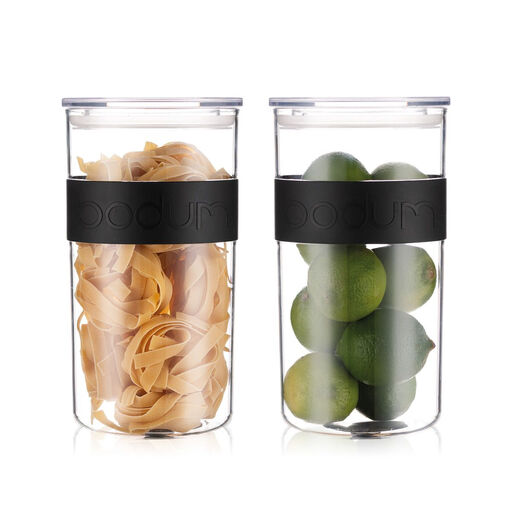
Why this choice suits this profile : This set of two 2 litre containers is designed for storing pasta, rice, cereals, flour or biscuits in a cupboard or pantry.
The airtight seal limits exposure to air and moisture. However, the product information states that these boxes are not suitable for microwave or oven use and are not intended for hot liquids.
Two 2 litre containers, stated BPA-free plastic, an airtight seal and a design dedicated to dry foods.
We have put together a comprehensive, real-time updated selection of products that meet these exacting criteria and European safety regulations.
To make your containers last as long as possible:
An oven-safe storage container must be described as suitable for this use in the product information. The lid is generally excluded. For dry foods, kitchen storage jars with labels can complement containers reserved for cooked dishes.
Glass is suitable for people looking for a non-porous surface and good visibility of the contents. Plastic is lighter and easier to carry. The best choice therefore depends on how much weight you are prepared to carry, how you reheat your food and how much space you have available.
Yes, but only if the manufacturer clearly states that it is suitable. Leave room for liquids to expand and avoid placing a very cold container directly in a hot oven. These precautions are particularly important with glass containers.
A set with several sizes lets you separate portions, side dishes and prepared ingredients. For one person, a few individual containers may be enough. A family will generally benefit more from combining medium-sized and large-capacity containers than from buying boxes that are all identical.