
Livraison le jour même ou le lendemain

Qualité garantie

Débloquez vos offres de bienvenue: Livraison GRATUITE | Jusqu'à -80 % | 30 jours d'essai gratuits à JoyPlus
Téléchargez l'application
A well-organised kitchen depends on more than simply having enough containers. An undersized, difficult-to-clean food storage container, or one with an unreliable lid, can quickly end up at the back of a cupboard. Before choosing an airtight kitchen storage set, it is therefore worth looking beyond the design and marketing claims.
A lid that clips on easily is not necessarily suitable for long-term storage. For dry foods such as flour, rice, sugar or pasta, check that the seal is sufficiently secure and that the container is suitable for food use.
However, the term ‘airtight’ should be treated with caution: it does not guarantee that the container will protect its contents indefinitely from every trace of moisture. The box must be closed properly and stored in a dry place.
A container that is too short for spaghetti or too narrow for a bag of flour will force you to decant the food, or even break the pasta. Before ordering, measure the available space in your cupboard and compare it with the dimensions provided by the seller.
To maintain a consistent system, also plan for several sizes: small jars for spices, medium containers for rice and cereals, and tall boxes for long pasta.
Glass lets you see the contents, but it is heavy and fragile. Metal protects against light, but often needs to be washed by hand. Some decorative finishes may also be susceptible to abrasive sponges.
Ease of maintenance matters just as much as appearance. A box that needs to be wiped dry immediately or is not dishwasher-safe may be suitable for occasional use, but less practical for a family handling several containers every day.
Start by sorting your food into groups:
A 4-piece set is suitable for getting started or equipping a small cupboard. Sets containing 16 or 24 pieces are better suited to households looking to standardise their entire pantry.
For dry foods, food-grade metal limits exposure to light. Carbon steel boxes with a black finish and gold details can also be displayed on a worktop, provided they are kept away from a heat source.
Never put a metal box in the microwave, and do not use it to store liquids unless the manufacturer allows it. To keep it in good condition, clean it with a soft cloth and dry the inside thoroughly before filling it.
Food containers with labels make it easier to identify the contents and keep track of dates. If necessary, note the name of the food, the opening date and the best-before date shown on the original packaging.
Avoid mixing two batches in the same box without checking their dates. This precaution is particularly useful for products consumed regularly, such as carbonara instant noodles, cereals or Barilla Penne Rigate pasta.
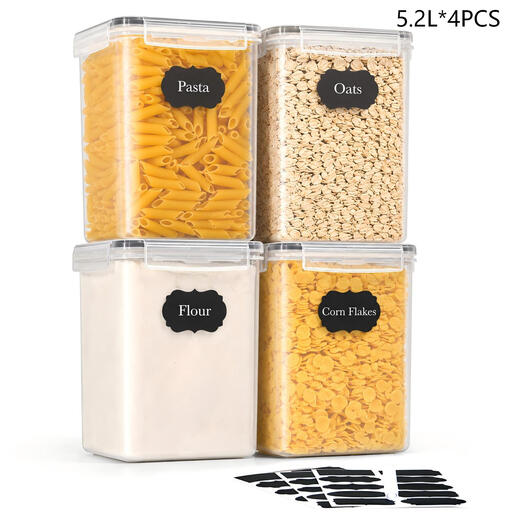
Why this choice suits this profile : This format lets you start organising your cupboard without building up a collection of unused containers. It is suitable for everyday dry foods and smaller kitchens.
With just four pieces, there is less risk of buying an oversized set before you have worked out what you need.
A 4-piece format suitable for storing dry goods and getting your first organisational system in place.
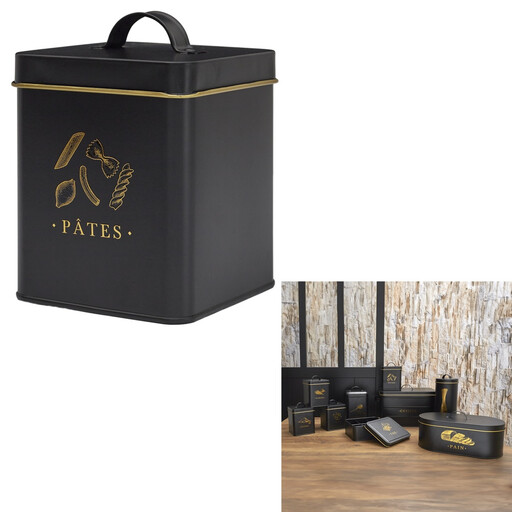
Why this choice suits this profile : Its matt black finish and gold details fit effortlessly into a contemporary kitchen where storage remains on display on the worktop.
The opaque metal construction limits exposure to light, while hand washing helps prevent potential damage from the dishwasher.
Dimensions of 11,2 × 19 × 11,2 cm, reinforced carbon steel construction and a securely closing lid.
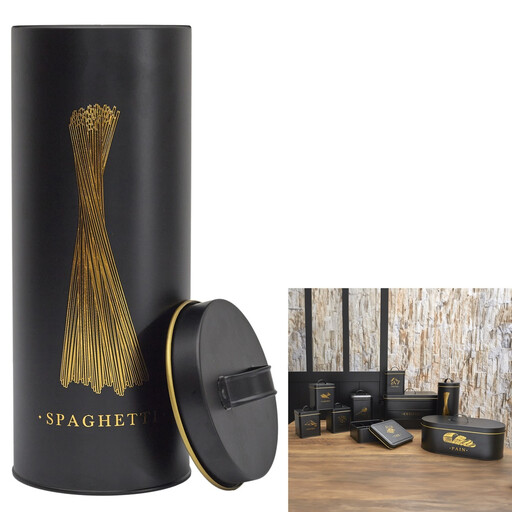
Why this choice suits this profile : At 31,5 cm high, it holds spaghetti, linguine and fettuccine without having to break the pasta.
Its vertical shape meets a very specific need and avoids storing long pasta in a container that is too short.
An 11,2 × 11,2 cm square base, an opaque structure and a design intended for dry foods.
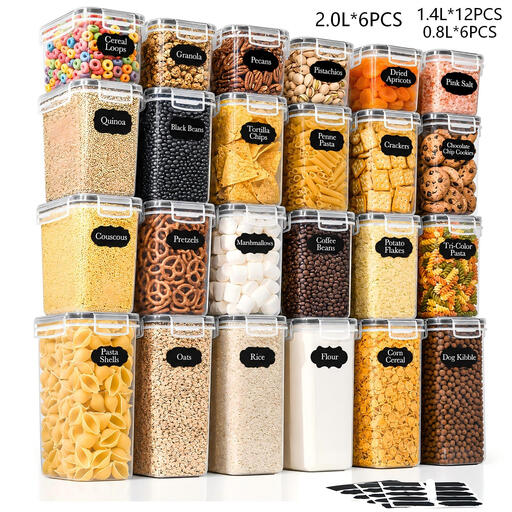
Why this choice suits this profile : The variety of containers, spice jars and labels makes it easier for a family to reorganise its cupboards completely.
The labels and range of sizes reduce identification errors and let you match each box to its contents.
A 24-piece set with labelling accessories, suitable for rice, flour, sugar and pasta.
We have put together a comprehensive, real-time selection of products that meet these demanding criteria and European safety standards.
Once you have chosen your boxes, group products according to how often you use them. Pasta eaten every week can stay at eye level, while supplies of Samyang Buldak Korean ramen or red bean drinks can be kept in a dedicated area.
For packaged products, retain the essential information: ingredients, allergens, best-before date and preparation instructions. Depending on the product, carbonara instant noodles may contain wheat, milk, soya or sesame. Checking the physical label remains essential, as the ingredients may vary depending on the market or batch.
A tall box measuring around 30 cm or more is generally the most practical choice for storing spaghetti without breaking it. The 31,5 cm metal model featured above is designed for this type of long pasta. Even so, remember to measure the height of your shelf before buying.
It depends on the food, its original date and its storage conditions. Decanting a product does not automatically extend its shelf life. Keep the date shown on the packaging and store the box away from moisture and heat.
Not always. The black and gold models featured here are designed for hand washing, followed by immediate drying. Avoid abrasive products and always check the care instructions for the specific model you have chosen.