
Same-day & Next-day Delivery

Quality Guaranteed

Unlock Your Welcome Offers: FREE Delivery | Up to 80% OFF | Free 30-day JoyPlus trial
Download the APP
A good food storage container can be a game-changer in your kitchen, helping you reduce waste and simplify meal prep. But the market is saturated with products that don't always live up to their claims. A lid that leaks in your bag, plastic that's permanently stained by bolognese sauce, or a curry smell that never goes away: these everyday mishaps are, however, entirely avoidable.
As experts in everyday products, our mission is to help you cut through the noise. Here are the pitfalls to avoid and the essential criteria to check before you buy.
For optimal food preservation and hassle-free kitchen organisation, focus on these three fundamental points.
The choice of material determines the container's use, durability, and hygiene.
Glass food container (borosilicate): This is the champion of versatility. Borosilicate glass is resistant to thermal shock, allowing it to go from the freezer to the oven (without its lid), and then straight to the table. Since it's non-porous, it won't stain, retain odours, and is a breeze to clean. Its only downsides are its weight and fragility.Plastic food container (BPA-free): Lightweight, often stackable, and more budget-friendly, it's perfect for storing dry goods or transporting cold meals. For use with saucy dishes or in the microwave, it's crucial to choose a high-quality plastic specifically designed for this purpose to avoid staining and warping.Stainless steel food container: Robust, lightweight, and unbreakable, the stainless steel food container is an excellent alternative for daily transport, much like a bento box. It keeps food fresh very well but is generally not microwave-safe. It's a healthy and durable solution built to last.A truly airtight food container relies on a winning combination: strong locking clips (often 4 of them) and a removable silicone seal. This seal creates a perfectly tight barrier that prevents liquids from escaping and air from getting in, thus preserving food freshness for longer. Remember to remove the seal when cleaning to prevent mould growth.
For flawless kitchen organisation, opt for a set of food storage containers of different sizes from the same range. Stackable containers are a real space-saver in cupboards and the fridge. Also, check for compatibility (dishwasher, freezer, oven, microwave) to ensure they fit your routine, whether it's for weekly meal prep or storing leftovers.
Instead of an endless catalogue, here are our top picks for three specific user profiles, based on our quality and practicality criteria.
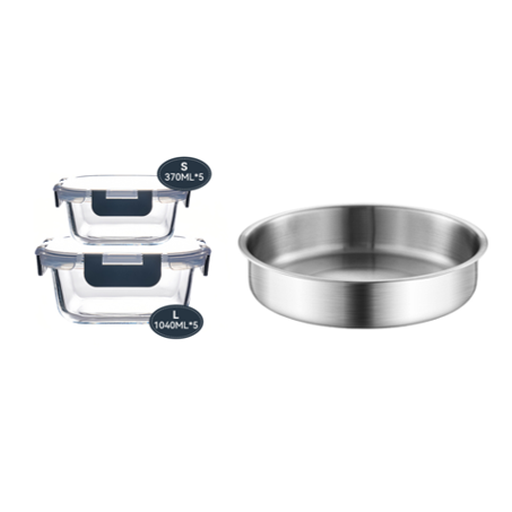
Why we chose it: This set combines borosilicate glass containers in two different sizes, perfect for preparing and portioning meals for the week. The glass allows you to reheat dishes directly in the oven or microwave without any risk.
Borosilicate glass is non-porous, which completely eliminates the risk of stains and trapped odours. The clip-lock system with a seal ensures excellent leak-proofing for transport.
Versatility and hygiene: A single container for cooking, storing, transporting, and reheating. The set even includes a stainless steel plate for a durable, on-the-go serving option.

Why we chose it: This complete set of 12 BPA-free plastic containers in 4 different sizes is a budget-friendly solution for overall kitchen organisation, from leftovers in the fridge to dry goods in the pantry.
By offering a large number of containers at an accessible price, this set helps unify your storage. The lids are well-suited for storing dry goods, where the risk of leaks is zero.
Value for money: A complete solution to bring order to your cupboards and fridge with a cohesive, stackable design.

Why we chose it: For those looking for a durable alternative to plastic and glass for their packed lunches, this 316 stainless steel set is perfect. It's lightweight, unbreakable, and won't get damaged in a bag.
Stainless steel is one of the most hygienic materials: it doesn't retain odours, colours, or flavours. Its robustness guarantees a virtually unlimited lifespan with no warping.
Lightweight and durable: The perfect combination for daily, on-the-go use, with no risk of breakage and a reduced long-term environmental impact.
We have compiled a complete, up-to-date list of products that meet our strict selection criteria and safety regulations.
Most glass, plastic, and stainless steel containers are freezer-safe. However, it's crucial to check the packaging. For glass containers, avoid thermal shock (don't go directly from the freezer to a hot oven) and never fill them to the brim, as liquids expand when they freeze.
If an odour persists after a standard wash, try filling the container with a mixture of warm water and baking soda. Let it sit for several hours, or even overnight, before rinsing. Another old-school trick is to let it air dry in direct sunlight.
It all depends on your priorities.