
Livraison le jour même ou le lendemain

Qualité garantie

Débloquez vos offres de bienvenue: Livraison GRATUITE | Jusqu'à -80 % | 30 jours d'essai gratuits à JoyPlus
Téléchargez l'application
A well-organised kitchen starts with smart storage. At the heart of this system, the food storage container is an essential ally for keeping food fresh longer, reducing waste, and simplifying the famous meal prep. However, with so many options on the market, it's easy to end up with products that don't live up to their promises. A warped lid, plastic permanently stained by bolognese sauce, a supposedly airtight container that leaks in your bag… Who hasn't experienced these frustrations? The good news is: they are entirely avoidable.
As the head of product selection for Joybuy, my mission is to help you cut through the noise. Let's forget the marketing jargon and get straight to the point, focusing on what truly matters for everyday use. Here are the pitfalls to avoid and the essential criteria for investing wisely.
The 3 pitfalls to avoid when choosing your food storage containers:
To make the right choice every time, focus on three fundamental points: the material, the locking system, and modularity.
Here, it all depends on how you plan to use them.
The effectiveness of an airtight container depends on its lid-and-gasket combination.
For truly optimised kitchen storage, the keyword is: modularity.
Rather than searching for a one-size-fits-all container that doesn't exist, it's better to choose solutions tailored to specific uses.

The verdict: Perfect for *batch cooking*, this container transitions effortlessly from the freezer to the microwave. Its borosilicate glass makes it a model of versatility for storing, reheating, and transporting.
Its borosilicate glass resists stains and odours, where cheap plastics fail. The clip-lock system ensures a completely leak-proof seal, even for dishes with sauce.
Versatility and durability. A single container to store, transport, and reheat, radically simplifying daily logistics.
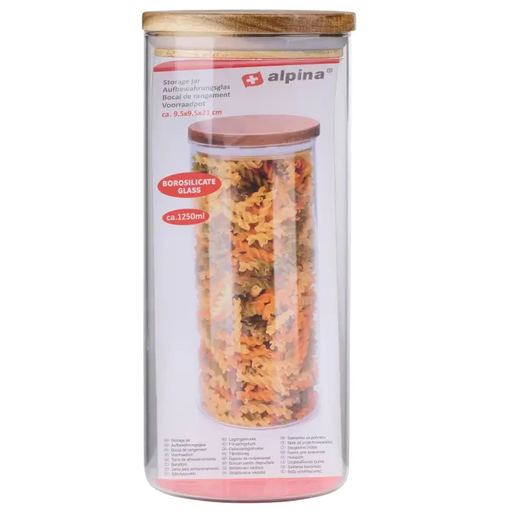
The verdict: Its square shape is a major asset for optimising shelf space. The combination of transparent glass and an acacia wood lid merges the practical with the aesthetic for an impeccable pantry.
It avoids the trap of style over substance. Its square shape allows for perfect alignment without wasting space, unlike round jars which create empty gaps.
Space optimisation and a refined design. Ideal for storing dry goods while adding a touch of elegance to the kitchen.

The verdict: For those who can't imagine lunch without a hot meal, whether at the office or on the go, this insulated jar is the solution. Its vacuum insulation maintains the temperature (hot or cold) for hours.
It solves a very specific problem that standard containers can't: keeping a meal genuinely hot. Say goodbye to the disappointment of a lukewarm lunch. Its wide mouth also makes filling easy and allows you to eat directly from it.
Temperature retention (hot or cold). Its 316 stainless steel construction is both robust and perfectly hygienic.
We have curated a complete selection of products that meet our selection criteria and current standards.
No, and this is a critical point of caution. Only borosilicate glass is designed to withstand significant thermal shock, such as moving from the refrigerator to the microwave. Regular glass (soda-lime) can crack or even shatter under the stress of a sudden temperature change. Always check the manufacturer's recommendations.
A wooden or bamboo lid is very stylish, but it requires a little attention. It should never go in the dishwasher or be left to soak in water, as this can cause it to warp or crack. Simply clean it with a damp sponge and a bit of soap, then dry it immediately and thoroughly before putting it back on the jar. This is the secret to preserving the wood and maintaining the seal's effectiveness.
Not necessarily, and therein lies the subtlety. "Airtight" protects against air (ideal for keeping biscuits crisp or coffee aromatic), whereas "leak-proof" protects against liquid spills. For transporting soup or a dish with sauce, prioritise models equipped with clip-on lids and a thick silicone gasket—these are the only ones truly designed to be 100% leak-proof.