
Same-day & Next-day Delivery

Quality Guaranteed

Unlock Your Welcome Offers: FREE Delivery | Up to 80% OFF | Free 30-day JoyPlus trial
Download the APP
For a well-organized kitchen, good food storage containers are an essential starting point. They are your everyday allies for preserving food freshness, preparing meals in advance (the famous meal prep), and fighting food waste. But faced with an overwhelming selection, it's easy to end up with products that warp, no longer seal, or take up a ridiculous amount of space in your cupboards. As a product expert for the Joybuy editorial team, I'm here to separate fact from fiction and help you make a smart choice, beyond the marketing hype.
Before you dive in, let's review the 3 classic traps that turn a good purchase into a real headache.
To avoid these disappointments, here are the technical points to check that change everything.
The choice of material directly impacts the durability, use, and maintenance of your containers.
A truly airtight food container depends on two things: a high-quality silicone seal that is both flexible and removable for easy cleaning, and a robust clipping system. Four-clip closures are often a sign of reliability: they distribute pressure evenly across the seal, guaranteeing a perfect seal against air and liquids.
Rather than collecting mismatched containers, investing in a food storage set is much smarter. Manufacturers design these sets to stack and nest perfectly, optimizing every square inch of your cupboards and fridge. A good set should offer several sizes to suit all uses, from a small sauce to a large family-sized dish.
Here is a selection of products that meet distinct user profiles, taking into account the quality criteria we've just discussed.
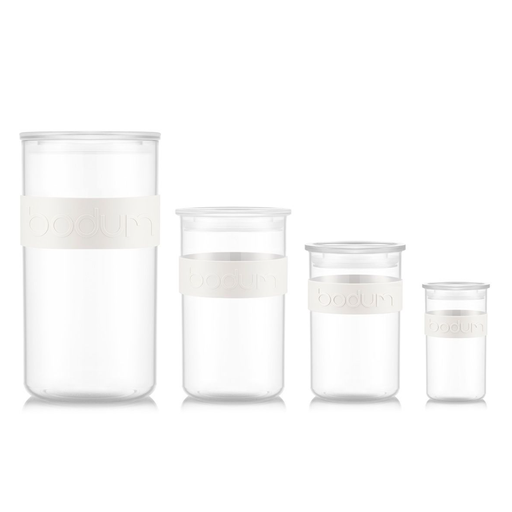
Why we chose it: To standardize your pantry with a complete system that is both aesthetic and functional. This versatile set covers all needs, from the smallest quantities to large volumes.
The design of the Bodum Presso range is engineered for perfectly stable stacking, which puts an end to haphazard storage. The consistency of the set eliminates the chaos of mismatched containers.
A complete 12-piece food storage set made of BPA-free plastic with airtight lids. Also available in a black version to match your kitchen.
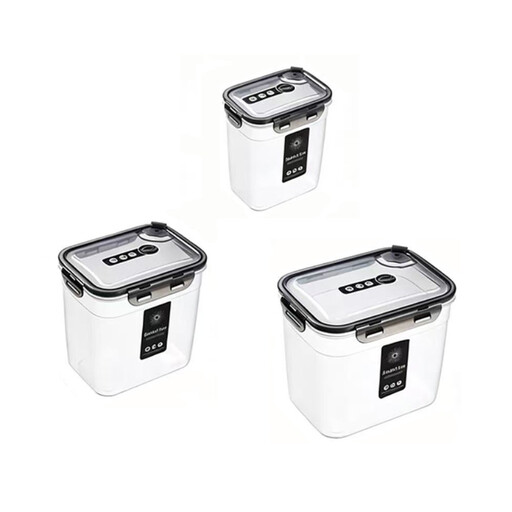
Why we chose it: Perfect for bulk storage of dry goods (cereals, flour, pasta, legumes...). The large capacities and transparency are key assets for managing your pantry at a glance.
This set gets straight to the point: storing large volumes efficiently. The transparent plastic allows you to see the contents and remaining level without having to open each container.
Three generous sizes (1.4 L, 2.5 L, 3.8 L) for bulk items. A simple design and an effective seal, designed for no-fuss daily use.
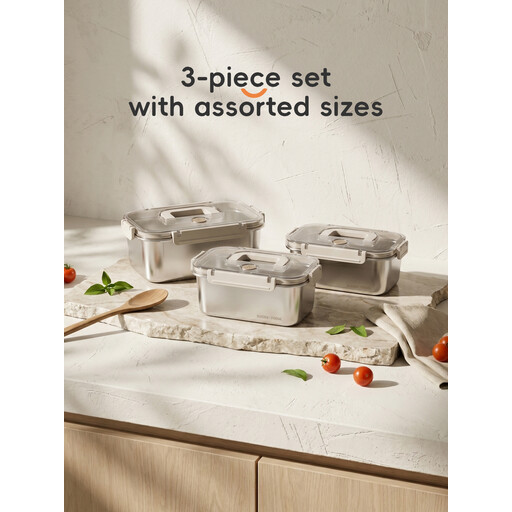
Why we chose it: For those who prioritize robustness, hygiene, and a durable alternative to plastic. Ideal for storing leftovers, meal prepping, or for picnics.
Food-grade 304 stainless steel is the solution to degrading plastic. It doesn't stain, retain any odours, or warp, ensuring a virtually unlimited lifespan.
A hygienic, ultra-durable, and easy-to-clean material. The four-sided locking clips ensure a perfect seal, making it an excellent fridge storage container.
Discover our complete selection of products, all tested and approved by our experts according to strict criteria.
Longevity primarily depends on the material and care. A well-maintained stainless steel food container can last for many, many years. Good quality plastic containers can also last several years, but it's advisable to replace them if they show cracks, significant warping, or stubborn stains. Hand washing is often gentler and extends the life of the product and its seal.
Absolutely not! This is a common mistake to be avoided at all costs. It is imperative to always check the pictograms on the product or its instructions. Stainless steel should never be placed in a microwave oven. For plastic containers, even if they are marked as compatible, it is generally recommended to remove the lid before reheating to prevent pressure build-up and premature wear of the seal.
If an odour lingers despite washing, don't panic; several old-fashioned tricks work wonders. You can fill the container with a mixture of warm water and baking soda and let it sit for several hours. Diluted white vinegar also works miracles. After cleaning, let the container and its lid dry completely in the open air before closing them. But the best solution is preventative: choosing a quality material from the start (stainless steel or high-density plastic) greatly limits this problem.