
Livraison le jour même ou le lendemain

Qualité garantie

Débloquez vos offres de bienvenue: Livraison GRATUITE | Jusqu'à -80 % | 30 jours d'essai gratuits à JoyPlus
Téléchargez l'application
A well-organized kitchen is the key to a stress-free daily life. The right food storage container becomes your best ally: it preserves the freshness of your food, reduces waste, and simplifies meal prep. But with an overwhelming number of options on the market, how do you avoid marketing traps or an unsuitable product? This guide is here to provide clarity and help you make a truly smart choice.
Before we get to the products, let's break down the most common disappointments so you don't make the same mistakes.
For a durable and truly practical purchase, three objective criteria should guide your decision.
The choice of material depends entirely on your primary use case.
A container's seal depends almost entirely on its lid. The most reliable systems combine locking clips on all four sides with a removable silicone gasket. This gasket creates a barrier that prevents air and liquids from passing through. A removable gasket is also a real bonus for deep cleaning, preventing mold growth.
Good kitchen organization is all about optimizing space. Opt for square or rectangular containers, which stack stably in the refrigerator and cupboards. A set of food storage containers from the same product line is often designed to nest inside one another, which is a significant space-saver when the containers are empty.
Here are a few options that meet specific needs, taking into account the quality and practicality criteria we've just discussed.

Perfect for meal prep and taking lunch to the office. Its glass body goes directly into the microwave, no transferring needed. The format is ideal for a single serving.
Its 4-clip locking system with a silicone gasket ends the nightmare of leaks, a classic flaw of entry-level containers. The thermal shock-resistant borosilicate glass avoids the "false versatility" trap where only the container is oven-safe.
Versatile for cooking, storage, and transport. Healthy material that doesn't stain or retain odors. Oven-safe (without lid).
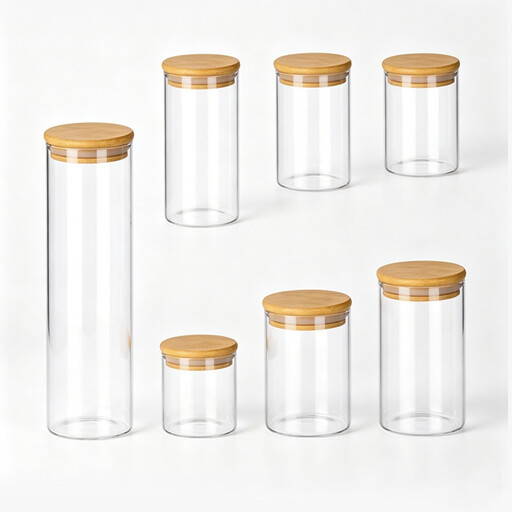
The perfect ally for organizing your dry goods (pasta, rice, cereal, flour) with style and efficiency. The set of different sizes offers perfect modularity.
No more opaque containers! This airtight glass jar lets you see the contents and remaining stock at a glance. Its lid provides an excellent airtight seal, protecting against moisture and pantry moths.
Elegant design with wood-look lids. The set of 7 different sizes allows for optimal modularity to organize the entire pantry.

Designed for families and batch cooking enthusiasts. Stainless steel, both robust and lightweight, is ideal for storing large volumes (leftovers, soups, salads) in the fridge or freezer.
316 stainless steel is the antidote to plastic containers that stain and retain odors. It's a virtually indestructible material, a much more sustainable investment than containers that need replacing every year.
Unbreakable, hygienic, and lightweight. The set includes a large 2200 ml capacity, ideal for family-sized meals.
Explore our complete selection of products that meet our quality criteria and current safety standards.
Standard (soda-lime) glass is what most of our drinking glasses are made of. It doesn't handle rapid temperature changes well and can shatter if you move it from the refrigerator to the oven. Borosilicate glass contains boron oxide, which makes it much more resistant to thermal shock. It is the preferred material for a glass dish with a lid intended for cooking.
No. It is imperative to check for the "microwave-safe" symbol on the container. Even if a container is compatible, it is recommended to limit its use to short reheating times and not to seal the lid tightly, allowing steam to escape. Also, avoid microwaving high-fat or high-sugar foods at high power, as they can reach temperatures that may damage the plastic.
To maintain the effectiveness of the silicone gasket, it is advisable to remove it from the lid at least once a week for a separate cleaning. Wash it by hand with warm water and dish soap, then let it air dry completely before reinserting it. This prevents the buildup of food residue and the formation of mold, which can compromise the seal and hygiene.