
Livraison le jour même ou le lendemain

Qualité garantie

Débloquez vos offres de bienvenue: Livraison GRATUITE | Jusqu'à -80 % | 30 jours d'essai gratuits à JoyPlus
Téléchargez l'application
Whether you’re storing leftovers, packing lunch for work, keeping dry foods fresh or preparing meals in advance, airtight glass food storage containers are useful for all sorts of things — as long as you choose the right ones. The wrong size, an unreliable lid or a misunderstanding about heat resistance can turn a practical purchase into something bulky and frustrating to use.
Here are the key things to check before comparing glass food containers, plus a selection to suit different needs.
A lid that clips shut on two sides may not offer the same protection as one with four clips and a removable silicone seal. If you plan to carry soup, sauce or a meal in the car, check that the container has a proper locking system and read the manufacturer’s guidance on leak resistance.
A seal that’s difficult to remove can also trap food residue. Models with removable seals are generally easier to clean thoroughly.
Even if a glass container is suitable for the oven or microwave, its lid may be made of plastic and unable to withstand high temperatures. With most of the models featured here, the lid must be removed before reheating.
You should also avoid sudden temperature changes — for example, putting a container straight from the freezer into a hot oven. Let the glass return to room temperature gradually, and check it regularly for cracks or chips.
A set made up entirely of large containers may suit a family, but it can be impractical for individual portions. On the other hand, small containers won’t be big enough for a salad, a gratin or a meal prepared for several servings.
Stackable containers in different sizes make it easier to organise your food in the fridge and cupboards.
Borosilicate glass is often used for food containers designed to withstand changes in temperature. However, it’s still essential to check the product details to see what each container can be used for: oven, microwave, freezer or fridge storage only.
Transparent glass also lets you see what’s inside without opening every container. That’s especially handy for organising leftovers, pre-prepared ingredients and dry foods.
For everyday use, the following sizes will cover many of your needs:
Rectangular containers generally make the most of fridge space. Round containers may be better suited to sauces, fruit or certain dry foods.
Before you buy, check whether the glass, lid and seal are dishwasher-safe. Some product details recommend washing the lid by hand to protect its clips and seal.
For airtight glass jars for rice, pasta, cereals or dried fruit, choose a wide enough opening and a lid that’s easy to dry. Airtight spice jars should be compact enough to line up in a drawer or on a shelf.
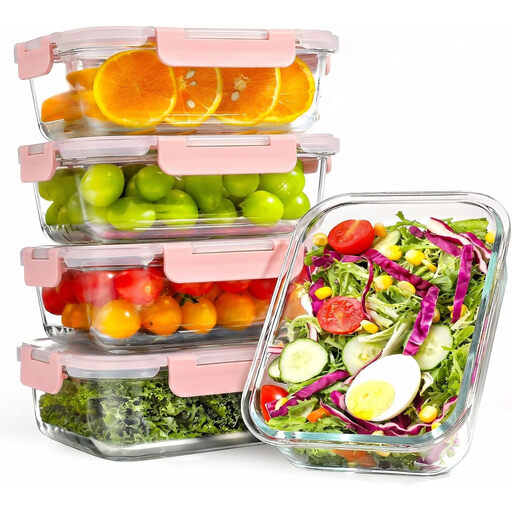
Why it suits this need: With five 1 040 ml containers, this set gives you a straightforward starting point for storing leftovers, packing lunches and organising meals without juggling different sizes.
Having just one size keeps things simple, while the removable silicone seal makes cleaning easier. Remove the lid before using the containers in the oven or microwave.
Borosilicate glass, 1 040 ml capacity, locking lid and stackable design, according to the product details.

Why it suits this need: The hammered glass and acacia lid will look right at home in a kitchen where pantry staples are kept on display on the worktop.
The 750 ml capacity is clearly stated, and the lid has a silicone seal. The wooden lid should be washed by hand and must not go in the dishwasher.
Clear borosilicate glass, 750 ml capacity and an acacia lid with a food-safe silicone seal.
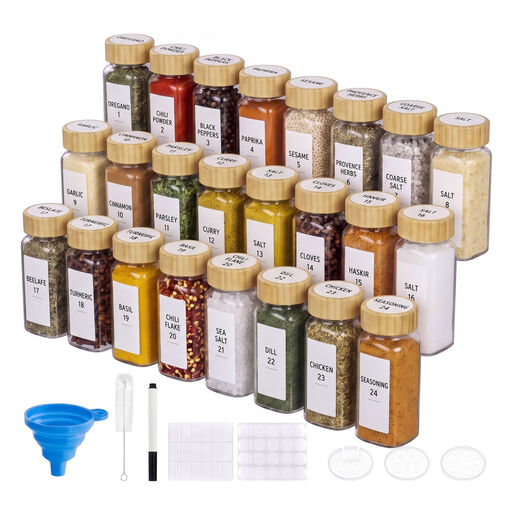
Why it suits this need: This set is ideal for organising a generous collection of spices, dried herbs or small ingredients in your pantry.
The 120 ml capacity means you won’t need to keep small quantities in oversized jars. The supplied labels, shaker inserts, funnel and brush make it easy to get started.
24 borosilicate glass jars, bamboo lids with airtight seals and handy labelling accessories included.
Before using them for the first time, wash each part and dry the seals thoroughly. When storing liquids, don’t fill the containers right to the top; leave enough room if you plan to freeze the contents. Put the lid on once the food has cooled sufficiently, unless the manufacturer’s instructions say otherwise.
To help your containers last longer, check the glass after any impact, don’t force the clips and replace any seal that has become misshapen. Store dry foods in a clean, completely dry container to help keep moisture at bay.
We’ve put together a comprehensive, regularly updated list of products that meet these strict selection criteria and comply with European safety regulations.
It depends on the model. The glass may be microwave-safe, but the lid generally needs to be removed. Check whether the seal and lid are dishwasher-safe too, or whether the manufacturer recommends washing them by hand.
A capacity of 600 to 1 040 ml is generally suitable for a complete individual portion. For a family or a meal to share, a 2 l container will often be a better fit. A range of sizes means you won’t have to squash a small portion into a large container or, conversely, fill a container that’s too small right to the brim.
It depends on the food, how fresh it is and the storage temperature. An airtight seal helps prevent leaks and limits exposure to air, but it doesn’t replace the usual rules for storing food in the fridge. Follow the appropriate guidance for each dish, and don’t eat food if its appearance, smell or texture seems unusual.