
Livraison le jour même ou le lendemain

Qualité garantie

Débloquez vos offres de bienvenue: Livraison GRATUITE | Jusqu'à -80 % | 30 jours d'essai gratuits à JoyPlus
Téléchargez l'application
Whether for taking lunch to the office, organising your fridge, or getting into "meal prep," the food storage container has become an indispensable tool. The problem? Faced with an overwhelming number of options, we often end up with disappointing products: leaky lids, or plastics that stain and warp after the very first use.
I'm the Head of Product Recommendations at Joybuy, and my mission is to bring you some clarity. Let's forget the marketing jargon and focus on what really matters: the essential criteria for a smart and sustainable purchase.
To avoid throwing your money away, let's review the most common disappointments.
To avoid these pitfalls, let's focus on a few technical points, no fluff.
This is the number-one criterion. Your choice will depend on your primary use.
A true airtight food container relies on a winning combination: a removable silicone seal (essential for deep cleaning) and a sturdy locking system. Four-sided locking clips are often the best guarantee against leaks. This is a non-negotiable feature for a lunch box!
Think about your daily routine. A fan of meal prep? A set of food storage containers in various sizes will be your best ally. Prioritise stackable models to optimise space in your cupboards and fridge. Finally, a quick glance at the pictograms (dishwasher-safe, freezer-safe) will make your life easier.
To move from theory to practice, here are a few products that tick all the boxes, each designed for a specific need.

The Profile: Ideal for batch cooking fans who prepare all their meals for the week. This comprehensive set offers multiple sizes to precisely portion main dishes, sides, and snacks, keeping your fridge perfectly organised.
The BPA-free plastic and lids are designed to store both dry goods and leftovers. By investing in a unified set, you eliminate the headache of incompatible, low-quality lids.
An ultra-comprehensive 12-piece set for maximum versatility. Their stackable design is a real bonus for optimising space in cupboards and the refrigerator.

The Profile: For those who prioritise healthy materials and seek a sustainable alternative to plastic. Stainless steel is a quintessentially robust choice, designed to last for years without degrading.
316 stainless steel is renowned for its high resistance to corrosion and food acids. It completely eliminates the risk of residual stains and odours—a common weakness in many plastics.
A food-grade material that is virtually indestructible and perfectly hygienic. The set of three sizes (0.6 L, 1.1 L, 2.2 L) covers most essential needs.
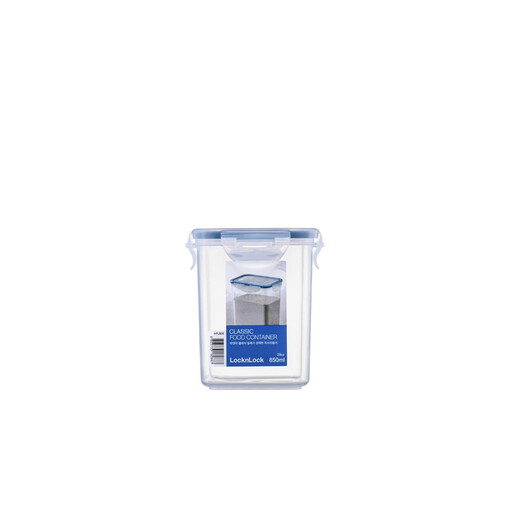
The Profile: The perfect lunch box for daily use. The goal is simple: a reliable and, most importantly, 100% leak-proof solution for carrying your lunch without fear of disaster in your bag.
Its 4-sided locking clips are the direct answer to the "false airtight" trap. This locking system ensures uniform pressure on the gasket, guaranteeing a foolproof seal.
Its renowned leak-proof design and practical 850 ml size, ideal for a main course. Its polypropylene material is perfectly microwave-safe for reheating your meal.
We have selected a full range of products that meet our quality criteria and current safety standards.
1. How can I be sure a container is truly airtight before buying? Look for four-sided locking clip systems and the presence of a thick, visible silicone gasket. Customer reviews are also a goldmine of information: check what users say about transporting liquids (soups, saucy dishes).
2. Is a "BPA-free" plastic container 100% safe? The "BPA-free" (Bisphenol A) label is an essential prerequisite, but it's not the whole story. For maximum peace of mind, choose plastics known for their heat stability, such as polypropylene (PP) or Tritan. They significantly limit the risk of particles migrating into your food.
3. Can you freeze food in a glass container without it breaking? Yes, as long as you choose borosilicate glass, which is designed to withstand thermal shock. The golden rule: never fill the container to the brim. Always leave 2 cm of space at the top to allow liquids to expand as they freeze, thus preventing the glass from cracking.