
Livraison le jour même ou le lendemain

Qualité garantie

Débloquez vos offres de bienvenue: Livraison GRATUITE | Jusqu'à -80 % | 30 jours d'essai gratuits à JoyPlus
Téléchargez l'application
A food storage container needs to meet a specific purpose: carrying lunch to the office, keeping leftovers in the fridge, organising a cupboard, or taking provisions on a camping trip. Yet the product’s appearance, promises of leak-proof performance, or oversized multi-packs can sometimes hide a few everyday limitations.
Before you buy, take the time to check three things: the material, the closure system, and compatibility with your appliances and cleaning habits. A compartmentalised lunch box can be perfect for dry foods, but far less practical with a sauce. Conversely, a large airtight container might take up too much space for a simple snack.
A press-on or clip-on lid keeps the contents in place, but that doesn’t necessarily mean the container is designed to carry liquids. Soups, dressings and saucy dishes require a sealing gasket or a system clearly marketed as airtight.
For a work bag or rucksack, therefore check:
A set of food containers may seem economical, but several small tubs don’t always replace one large storage container. The capacities should match your usual portions: allow roughly 300 to 500 ml for a snack or side dish, and more for a full meal or family leftovers.
Graduated sizes are handy for reducing waste, provided they stack and store easily in your kitchen storage container or fridge.
The container may be dishwasher-safe while the lid, its gasket, or certain decorative elements need hand washing. Misreading the instructions can accelerate plastic warping or encourage odours to develop.
Always read the manufacturer’s guidelines: maximum temperature, dishwasher compatibility, any microwave restrictions, and the recommended drying method.
A glass food storage container, especially one made from borosilicate glass, generally withstands temperature changes better than ordinary glass. It’s suitable for the fridge and can be handy for reheating a meal, but only if the manufacturer clearly states it’s microwave-safe. Its main drawback: it’s heavier and can break if dropped.
Food-grade plastic is lightweight and well suited to a lunch box, snack box, or everyday use in a bag. Check the food-contact indications and avoid any heat source if the product isn’t designed for it.
A stainless steel food container offers a durable, corrosion-resistant structure. However, metal models must never go in the microwave. The lid, often made of polypropylene, may also have specific care instructions.
Compare the external dimensions, not just the stated volume. A 1,000 ml container may be roomy enough for lunch, but its shape might stop it fitting in a bag or on a fridge shelf.
For a bento box or a compartmentalised lunch box, also look at the depth of each compartment. Dividers are most useful for foods that shouldn’t mix: crudités, fruit, starchy items, snacks, or small sides. Very liquid preparations can seep from one section to another when the compartments aren’t independent.
Rounded corners, removable lids, and detachable compartments make washing easier. Dry each part before closing the container to reduce odours and residual moisture.
For heavy use, regularly check:
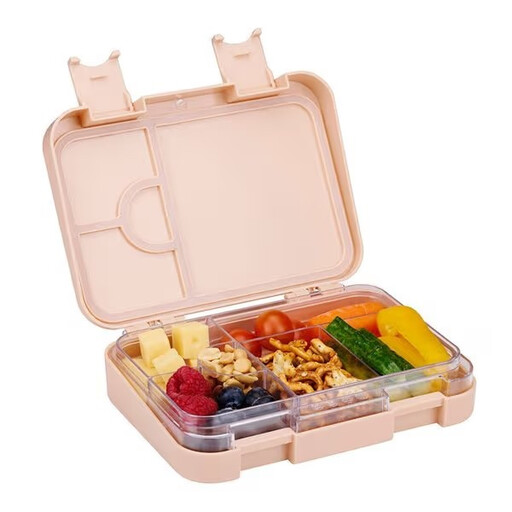
Why this choice suits this profile: Its six compartments let you organise a lunch, fruit or snacks in a 21 × 15 × 4.5 cm format, practical for school, the office or a sports bag.
Separating foods limits mixing between sides and snacks. The manufacturer does state, however, that it is not microwave-safe and recommends avoiding very liquid preparations.
Six removable sections and stated dishwasher compatibility. Approximate weight: 425 g.

Why this choice suits this profile: This set combines five 1,040 ml containers and five 370 ml containers in borosilicate glass, covering individual meals as well as leftover storage in the fridge.
The two sizes prevent you from being left with only large containers, which are less suitable for small portions. Check the manufacturer’s instructions before any use in the oven or microwave.
Borosilicate glass and snap-lock lids. Set of 10 pieces in two distinct capacities.
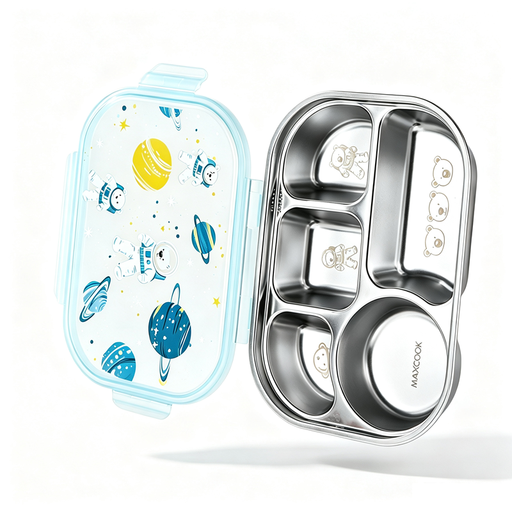
Why this choice suits this profile: Its 316L stainless steel construction and five compartments are ideal for packed lunches, picnics, sports activities, and regular outings.
The four loops let you check at a glance that the box is properly closed. The manufacturer recommends hand washing and prohibits use in the microwave or oven.
316L stainless steel, five compartments, PP lid and four closure loops.
We’ve put together a comprehensive, real-time updated list of products that meet these strict selection criteria as well as European safety regulations.
It all depends on the use, transport and heat. Glass is suitable for the fridge and lets you see the contents easily, but it’s heavier. Plastic is lightweight and practical for the office or school. Stainless steel stands up well to regular use, but can’t go in the microwave. In every case, check the instructions for the specific model you choose.
The lifespan depends on the number of washes, knocks and frequency of use. Replace any container or lid that has a crack, warping, a deteriorated gasket, or a lingering smell. Gentle cleaning and thorough drying help prevent premature wear.
Not always. Simple compartments separate foods, but they aren’t necessarily independent or leak-proof. For a sauce, use a small separate sealed container or choose a model where each section’s leak-proofing is clearly stated.