
Livraison le jour même ou le lendemain

Qualité garantie

Débloquez vos offres de bienvenue: Livraison GRATUITE | Jusqu'à -80 % | 30 jours d'essai gratuits à JoyPlus
Téléchargez l'application
A good food storage container can simplify your kitchen routine, reduce waste, and become your best ally for meal prep. But with an overwhelming number of options and vague marketing claims, finding the right one can be a challenge. As the Head of the Home & Kitchen section, my mission is to cut through the noise for you. Let's break down the common pitfalls and the criteria that truly matter to help you make the perfect choice.
Before you even start comparing models, let's learn how to spot the design flaws that can turn a bargain into a nightmare after just a few months.
To ensure you make the right decision, focus on these three key points.
Each material serves a specific purpose.
A container's seal is all about the lid. Four-sided locking clip systems with a removable silicone gasket are the best guarantee against leaks. Make sure the gasket is easy to remove—this is essential for deep cleaning and preventing mould growth. For an airtight jar intended for dry goods, a screw-on or lever-style lid with a solid seal is often sufficient.
Instead of collecting mismatched containers, think in "systems." A stackable food container will save you precious space in your cupboards and refrigerator. Sets with various sizes adapt to all your needs, from dinner leftovers to storing bulk cereals in a dry food storage canister.
Enough theory—let's get practical. Here is our selection of products that meet specific needs, all in line with the criteria we've just defined.

Why we chose it: Ideal for those who prep their meals in advance. This large container lets you cook a family-sized dish (like a casserole or lasagna), store it in the fridge, and then reheat it directly in the oven or microwave. It's the winning trifecta: cook, store, and reheat without switching dishes.
The body is made of borosilicate glass, explicitly designed to withstand oven heat (up to 400°C without the lid), which eliminates any risk of confusion or accidents. The 4-clip system ensures a secure closure.
The ultimate all-in-one. Glass is a perfectly neutral material: it won't stain or retain odours, even from a bolognese sauce.

Why we chose it: For those who take their lunch to work or on the go. Stainless steel is lightweight, durable, and won't get damaged in a bag. This set of three different sizes is perfect for any meal, from a large salad to a small snack.
Unlike plastic, which scratches and retains odours, 316 stainless steel is a hygienic and durable solution. It won't stain, even with vinaigrette or tomato sauce, and it won't warp.
Lightweight, hygienic, and incredibly robust. The ultimate portable solution, built to last.
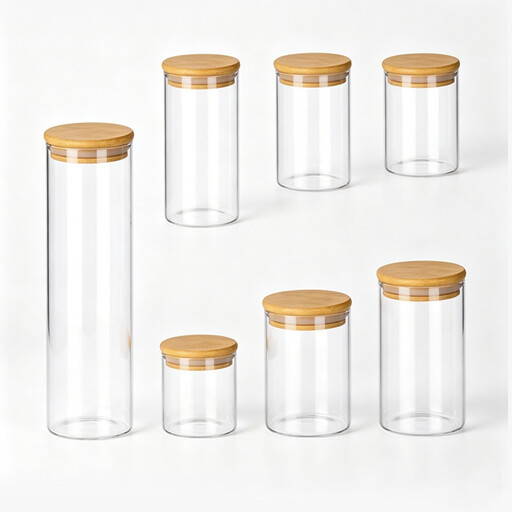
Why we chose it: For those who want to organise their dry goods (pasta, rice, lentils, cereals) in a way that is both beautiful and functional. This set of 7 jars in various sizes creates visual harmony on your shelves while protecting food from moisture.
These airtight jars are specifically designed for dry foods. Their sealing system is optimised to keep out air and moisture, a function that all-purpose containers don't always perform as well over the long term.
A sophisticated design featuring wood-look lids. The set of 7 sizes offers a turnkey solution for an organised and aesthetically pleasing pantry.
We have curated a complete range of products that meet our strict criteria and current safety standards.
Absolutely not! That's the quickest way to shatter it. Thermal shock (the rapid change from a very cold to a very hot temperature) can cause the glass to break, even if it's borosilicate glass. To prevent any accidents, let your glass dish return to room temperature for a few minutes before putting it in the oven. Also, remember to always remove the plastic lid before placing it in the oven.
To prevent mould growth and lingering odours, the best practice is to remove the gasket from the lid after each wash. Wash it separately by hand with hot, soapy water, rinse it well, and let it air-dry completely before putting it back in place.
Absolutely not. You should never place any metal object, including a stainless steel container, in a microwave oven. It can cause electrical arcs (sparks) and irreversibly damage your appliance. These containers are perfect for storage and transport, but to reheat the contents, you will need to transfer your food to a microwave-safe plate or bowl.