
Livraison le jour même ou le lendemain

Qualité garantie

Débloquez vos offres de bienvenue: Livraison GRATUITE | Jusqu'à -80 % | 30 jours d'essai gratuits à JoyPlus
Téléchargez l'application
Finding the right food storage container might seem simple, but it's often a real challenge. Caught between marketing promises and daily reality, many of us end up with cupboards full of warped, stained, or unsealable containers. Yet the goal is straightforward: keep food fresh, transport your lunch without a single leak, and organise your fridge like a pro.
Before you make your choice, let's review the most common pitfalls that lead to buyer's remorse.
To avoid these disappointments, it's essential to focus on a few technical criteria that make all the difference.
To ensure you won't regret your purchase, focus on a few key technical points, whether you're looking for an airtight lunch container for the office or solutions for fridge food storage.
The choice of material directly impacts your container's lifespan, food safety, and usability.
An effective lid is what separates a simple box from a true transport solution. The most reliable systems combine two elements:
For optimal use, especially as a meal prep container, the overall design is important. Containers of different shapes and sizes that are designed to be stackable save considerable space in both the fridge and cupboards. A well-designed food container set offers valuable modularity for daily use.
To help you see how these criteria apply in practice, here are a few options that cater to distinct user profiles.

Why we chose it: This set is an organisational powerhouse. With five 1040 ml and five 370 ml containers, it allows you to prepare and portion out meals for the week. The borosilicate glass is ideal for safely reheating dishes directly in the microwave.
Its glass body doesn't stain or retain odours, putting an end to the premature wear-and-tear trap. The locking lids with gaskets ensure a tight seal for fridge storage and transport.
The borosilicate glass resists thermal shock, and the 10-piece set offers excellent modularity for meal prep.

Why we chose it: For those seeking a durable and lightweight solution for their adult lunch box. Stainless steel is shatterproof, making it perfect for daily commutes. This set offers three practical sizes for a full meal and snacks.
316 stainless steel is a premium material that won't warp, resists scratching, and retains no odours. It's a long-term investment that avoids the frequent replacement of plastic containers.
Highly corrosion-resistant, lightweight, and shatterproof material. The containers are stackable for compact storage.
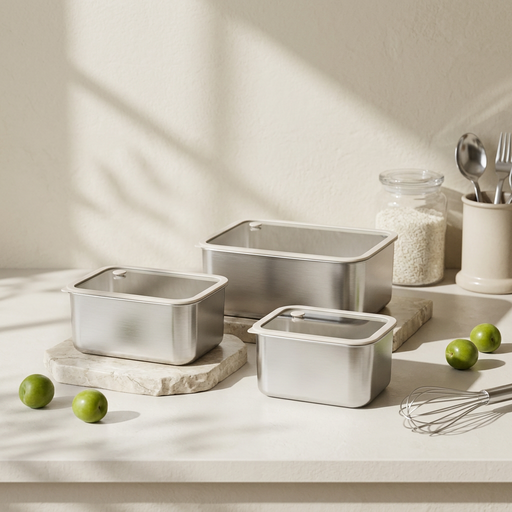
Why we chose it: This set stands out for its large capacities (up to 3000 ml) and deep design, ideal for storing family-sized leftovers, large salads, or organising the fridge. The glass lid lets you see the contents at a glance.
The combination of a 304 stainless steel body and a borosilicate glass lid with a silicone gasket offers a robust and versatile solution that won't warp and ensures excellent preservation.
Large capacities for family use and transparent lids for visual organisation of the fridge.
Explore our full selection of products that meet our quality criteria and current safety standards.
No, and caution is advised. Stainless steel containers must never be used in a microwave. For glass containers, the base itself is generally compatible, but it's often recommended to remove the plastic lid, which could warp or release substances under heat. Always check the pictograms and manufacturer's instructions.
The best approach is to choose a model with a removable silicone gasket. After each use, or at least once a week, remove the gasket and wash it separately with hot, soapy water or in the top rack of the dishwasher. Most importantly: let it air dry completely before putting it back to eliminate any residual moisture.
Both are types of food-grade stainless steel, excellent for storage. 304 stainless steel is the most common standard, offering very good resistance to rust and corrosion. 316 stainless steel also contains molybdenum, which gives it enhanced corrosion resistance, especially against salts and acids (found in salad dressings, for example). For everyday use, 304 is more than sufficient, while 316 represents an extra guarantee of durability.