
Livraison le jour même ou le lendemain

Qualité garantie

Débloquez vos offres de bienvenue: Livraison GRATUITE | Jusqu'à -80 % | 30 jours d'essai gratuits à JoyPlus
Téléchargez l'application
A more organized kitchen and less food waste—that's the dual promise of a quality food storage set. Yet, the market is saturated with products and marketing promises that often fall short. Between an airtight container that leaks after three washes and plastic that warps in the heat, it's easy to make the wrong choice. As a product expert at Joybuy, my mission is to bring you clarity and identify the criteria that truly make a difference, for a purchase that is as useful as it is durable.
Before you even start comparing models, it's crucial to sidestep the common traps that render a food storage container useless in the long run.
To avoid these pitfalls, focus on three key criteria before you check out.
The choice of material has a direct impact on the use, durability, and maintenance of your food storage container.
The effectiveness of an airtight container relies on two inseparable elements: the locking mechanism and the gasket.
Good design goes far beyond simple aesthetics. For optimal kitchen organization, check that empty containers nest perfectly inside one another and that full containers stack stably. A modular design, where smaller containers correspond to fractions of larger ones, is a real plus for optimizing space in your cupboards and refrigerator.
To help you see how these criteria apply in practice, here are a few models that meet specific needs.
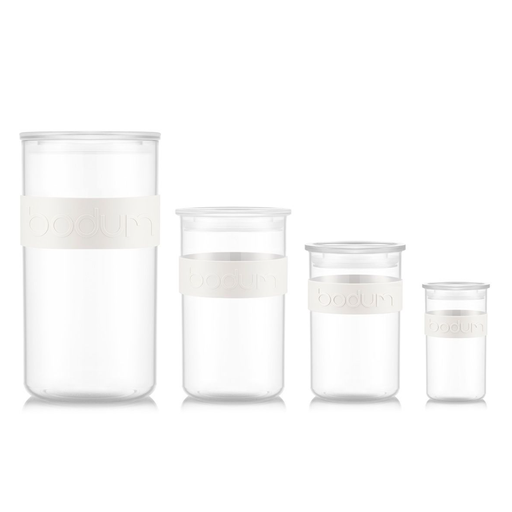
Why we chose it: This comprehensive food storage set is perfect for anyone looking to bring order to their cupboards and pantry. Its 12 pieces in four different sizes offer maximum versatility for storing dry goods like pasta, rice, or cereal.
It directly tackles the problem of chaotic storage with a genuinely well-designed stackable system. Its BPA-free plastic ensures food-safe contact, thus avoiding the trap of poor-quality materials.
The wide variety of sizes in a single set allows for immediate and cohesive kitchen organization, without having to hunt for additional pieces.

Why we chose it: For those who practice meal prep, the glass container is the reigning champion. This set allows you to prepare, store, transport, and reheat your meals all in the same container. The two sizes are practical for separating main dishes from sides or desserts.
Borosilicate glass doesn't stain or absorb any odors, bypassing the pitfall of material degradation. The clip-on lids ensure a reliable, airtight seal—an essential feature for a portable lunch box.
Maximum versatility: the glass withstands wide temperature swings, allowing it to go from the freezer to the microwave safely (after removing the lid).

Why we chose it: For those seeking a nearly indestructible solution, the stainless steel container is unmatched. This set is perfect for heavy-duty use: storing leftovers, packing lunch, or for outdoor activities like camping.
316 stainless steel is extremely resistant to corrosion, impacts, and scratches. It eliminates any risk of breaking, warping, or staining, ensuring an exceptional lifespan.
Unbeatable durability and hygiene. Stainless steel is a non-porous material that prevents bacterial growth and retains no odors, even after years of use.
We've compiled a complete, up-to-date selection of products that meet our strict selection criteria and current safety standards.
1. What is the lifespan of a food storage container? The lifespan depends primarily on the material. A well-maintained stainless steel container can last indefinitely. A glass container can also last for many years if protected from thermal and physical shocks. For a plastic container, even a high-quality one, it is advisable to replace it every 3 to 5 years, or as soon as it shows deep scratches, permanent stains, or signs of warping.
2. How can I clean my containers properly to avoid stubborn odors? Wash your containers and lids after each use with hot, soapy water or in the dishwasher if the manufacturer allows. For persistent odors, especially on plastic, let the open container soak with a paste of baking soda and water for a few hours before rinsing. Don't forget to clean the lid's silicone gasket separately—that's often where residue hides!
3. Are all plastic containers safe for your health? No, and this is a critical point to watch for. It is crucial to choose only containers labeled BPA-free. Bisphenol A is a suspected endocrine disruptor that is best avoided as a precaution. Finally, never use a plastic container in the microwave unless it is explicitly designed for that purpose. Heat can promote the migration of chemical compounds into food.