
Livraison le jour même ou le lendemain

Qualité garantie

Débloquez vos offres de bienvenue: Livraison GRATUITE | Jusqu'à -80 % | 30 jours d'essai gratuits à JoyPlus
Téléchargez l'application
By the Joybuy Editorial Team, August 26, 2026
Properly storing food and organising your kitchen shouldn't be a luxury. Yet, who hasn't thrown out leftovers because of a container that didn't seal properly? Or cursed at a plastic dish permanently stained by last night's bolognese sauce? Choosing the right food storage container seems simple, but the market is saturated with products whose promises fall flat after the first use.
Before you decide, here are the common pitfalls to avoid so you don't regret your purchase:
To avoid falling for these traps, just focus on a few key technical points. They are what make the difference between a smart purchase and a gadget that will end up at the back of a cupboard.
This is the number one criterion. While BPA-free plastic remains an interesting option for its light weight, glass stands out for its durability and neutrality.
The seal depends entirely on the lid-and-gasket duo. A good system preserves freshness, prevents leaks, and contains odours (goodbye, fishy smells throughout the fridge!).
Opt for lids equipped with a removable silicone gasket. This creates an infallible barrier against air and liquids. Locking clips on all four sides are generally the most effective for maintaining uniform pressure and ensuring the lid stays put. An airtight glass jar with such a system is as valuable for storing dry goods as it is for saucy dishes.
Versatility means everyday convenience. A good glass meal prep container should be able to do it all:
Always check the pictograms on the packaging or the manufacturer's instructions. Golden rule: the plastic lid NEVER goes in a conventional oven.
Rather than an endless list, we've selected a few top picks that meet specific needs, all while respecting the quality and durability criteria we've just covered.

Why we love it: This food storage container set is perfect for prepping your meals for the week. The different sizes (370 ml and 1040 ml) allow you to separate main dishes and sides. The clip-on lid ensures leak-proof transport. Guaranteed.
The borosilicate glass body resists stains and odours, even from a curry sauce. Its robust clip-locking system ensures a reliable seal, whereas classic lids eventually warp.
Ultimate versatility: it goes from the freezer to the oven (without the lid), then into the dishwasher. A single container to cook, store, transport, and reheat.
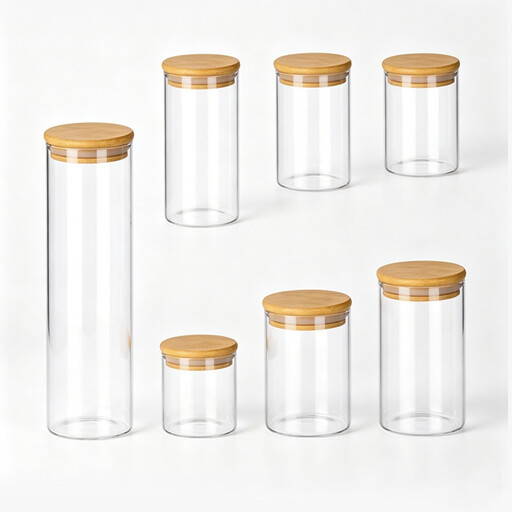
Why we love it: Perfect for storing dry goods (pasta, rice, lentils, flour...). This set of 7 different sizes helps create a flawless and harmonious setup in the pantry or on a shelf.
The gasket-sealed lid guarantees a truly airtight closure, protecting food from moisture and pantry moths. This is a common weak point in many purely decorative jars.
The transparent glass lets you identify the contents and remaining quantity at a glance. No more half-open packages lying around—hello, simplified shopping list!

Why we love it: Its generous 2-litre capacity is ideal for family-sized leftovers, a potato gratin, or a large batch of homemade soup. It's the glass dish with a lid that's the ultimate all-rounder.
Its borosilicate glass construction allows it to go in the oven up to 400 °C (according to the manufacturer), which eliminates the risk of shattering from thermal shock—the Achilles' heel of ordinary glass dishes.
One single dish to cook, serve, store, and reheat. Its 4-clip locking system is ultra-secure, even for storing soup or a saucy dish.
Explore our full selection of products that meet our quality criteria and current safety standards.
Regular glass (soda-lime) is sensitive to sudden temperature changes. Borosilicate glass, however, is enriched with boron trioxide, which gives it a very low thermal expansion coefficient. In practical terms, it can go from cold to hot (and vice versa) without cracking. This is what makes it compatible with the freezer, oven, and microwave.
In the oven, that's a categorical no: the plastic would melt. In the microwave, it's best to remove it or at least leave it ajar to let steam escape. Even if some manufacturers indicate compatibility, repeated use at high power can warp the lid and its gasket. As a precaution, wash it by hand and avoid putting it in the microwave.
The glass container is completely dishwasher-safe. For the lid, hand washing is preferable to preserve the plastic and the silicone gasket. Remember to remove the gasket from time to time to thoroughly clean the groove and prevent residue from getting trapped. Let each component air dry completely before reassembling and storing.