
Livraison le jour même ou le lendemain

Qualité garantie

Débloquez vos offres de bienvenue: Livraison GRATUITE | Jusqu'à -80 % | 30 jours d'essai gratuits à JoyPlus
Téléchargez l'application
A well-organised kitchen starts with effective storage. Choosing the right food storage container is the key to keeping your food fresh longer, reducing waste, and simplifying your life in the kitchen while keeping your cupboards and fridge spotless. But with an overwhelming number of options on the market, it's easy to make the wrong choice.
Before you start shopping, here are the 3 common pitfalls to avoid so you don't regret your purchase.
To make the right choice, focus on a few key points that will make all the difference in your daily routine.
The choice of material will primarily depend on your habits.
The seal is the most critical feature of a storage container.
To maximise your space, shape and modularity are essential criteria. Favour square or rectangular shapes, which allow you to optimise every square inch of your cupboards and fridge. Investing in a set of food storage containers from the same product line is a smart strategy: the containers, even in different sizes, will stack perfectly.
Here are a few options that meet specific needs, taking into account our criteria for quality and practicality.

The verdict: Perfect for those who want a complete, hassle-free setup from the get-go. This set offers a great variety of sizes for every use, from small snack portions to leftovers from a family meal, all with a clean and consistent design.
This set sidesteps the non-functional design trap. Its stackable design and variety of sizes allow for meticulous organisation. The BPA-free plastic directly addresses concerns about material quality.
The value for money is unbeatable for a starter set. The airtight lids keep food fresh, and the uniform design instantly brings order to the kitchen.

The verdict: A must-have for batch cooking fans and anyone who loves to go from oven to table to fridge without changing dishes. This borosilicate glass model is a true workhorse, built to last.
It perfectly solves the problem of unsuitable materials: the borosilicate glass withstands heat (up to 400°C without the lid), doesn't stain, and traps no odours. Its 4-clip system guarantees a rock-solid seal.
Its extreme versatility (oven, microwave, freezer, dishwasher) makes it a cost-effective and durable investment. Its large 2L capacity is ideal for casseroles and family-sized meals.
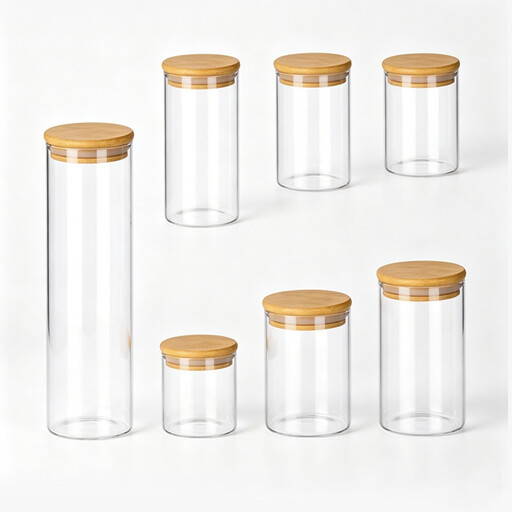
The verdict: The perfect solution for bulk-buy enthusiasts who dream of a pantry that's as beautiful as it is practical. This set of glass jars with airtight lids is perfect for stylishly storing pasta, rice, legumes, or cereals.
This set of kitchen storage jars bypasses the pitfall of impractical design. The different sizes are designed to harmonise, and the transparent glass lets you identify the contents at a glance. No more torn-open packages!
The stylish aesthetic, with its wood-effect lids, adds a real decorative touch. The airtight lids effectively protect dry goods from moisture and pantry moths.
Discover our full selection of products that meet our quality criteria and current safety standards.
It's a classic problem! To tackle it, fill the container with a mixture of hot water and white vinegar (or baking soda). Let it sit for several hours, then wash as usual. A time-tested trick? Leave the empty, clean container out in the sun: UV rays are surprisingly effective at fading stains.
It all depends on the glass. Only borosilicate glass is designed to handle major thermal shocks. As a precaution, and to maximise the lifespan of your dish, it's best to avoid overly abrupt temperature changes. Let the dish thaw for a few minutes at room temperature before putting it in the oven. And the golden rule: never put a plastic or silicone lid in the oven!
A high-quality, well-maintained seal can last for several years. The best practice is to remove it from the lid during each cleaning to wash both parts thoroughly and prevent residue from building up. Let it dry completely before putting it back. If it becomes stiff, cracks, or the seal seems compromised, it's time to replace it (if the model allows) or, failing that, to replace the container.