
Livraison le jour même ou le lendemain

Qualité garantie

Débloquez vos offres de bienvenue: Livraison GRATUITE | Jusqu'à -80 % | 30 jours d'essai gratuits à JoyPlus
Téléchargez l'application
Getting more organized in the kitchen and reducing waste often starts with one simple step: choosing the right food storage container. Yet, faced with an overwhelming number of options, it's easy to end up with cupboards full of mismatched containers, warped lids, or boxes that hold onto odours.
As the Head of Product Recommendations at Joybuy, my role is to help you see things more clearly. Let's cut through the marketing jargon and focus on what really matters for keeping your food fresh longer and optimizing your kitchen organization.
Before you choose, it's best to know the most common disappointments so you don't fall into the same traps.
To avoid these letdowns, you just need to check a few key points. The final choice will depend on your primary use: storing leftovers, meal prepping, packing your lunch box, or storing dry goods.
Each material has its pros and cons. There's no one-size-fits-all solution, but rather a material suited for each specific need.
A truly airtight food container relies on two elements: a quality silicone seal and an effective locking mechanism. Lids with clips on all four sides are often the best guarantee against leaks. For a storage jar intended for dry goods (pasta, rice, flour), a screw-on or lever-style lid with a good seal is usually sufficient to protect against moisture and pantry moths.
To help you see how these criteria apply in practice, here are a few options that cater to very different user profiles.
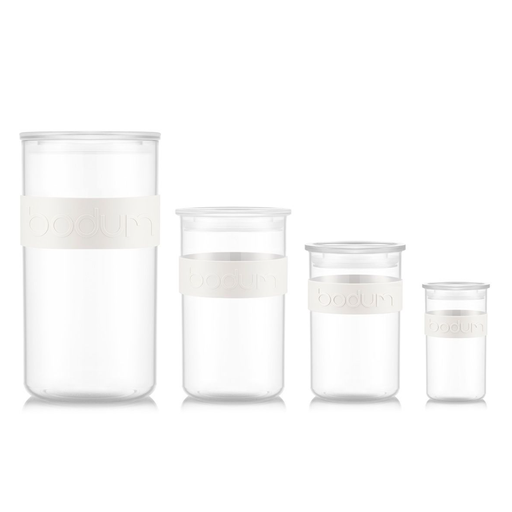
Why we chose it: This food storage container set is the perfect solution for unifying and harmonizing your kitchen storage. With 12 pieces in 4 different sizes, it covers most needs, from dinner leftovers to dry goods in the pantry.
Its high-quality (BPA-free) plastic and well-designed lids stand the test of time and the dishwasher, unlike cheap models that warp quickly.
One set to store it all. Its stackable design is a real bonus for optimizing space in cupboards and the fridge.

Why we chose it: The perfect partner for meal prep enthusiasts. This borosilicate glass container goes from the oven to the freezer, then to the microwave (without its lid). Prepare your casserole, store it, and reheat it—all in the same dish.
Unlike plastic, glass won't stain from the first hint of tomato sauce and doesn't hold onto fish odours. Its resistance to high temperatures (up to 400°C) gives it unparalleled versatility.
One dish to do it all: bake, store, transport, and reheat. Its 4-clip lid with a silicone seal guarantees a leak-proof experience.

Why we chose it: For those who carry their lunch daily, this stainless steel set is the healthiest and most durable solution. Lightweight and shock-resistant, it's perfect for tossing in a bag without worrying about breakage.
Stainless steel is resistant to shocks (unlike glass) and scratches that can become breeding grounds for bacteria (unlike plastic). It's the hygiene champion for heavy, on-the-go use.
A healthy material that resists everything (corrosion, odours, shocks). The set of 3 sizes is perfect for compartmentalizing your meal: main, side, and dessert or snack.
Explore our complete collection of food storage containers, all tested and approved based on our quality and safety criteria.
The glass container is the champion of hygiene (it doesn't retain stains or odours) and versatility (it's often oven-safe). However, it's heavier and more fragile. The food-grade plastic container (always BPA-free!) is lighter, more affordable, and ideal for transport. Its Achilles' heel: it can stain or retain odours from certain foods.
Check for a soft, removable silicone seal in the lid (for easy cleaning). A robust locking system, like clips on all four sides, is also an excellent indicator. The foolproof test: fill the container with water, close it, and shake it. Not a single drop should escape.
No, and that's a rookie mistake you don't want to make! Always check the pictograms on the product.