
Livraison le jour même ou le lendemain

Qualité garantie

Débloquez vos offres de bienvenue: Livraison GRATUITE | Jusqu'à -80 % | 30 jours d'essai gratuits à JoyPlus
Téléchargez l'application
Between dinner leftovers, prepared meals, cereals and bulk-bought ingredients, food storage boxes are used for all sorts of purposes. But an attractive appearance or the simple word ‘airtight’ does not necessarily mean that a container will suit your needs.
Here are the criteria to consider when organising your kitchen, fridge or pantry without accumulating impractical boxes.
A lid simply placed on a jar may be sufficient for biscuits or dry foods. However, it will be less suitable for transporting soup or a saucy dish. To help prevent leaks, moisture and odours, choose a silicone-sealed closure or a locking system clearly described by the manufacturer.
The lid design also deserves your attention. A seal that is difficult to remove may trap residue and make everyday cleaning more complicated.
A set made up solely of large containers may seem like good value, but it will quickly take over your cupboards if it does not match the quantities you actually consume. Small boxes are handy for individual portions, nuts or leftovers. Larger formats are better suited to pasta, rice, flour and family-sized preparations.
An assortment of different capacities is therefore often more useful than a series of identical boxes.
Not all materials can withstand the same uses. A glass jar with a wooden lid should not be used like a glass container designed for the oven or freezer. Similarly, placing a still-hot container directly into a cold environment can cause thermal shock.
Before ordering, check the instructions for the container, lid, seal and dishwasher separately.
Glass food storage boxes are transparent and generally do not absorb odours, unlike some more porous materials. They are suitable for leftovers, reheating when authorised by the manufacturer and meal preparation. However, their weight and fragility should be taken into account.
Transparent food-grade plastic is lighter and better able to withstand everyday knocks. It is suitable for storing food in the pantry as well as for transport, provided you follow the usage limits specified by the manufacturer. A combination of glass, plastic and silicone can offer a versatile solution, but each component remains subject to its own instructions.
To choose suitable airtight food containers, start by measuring the available space in your cupboards and fridge. A 0.8 l box may be suitable for an individual portion or a few leftovers. A 2 l format will be better suited to a family-sized preparation or a large quantity of dry ingredients.
External dimensions matter just as much as the stated capacity. A box that is too tall may be difficult to slide under a shelf, while a very wide container could reduce the space available on a fridge shelf.
Stackable boxes make better use of cupboard height, provided they remain stable when full. Look for a level base and a lid designed to support another container.
For care requirements, check whether the product is marked dishwasher-safe. Some models allow the container to be washed in the dishwasher, but not the wooden lid. Removable seals make it easier to reach the corners where crumbs and moisture can collect. In all cases, dry each component thoroughly before closing the box.
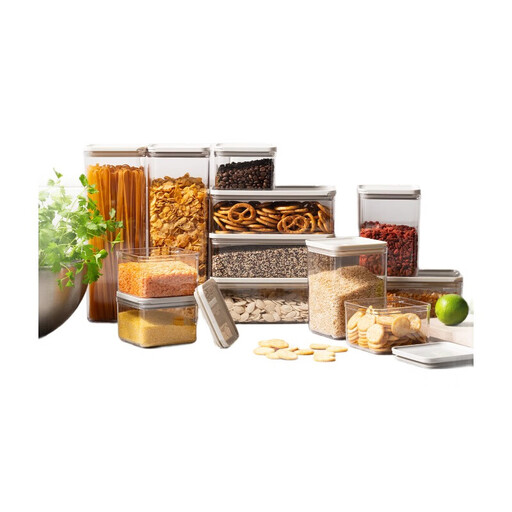
Why this choice suits this profile : This set includes 12 jars in four different capacities: 0.5 l, 1 l, 1.2 l and 2.6 l. It gives you everything you need to organise your pantry from your very first purchase, without having to expand your collection straight away.
The varied sizes prevent you from storing a small quantity in a large container. The lids feature silicone seals and are described as airtight.
Transparent BPA-free plastic bodies, according to the product details, several sizes and a stackable design. The components are stated to be dishwasher-safe.

Why this choice suits this profile : Its transparent hammered glass and acacia lid will sit comfortably in a kitchen where containers remain on display on the worktop.
The product details clearly distinguish between the glass, seal and lid: the container is dishwasher-safe, while the wood must be washed by hand.
A 750 ml capacity, hammered borosilicate glass, a food-grade silicone seal and an immediate view of the contents. However, the acacia lid requires specific care.

Why this choice suits this profile : With its 2 l capacity, this model is aimed at families and people who prepare several portions in advance.
The removable seal makes cleaning easier. The instructions require the lid to be removed when using the microwave and enough space to be left for expansion in the freezer.
Borosilicate glass, a rectangular format measuring 25.4 × 19.4 × 8.7 cm and stated compatibility with the fridge, freezer, microwave and dishwasher.
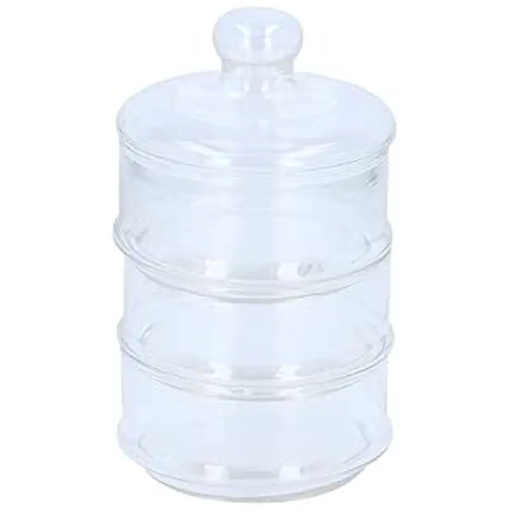
Why this choice suits this profile : Its three tiers allow you to group nuts, biscuits and dried fruit on a small area of worktop.
Each tier can be removed separately, so you do not have to handle one large box every time you use it. The product details advise against storing liquid or damp foods in it.
Three stackable glass jars, a diameter of 12 cm, a total height of 23 cm and glass components stated to be dishwasher-safe.
We have put together a complete, real-time updated selection of products that meet these exacting criteria and European safety standards.
To extend the life of your food storage containers:
For storing dry foods, fill clean, completely dry jars. Cereals, pasta, rice, pulses, dried fruit and baking ingredients are easier to identify in transparent containers. Organising them according to how often they are used also reduces unnecessary handling.
Glass is suitable for leftovers and prepared meals when the instructions permit use in the fridge, freezer, microwave or oven. However, it is heavier and can break. Plastic is lighter, but you should check its temperature and usage limits in the product details.
No. Compatibility may vary depending on the container, lid and seal. A glass jar may be dishwasher-safe, while a wooden lid must be washed by hand. Remove detachable seals when instructed by the manufacturer, then dry them thoroughly before putting them back in place.
For cereal and pasta jars, choose the capacity based on the quantities you usually buy and the height available in your cupboard. Formats of 1 to 1.2 l are suitable for many everyday uses. A container of 2 l or more will be better suited to buying in bulk, provided you can still handle it easily once full.