Which option is right for you?
Your decision mainly depends on the tasks you repeat and how much cooking is part of your meal preparation.
Households that prepare meals in advance
If you grate or slice vegetables, chop herbs and prepare sauces or portions to store, check the bowl’s usable capacity and which discs are actually included. The food processor prepares the ingredients; any cooking is done separately.
Home cooks who alternate between vegetables and homemade dough
A food processor with the right attachments can handle chopping and occasional kneading. If dough-making and whisking become your main tasks, compare stand mixers too, and check separately what they can do for chopping.
Households considering a heated food processor
UFC-Que Choisir distinguishes a heated food processor by its cooking function. If you mainly want to chop, grate, mince or blend ingredients before cooking them with other appliances, start by choosing according to those preparation tasks. Consider integrated cooking if it meets a regular need.
What should you check before buying?
First decide which tasks you want one appliance to handle, then check that its capacity and included attachments suit the recipes you make regularly.
Food processor
Choose this if: you often slice and chop, and also need to blend or knead certain ingredients.
Bear in mind: cooking is done separately, and attachments vary by model.
Stand mixer
Choose this if: making dough and whisking take up most of your food-preparation time.
Check: grating, slicing or chopping may require extra attachments or a separate appliance.
Separate blender and mini chopper
Consider this if: you mainly blend sauces or cold soups and chop small quantities.
Limitation: you’ll need another solution if you also regularly grate, slice or knead.
Heated food processor
Consider this if: cooking, simmering or steaming in the appliance is a regular task.
Check: integrated cooking alone doesn’t tell you which chopping attachments are included.
| Consideration |
What to check |
What I need |
| Capacity |
Distinguish between total volume and usable capacity. For dough, look for the maximum quantity specified for that model. Also consider how much room the bowl and attachments will need. |
I prepare several portions at once and want my usual quantities to fit in the bowl, without choosing a set that takes up too much space in my kitchen. |
| Attachments |
Check for grating and slicing discs, a blade, a dough tool or a blender to suit your recipes. UFC-Que Choisir notes that some of its tests depend on the attachments supplied. |
For vegetables and sauces, I want the tools I’ll use regularly to be included from the outset, rather than relying on the ‘multi-function’ name. |
| Regular tasks |
Look for the stated dough limit and, where available, test results for the preparations you make often. Don’t judge kneading, grating or blending performance by wattage alone. |
If I knead regularly, the amount of dough the appliance can handle matters more to me than a long list of functions I’ll rarely use. |
| Integrated cooking |
Decide whether the appliance also needs to cook, simmer or steam. UFC-Que Choisir identifies cooking as the feature that sets a heated food processor apart. |
I can prepare ingredients with a food processor and cook them another way afterwards. If I want to cook in the same appliance, I should compare heated food processors. |
Which branded models should you compare?
The capacities below apply to specific models and don’t describe every appliance from each brand.
Magimix
Magimix lists the CS 5200XL Premium’s bowl as having a total capacity of 3,6 L and a usable capacity of 1,8 L. These are two separate figures to bear in mind when preparing several portions.
- For this model, the brand lists grating, slicing, chopping, blending and kneading functions, among others.
- Magimix states that spare parts are available for 30 years for this model. Also check that you have room in your kitchen for the bowl and attachments.
Moulinex
For the Double Force FP821811, Moulinex specifies a 3 L bowl and describes a set that includes a 2 L blender, a dough tool and a grating or slicing disc.
- This combination is worth considering if you switch between preparing vegetables, blending and making dough.
- The contents of Double Force sets vary by model, so check the full model number before counting on a particular attachment.
Bosch
Bosch specifies a 2,3 L bowl for the MultiTalent 3 MCM3531M and a maximum dough quantity of 800 g, including 500 g of flour plus the other ingredients.
- The stated dough limit makes it easier to compare this model with the size of your usual batches.
- This limit applies to the MCM3531M. Don’t assume it applies to another model based on the bowl volume alone.
Kenwood
Kenwood lists a 3 L bowl for the MultiPro Express FDP65.450WH, with a usable capacity of 1,5 kg of dry ingredients or 1,5 L of liquid.
- These limits distinguish between dry ingredients and liquids, helping you assess the relevant recipes.
- Functions and attachments vary across the MultiPro Express range, so check what’s included with the FDP65.450WH.
A food processor option on Joybuy
This option is for preparing ingredients without integrated cooking. Consider it if your tasks include chopping, mincing or blending, and check that its capacity and attachments suit your recipes.
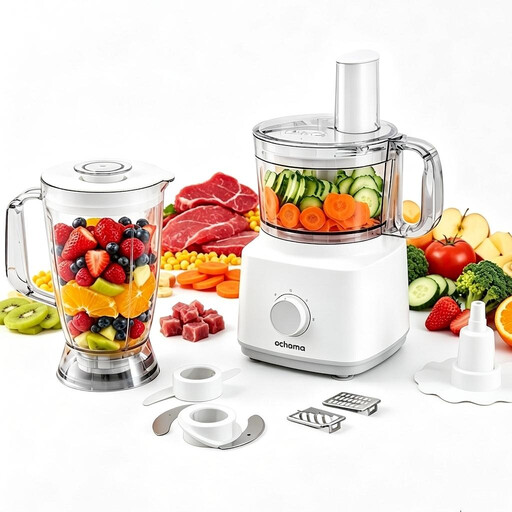 Image unavailable
ochama 750 W food processor, 1,8 L
Worth considering for preparing vegetables and blending ingredients in one set. The product title lists 750 W, a 1,8 L bowl, a blender, a chopper and slicing or grating discs. Before choosing it for large batches, check the usable quantity for the ingredients you plan to process and exactly what’s included. The stated volume alone doesn’t tell you how much the appliance can handle.
View on Joybuy
Frequently asked questions
Can a food processor replace a heated food processor?
Not if you need to cook, simmer or steam in the appliance itself. UFC-Que Choisir distinguishes a heated food processor by this function. If you want to chop, mince, grate or blend before cooking separately, compare the food-preparation functions of food processors instead.
Which attachments should I check for preparing vegetables and sauces?
Check for discs suited to grating and slicing, as well as the blade and bowl you need for your recipes. If a recipe requires a blender, make sure it’s included with the exact model you’re considering. A function listed for a product range doesn’t confirm that it comes with every model.
How should I compare the capacity of two food processors?
Compare like with like, rather than looking at two figures in litres in isolation. Magimix lists a total capacity of 3,6 L but a usable capacity of 1,8 L for the CS 5200XL Premium. For the FDP65.450WH, Kenwood specifies a 3 L bowl and separate limits of 1,5 kg of dry ingredients or 1,5 L of liquid. If you knead, also look for a specific dough limit.
What should I do after preparing raw food with a food processor?
Clean the parts according to the appliance instructions and keep raw food separate from ready-to-eat preparations. Anses warns that cross-contamination and improper storage can encourage bacteria to grow. Cleaning doesn’t replace storing prepared portions properly.
What warranty applies if the food processor doesn’t match its description?
For an item bought in France by an individual from a professional seller, the Ministry of the Economy states that the statutory guarantee of conformity is compulsory, whether the item is new, second-hand or refurbished. If the food processor you receive doesn’t match the sales description, keep a copy of that description and your proof of purchase, then contact the seller about the issue.


