People who regularly prepare ingredients
You often chop, grate, slice or blend, but your hob, oven and pans already take care of the cooking. The right food processor mainly depends on having the tools for the tasks you do most.


If your existing appliances already take care of cooking, choose a food processor for the tasks you do regularly. Look for a blade and discs for chopping, blending, grating or slicing, then add a dough tool or whisk if your recipes call for one. A compact model is easier to store, while doughs and larger batches make it important to check the bowl’s usable capacity. Only compare food processors with a cooking function if you’d like the appliance to cook as well.
You often chop, grate, slice or blend, but your hob, oven and pans already take care of the cooking. The right food processor mainly depends on having the tools for the tasks you do most.
You want to keep the number of appliances in your kitchen to a minimum. Measure the space available for the food processor and check where its bowls, blades and discs can be stored.
If you knead dough or prepare large quantities, check the stated capacity for those recipes and the accessories supplied with the exact model, rather than relying on the bowl’s overall volume alone.
Start with the things you regularly prepare, then consider the bowl and full range of accessories alongside the space you can spare. The priorities below are for shoppers whose cooking is already taken care of, and highlight their main needs.
| Criteria | What to check | Who it matters to |
|---|---|---|
| Regular food preparation | Check which blades and discs are included with the exact model. Only choose a dough tool or whisk if you’ll genuinely use it in your recipes. | When I chop or grate often, I want the tools for those jobs rather than a set of accessories I won’t use; around 36% of consumers prioritise these regular tasks. |
| Capacity and dough | Compare the usable capacity for your recipes and, if you knead dough, check the maximum dough capacity stated for the model. | For my batches, a bowl capacity given in litres doesn’t tell me on its own how much dough I can work with; this is the priority for around 21% of consumers. |
| Storage and duplicate functions | Measure the space available and check how the accessories are stored, as well as which functions your existing appliances already cover. | If my cupboards are full, I’d rather be able to store the food processor and its parts without adding a cooking function I already have; around 29% of consumers prioritise this consideration. |
| Cleaning and noise | Check the manual for a list of parts that can be washed. If noise matters to you, look for a comparable measurement in dB rather than relying on the wattage. | When I use my food processor often, how easy its parts are to clean and how noisy it is both influence my choice; around 14% of consumers put these aspects first. |
The number of litres shown isn’t enough to tell you how much liquid or dough you’ll be able to prepare.
Compare the stated limits for the recipes you make and for the exact model you’re considering.
Every extra bowl, disc or blade needs to be stored and cleaned, even if you rarely use it.
Make a list of the recipes you prepare regularly, then check which accessories are included and how they can be stored.
According to Que Choisir, an integrated cooking function is what sets a cooking food processor apart from a standard food processor. It may duplicate appliances you already have.
Only compare cooking food processors if you want the appliance to take care of a cooking step.
The wattage and the appliance’s size don’t tell you how noisy it will be when running.
If noise is a deciding factor, look for dB measurements taken under comparable conditions for the models you’re considering.
Magimix presents the CS 3200 XL as a food processor for slicing, grating, blending, kneading, chopping and making sauces, with no integrated cooking function.
For the Masterchef 8000 FP6600B1, Moulinex lists a 3 L maxi bowl and capacities of 1 kg of heavy dough or 1.2 kg of light dough.
In its MultiTalent 3 range, Bosch lists a 2.3 L bowl for the MCM3200W and says that several accessories for the MCM3100W can be stored inside the bowl.
Kenwood lists the MultiPro Go FDP23.140GY as 30 cm tall. According to the brand, its MultiPro Compact FDP31.170GY has a 2.1 L bowl and a 1.2 L blender.
This selection is for food preparation without an integrated cooking function: chopping, slicing, grating and blending. If storage space matters in your kitchen, check the appliance’s dimensions before you choose.
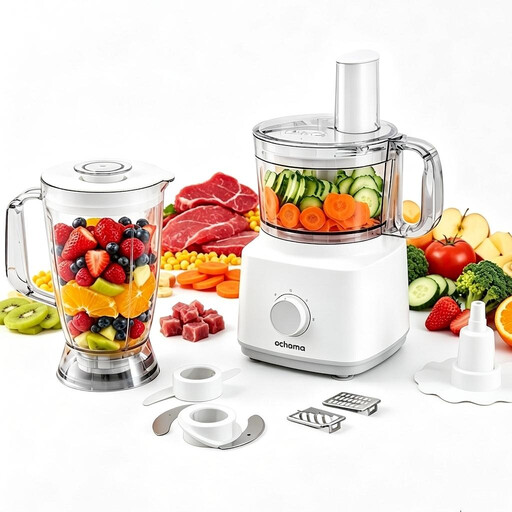 Image unavailable
Worth considering if you want to chop, slice, grate and blend without adding an integrated cooking function.
The product name lists a power rating of 750 W and a 1.8 L bowl. It also mentions grating discs and removable parts. Check the bowl’s usable capacity against the quantities you usually prepare.
If you make dough, check whether a suitable dough tool is included. Also measure the space available for the appliance and its accessories. If noise is a key consideration, look for a comparable measurement.
It can handle food preparation tasks supported by its accessories, but it won’t cook food like a cooking food processor. If your existing appliances are all you need for cooking, start by comparing preparation functions, capacity and the space required.
Choose a size based on the quantities you actually prepare, and don’t assume the stated total volume is the usable capacity for every recipe. For dough and liquids, check the limits listed for the specific model.
Check the manual for the exact model to see which parts are dishwasher-safe and how to clean the rest. Handle blades and discs according to the manufacturer’s instructions.