Households already set up for cooking
You already use a slow cooker or multi-cooker and mainly want to chop, grate, slice or blend ingredients. Your choice comes down to the preparation tasks your current appliances don’t cover.


If you regularly prepare ingredients but already cook your meals elsewhere, a food processor is a more direct fit than a cooking food processor. Que Choisir presents it as a less bulky option when you don’t need built-in cooking or already have a multi-cooker; just remember to check which accessories are included and how much room you’ll need to store them. If you mainly need one function, a specialist appliance may be all you need.
You already use a slow cooker or multi-cooker and mainly want to chop, grate, slice or blend ingredients. Your choice comes down to the preparation tasks your current appliances don’t cover.
You’ll need room to set up the food processor and store its bowls, discs and blades. The dimensions of the base alone won’t tell you how much space you’ll need.
You switch between chopping, grating or slicing vegetables, making sauces and sometimes whisking or kneading. The exact contents of the package matter more than the number of advertised functions.
Consider it: if you regularly do several food preparation tasks but don’t want to cook in the appliance.
Bear in mind: the accessories you need for those tasks will also take up storage space.
Consider it: if you genuinely plan to prepare and cook food in the same appliance.
Bear in mind: if you already use a multi-cooker, its cooking function may duplicate what you have.
Consider it: if one task, such as blending or chopping, clearly makes up most of your food preparation.
Bear in mind: you may need to rely on the appliances you already own for other tasks.
| Criteria | What to check | Who it’s for |
|---|---|---|
| Built-in cooking | Decide whether you’ll use the food processor’s cooking function and which appliances already handle that job. | If my multi-cooker already cooks my meals, I’m mainly looking for an appliance to prepare ingredients; around 34% of consumers would prioritise avoiding a duplicate cooking function. |
| Tasks and accessories | List the tasks you do regularly, then check which blades, discs and other accessories come with the exact model. | When I switch from chopping to slicing or grating vegetables, I want the package to cover these regular tasks; versatility would be the main priority for around 33% of consumers. |
| Space and storage | Measure the space available and check where the bowls and accessories can be stored. | In a kitchen with limited worktop and cupboard space, I need to keep the food processor within easy reach without having to store its accessories in several places; around 20% of consumers would put this need first. |
| Parts and maintenance | Look for parts compatible with the exact model and check the applicable warranty terms. | If I need to replace a bowl or lid later, I want to be able to find its reference number and the corresponding parts; this would be the priority for around 13% of consumers. |
A cooking food processor may duplicate a function already covered by a multi-cooker, which can be used to cook and slow-cook food.
Decide whether you want to cook in the food processor before comparing its preparation functions.
The number of functions alone doesn’t tell you which discs, whisks or other accessories come with the model you’ve chosen.
Check the package contents against each task and distinguish between included accessories and those sold separately.
Que Choisir points out that food processor accessories also take up space. Some models let you store them inside the bowl, but this isn’t a standard feature.
Allow room for the appliance itself as well as its bowls, blades and discs.
Parts catalogues and manufacturers’ commitments don’t remove the need to check compatibility with the exact model.
Make a note of the food processor’s full model reference and use it to search for the bowl, lid and any other parts you may need to replace.
These product ranges provide examples for comparing specific configurations, but don’t guarantee the results you’ll get for each task.
The Compact System range is designed for food preparation without cooking. Magimix says the CS 3200XL can blend, grate, slice, whisk and knead.
The Double Force and Double Force Compact ranges combine several food preparation accessories, with the exact selection depending on the model.
The MultiTalent 3 range includes food processors for chopping, grating and slicing.
This food processor could suit you if you’re looking for one appliance to handle several food preparation tasks and built-in cooking isn’t a deciding factor.
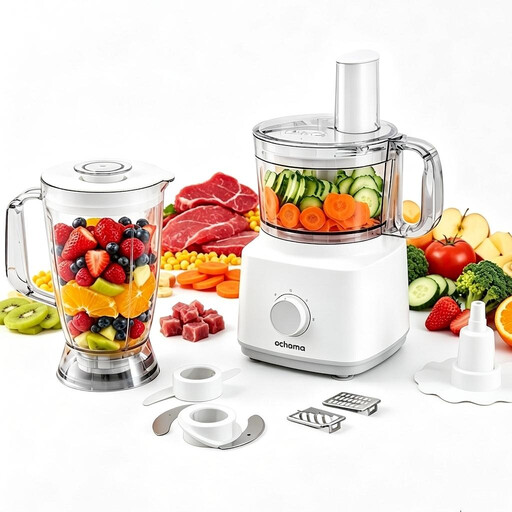 Image unavailable
Worth considering if you want one food preparation appliance for chopping, slicing and grating.
The product listing specifies a power rating of 750 W and a stated capacity of 1.8 L. It also describes blending and grinding functions, as well as removable parts.
Before choosing this model, check which accessories are actually included and allow enough room for the appliance and its accessories.
Yes, if you mainly want to prepare ingredients without cooking in the food processor. Que Choisir presents a food processor as a less bulky option in this situation; a cooking food processor is more worth considering if you’ll use its built-in cooking function.
Start with the tasks you do regularly, then check which accessories come with the exact model. In its testing, Que Choisir assesses some additional functions only when the model comes with the relevant accessory.
The French repairability index isn’t a regulatory comparison criterion for food processors. To plan for maintenance, look for parts compatible with the exact model and check the commitments published by the manufacturer.
If you bought it from a professional seller in France, you should make a claim under the statutory legal guarantee of conformity to that seller, as explained on the official economie.gouv.fr website. Any commercial warranty offered by the manufacturer is separate and subject to its own terms.