
Livraison le jour même ou le lendemain

Qualité garantie

Débloquez vos offres de bienvenue: Livraison GRATUITE | Jusqu'à -80 % | 30 jours d'essai gratuits à JoyPlus
Téléchargez l'application
A food processor promises a simplified kitchen: chopping, mixing, kneading, emulsifying... But faced with a sea of options, how do you distinguish a true culinary assistant from a gadget that will end up in the back of a cupboard? As a product expert at Joybuy, my mission is to decode the spec sheets for you and guide you beyond the marketing claims. Let's analyse the crucial points together for an informed choice and find THE robot perfectly suited to your needs.
Before giving in to temptation, keep these common pitfalls in mind that can quickly turn a promising purchase into a regret.
To avoid making a mistake, focus on these three characteristics. They are the true barometer of the performance and longevity of your future kitchen ally.
Power and Motor Type: The wattage should match your usage. For everyday tasks (soups, smoothies, chopped vegetables), 300 to 800W is more than enough. However, a blender for crushing ice or a stand mixer for kneading heavy doughs will require a more robust motor, around 1000W or more. Also, check if the displayed power is nominal (continuous) or peak; the latter is far less representative of day-to-day performance.
Bowl Capacity and Materials: The size of the bowl (in litres) should correspond to your household size. Less than 1 litre for a single person or a couple (perfect for a mini electric chopper or a baby food maker). For a family, aim for 1.5 to 3 litres for more convenience. Stand mixers, on the other hand, can offer bowls of 5 litres or more.
Accessories: Quality Before Quantity Rather than an array of gadgets, focus on the accessories you'll actually use.
Let's get practical with a few models that have caught our attention, each catering to a specific user profile.
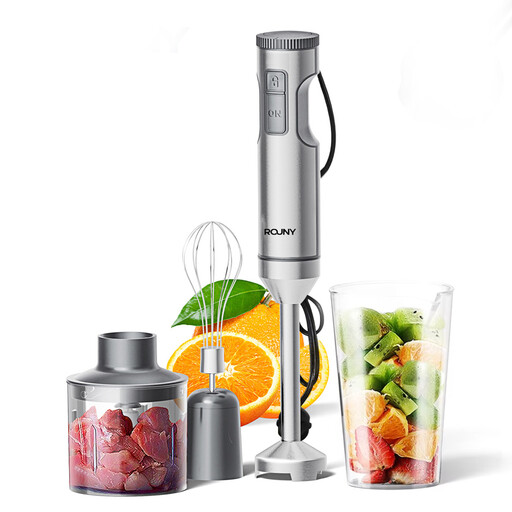
Ideal for those who are short on space but not on ideas. This immersion blender replaces a standard blender, chopper, and mixer thanks to its clever accessories. When the job is done, it stores away in a drawer. Perfect for everyday soups, sauces, and small preparations.
It avoids the bulky "all-in-one" appliance syndrome by focusing on essential functions in an ultra-compact design, without sacrificing the power needed for common tasks.
4-in-1 Versatility: blending wand, 500 ml chopper, whisk, and 700 ml beaker. Adjustable speed for precise texture control.

Young parents will love it. With its two different-sized glass bowls (0.6 L and 2 L), you can prepare baby purée in the small bowl and chop vegetables for the family meal in the large one, without mixing odours or flavours.
It bypasses the risk of low-quality materials with its thick, hygienic glass bowls. It also solves the "single bowl" problem, which is often too large or too small for the right quantity.
Two glass bowls: for separate and perfectly hygienic preparations. Two speeds to adapt to ingredients, from the softest (fruits) to the hardest (nuts, meat).
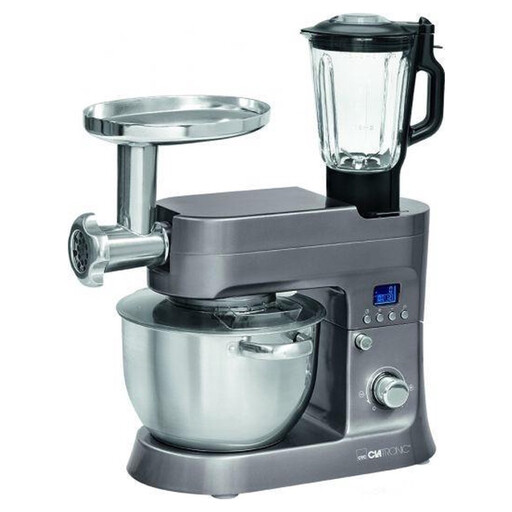
For those who take cooking (and especially baking) very seriously. Its powerful 1200W motor and huge 6.2 L stainless steel bowl allow it to knead large quantities of dough (up to 3.5 kg) and handle demanding tasks one after another without ever faltering.
Here, power isn't just a marketing gimmick. It is genuinely calibrated for heavy-duty tasks like kneading, where less powerful models would overheat or struggle to keep up.
XXL Capacity and Power: 6.2 L bowl and 1200W motor. Complete Kit: baking kit, 1.5 L glass blender, and meat grinder included.
Discover our full selection of food processors and choppers that meet our performance criteria and European safety standards.
What wattage for what use? It all depends on what you cook. For blending soups, making smoothies, or chopping soft ingredients, 300 to 600 watts is more than enough. For crushing ice, kneading bread dough, or grinding meat, aim for models with 800 watts or more. The most important thing remains the balance between power and the overall design of the appliance (blade quality, mechanism robustness).
How do you properly clean a food processor? Ease of cleaning is an essential buying criterion. Opt for models where the accessories (bowl, lid, blades) are removable and dishwasher-safe. For the motor block, a simple wipe with a damp cloth is sufficient: never submerge it in water. Finally, handle the blades with care, always by their plastic base.
Bowl: glass, plastic, or stainless steel? Each material has its strengths. Glass is the champion of hygiene and doesn't stain, but it's heavy and can break. Stainless steel is unbreakable, lightweight, and perfect for baking, but it's opaque. BPA-free plastic is the lightest and most budget-friendly option, but it can get scratched or stained with use. Your choice will depend on your priorities: durability (stainless steel), hygiene (glass), or budget (quality plastic).