
Livraison le jour même ou le lendemain

Qualité garantie

Débloquez vos offres de bienvenue: Livraison GRATUITE | Jusqu'à -80 % | 30 jours d'essai gratuits à JoyPlus
Téléchargez l'application
Nothing beats the authentic taste of homemade purées, creamy soups, or fresh fruit sauces. The food mill, an iconic kitchen tool, is the essential partner for achieving this. However, not all models are created equal. A poor choice can quickly turn food prep into a chore: an unstable device, materials that stain or break, and a clean-up that takes longer than the recipe itself. To help you see clearly and avoid common pitfalls, we've broken down the key points to check before you buy.
Before being tempted by a design or a special offer, it's crucial to know the hidden flaws that can render a food mill unusable in the long run.
To ensure you make a lasting investment, focus on a few technical features that make all the difference in practice.
The stainless steel food mill is the gold standard for durability and hygiene. Unlike plastic, stainless steel doesn't stain, retain odours, or corrode, and it's resistant to shocks. It's a neutral material that preserves the taste of your food. A manual potato ricer made entirely of stainless steel is a guarantee of longevity and easy maintenance, as it can generally go in the dishwasher without deteriorating.
A food mill's versatility lies primarily in its discs. Having several perforated discs with different hole diameters allows you to adapt the texture of your preparations:
Check for non-slip feet or a stable fastening system. Some models, like the Moulinex A40102, have foldable legs that adapt and securely lock onto containers of different diameters. The crank handle should also offer a good grip to allow for effortless turning, even with firmer vegetables.
We have identified a few products that meet different kitchen needs, based on their objective features.
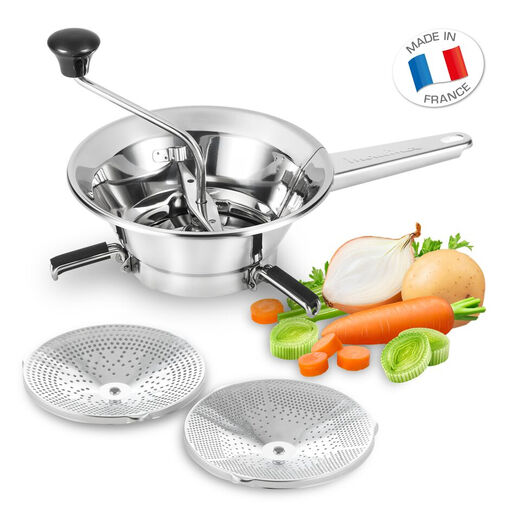
Why it's a great choice: This is the benchmark tool for making classic recipes (purées, soups, compotes) with a reliable and dedicated device. Its 190 mm diameter is well-suited for family-sized quantities.
Its all-stainless steel construction prevents stains and breakage. Its non-slip, foldable legs ensure perfect stability. Fully disassemblable and dishwasher-safe, cleaning is no longer a chore.
Comes with 2 stainless steel discs (fine and medium) for precise texture control. Its foldable legs allow for compact storage.
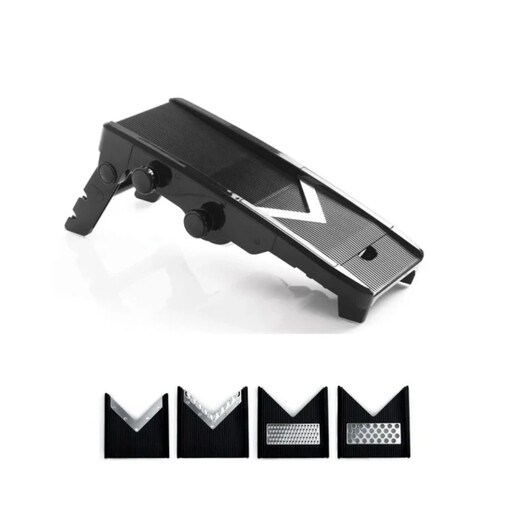
Why it's a great choice: For those seeking professional-level cutting precision for salads, gratins, and stir-fries. This utensil offers a uniformity that a food mill cannot guarantee for raw ingredients.
Although the body is plastic, the V-shaped blades are made of high-quality stainless steel, ensuring a durable edge. Ultra-versatile, it replaces several graters and knives on its own.
It comes with 6 interchangeable blades for slicing, grating, and julienning. The cutting thickness is adjustable from 1 to 9 mm for total control.
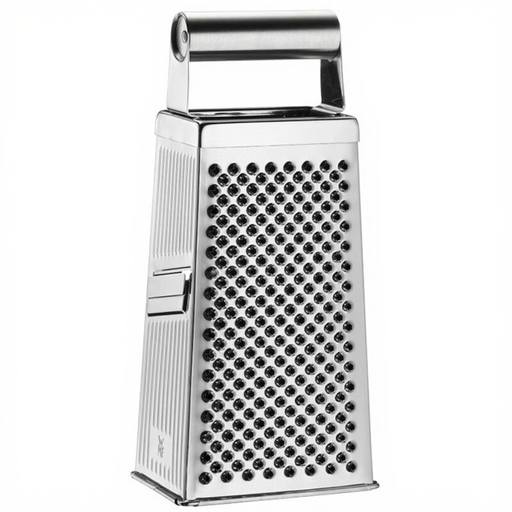
Why it's a great choice: An excellent complement or alternative for those who need a multi-function tool for grating cheese, vegetables, chocolate, or zesting citrus, all in a compact and elegant design.
Made from Cromargan stainless steel, it is extremely robust, acid-resistant, and retains its sharpness, unlike low-end graters. Its single-piece design makes it very easy to clean.
Combines 4 functions in 1 (coarse grater, fine grater, slicer, zester). The ergonomic handle ensures a secure and comfortable grip.
We have put together a complete selection of products that meet our criteria for quality and durability.
The simplest trick: rinse it immediately after use, before the pulp dries. Disassemble the different parts (disc, blade, handle). Use a brush to thoroughly clean the perforations in the disc. Most stainless steel models, like the Moulinex A40102, are fully dishwasher-safe for effortless maintenance.
Absolutely, that's one of its main advantages. By using the finest disc, you will get a smooth purée, free of fibres, skins, or seeds. This allows you to have complete control over the ingredients (vegetables, fruits, a little cooking water) without adding salt, sugar, or preservatives, for a healthy, homemade diet.
Be careful, these two appliances do not produce the same result at all. The food mill presses food through a disc, which separates the pulp from skins, seeds, and tough fibres. The resulting texture is dense and uniform. A blender, on the other hand, grinds and mixes all the ingredients, including skins and seeds. It also incorporates air, which often results in a more liquid and airy texture, similar to a smoothie or a thin velouté. For a traditional potato purée or a tomato coulis, the food mill reigns supreme.