
Livraison le jour même ou le lendemain

Qualité garantie

Débloquez vos offres de bienvenue: Livraison GRATUITE | Jusqu'à -80 % | 30 jours d'essai gratuits à JoyPlus
Téléchargez l'application
Camping gear, weekly groceries, bags of soil for the garden… Transporting heavy and bulky loads can quickly become a nightmare. Fortunately, the folding utility cart has emerged as the clever solution for moving everything without breaking a sweat. But with a plethora of options available, how do you find the perfect one?
Don't worry. Our guide is here to help you navigate the options. We've broken down the essential criteria and selected the best models currently on the market so you can make the right choice with confidence (or close to it).
Before you dive into our selection, let's review the key factors that will help you find the model perfectly suited to your needs.
It all comes down to how you plan to use it. What will you be carrying, and how often?
Your cart's maneuverability depends entirely on its wheels. Don't overlook them!
The main appeal of a folding cart is, of course, its space-saving design. Be sure to check its dimensions when folded: will it fit in your car trunk, a closet, or under a bed? The cleverest folding systems, often centralized, allow you to collapse it in a flash. This is a significant time and energy saver in daily use.
After our analysis, here are three models that caught our eye, each excelling in a specific category.

Why it stands out: This model is the perfect Swiss Army knife: it combines an impressive load capacity and a comfortable volume, all with well-designed safety features like a dual-brake system. Its express folding mechanism makes it the ideal companion for spontaneous outings.
Key features:
Who is it for? For active families looking for an ultra-versatile cart that can accompany them from the campsite to the beach, as well as for grocery shopping and small moves.
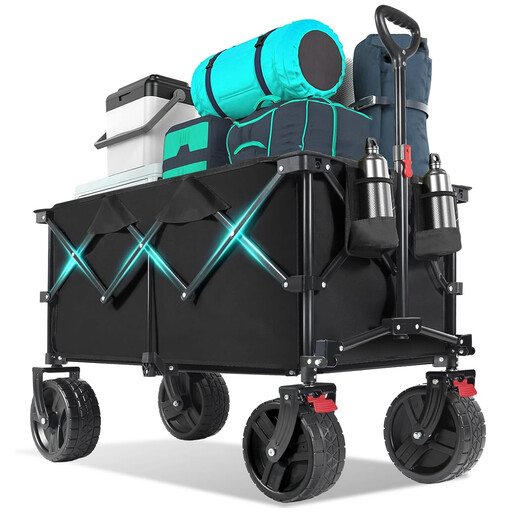
Why it stands out: With its XXL 200 L volume and oversized wheels, this cart is a true workhorse, built for hostile terrain and bulky loads. It's the ultimate weapon for festivals and major outdoor adventures.
Key features:
Who is it for? For festival-goers, long-term campers, and large groups heading to the beach. In short, for anyone who needs to transport a maximum amount of gear in a single trip over difficult terrain.
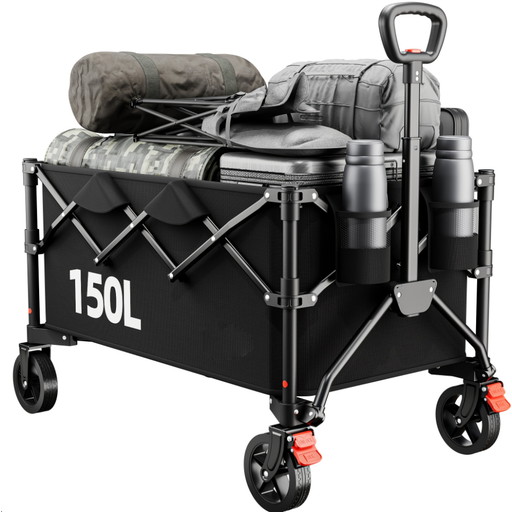
Why it stands out: The focus here is on everyday practicality and ease of maintenance. Its ultra-compact fold and the ability to quickly remove the wheels and fabric liner for cleaning make it a particularly clever model.
Key features:
Who is it for? For gardeners, DIY enthusiasts, and anyone looking for a garden cart or utility wagon that is above all easy to clean and store. Its versatility also makes it a great choice for family outings.
Our selection highlights versatile models that have proven their worth. But the world of transport solutions is much broader! If you're looking for a model with different features, a folding hand truck for your boxes, or an even more specialized cart, you're likely to find it in our full catalogue.
? To explore a wider variety of models, discover our complete collection of wheeled carts.
1. How do I maintain my folding utility cart? It's very simple. After each use, wiping the fabric with a damp cloth is sufficient. Let it air dry completely before folding the cart to prevent mildew. Also, remember to periodically check that the wheels are clean and turn without resistance, and inspect the tightness of the screws and the effectiveness of the brakes.
2. Is a camping cart really effective on sand? Yes, provided you choose the right model! Its effectiveness depends entirely on the wheels. For sand, nothing beats wide, relatively smooth all-terrain wheels. They distribute the weight more evenly and prevent the cart from sinking, unlike thin, hard wheels. A pro tip: on sand, it's often easier to pull the cart behind you than to push it.
3. What's the difference between a utility cart and a folding hand truck? The utility cart (also known as a garden or camping wagon) is a type of four-wheeled fabric cart, ideal for transporting loose items of various shapes. The folding hand truck, on the other hand, has two wheels and a metal platform. It's perfect for moving stable, vertically stackable loads like boxes, crates, or appliances. The choice, therefore, depends entirely on what you typically need to transport.