
Livraison le jour même ou le lendemain

Qualité garantie

Débloquez vos offres de bienvenue: Livraison GRATUITE | Jusqu'à -80 % | 30 jours d'essai gratuits à JoyPlus
Téléchargez l'application
A folding treadmill for home lets you walk, jog or run when the weather, your schedule or the lack of a gym makes training difficult. But a flattering photo and a promise of quiet operation aren't enough to pick the right model.
Before you place an order, three common pitfalls keep cropping up:
For everyday walking, a walking treadmill or walking pad limited to 6 km/h may be enough. If you want to alternate brisk walking, jogging and running, a top speed of 12 km/h gives you more options. Those who plan to run regularly could aim for a faster model, like the Formill FT71, which is rated at 16 km/h.
The running surface deserves as much attention as the speed. A belt of 38 × 94 cm is mainly suitable for walking and gentle movement, while a surface of 101.6 × 40.6 cm or larger gives you more freedom for jogging. Always compare these dimensions with your height and stride length.
The maximum load must exceed your weight, with a reasonable margin. This figure affects the stability and lifespan of the machine. It doesn't replace reading the manual or following the manufacturer's instructions.
A treadmill with incline lets you increase intensity without always having to speed up. A manual incline, like the 0 to 8% adjustment on the CITYSPORTS PRO WP9, usually requires you to stop the machine to change the position. An automatic incline, such as the one rated up to 18% on the YOSUDA, is adjusted from the console or remote control, depending on the product's design.
Incline puts more strain on the mechanics and can change how stable the treadmill feels. Check the frame width, the maximum supported load and the space available behind the machine before making this a priority criterion.
For a flat or an office, choose a quiet treadmill, but look carefully at the stated value and the test conditions. The CITYSPORTS PRO WP9 claims a noise level below 45 dB, while the Mobvoi Home Treadmill SE is rated up to 60 dB. These figures alone aren't enough to predict the noise you'll experience in your own home.
A compact treadmill should be measured in all its configurations. For use under a desk, height is crucial: the KeHot YQ N3897 is 15 cm high and runs from 1 to 6 km/h. This is therefore a walking machine, not one for running.
Finally, a connected treadmill, compatible with Bluetooth or an app, can display your data, offer virtual routes or track your progress. Check which apps are actually supported, compatibility with your phone and which features are available without a subscription.
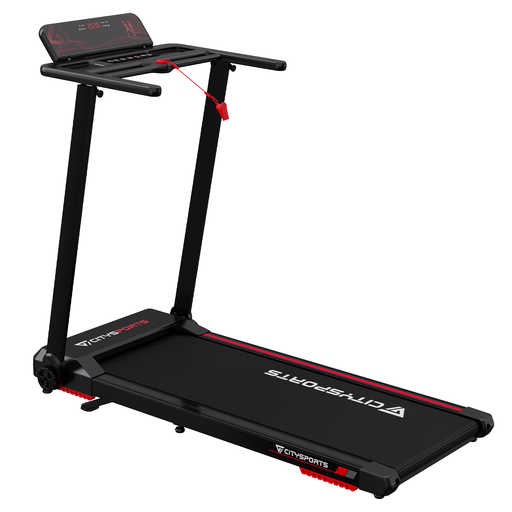
Why this choice suits this profile: Its speed range of 1 to 12 km/h covers walking, jogging and moderate running at home. With stated dimensions of 123.2 × 61 × 10.2 cm and a net weight of 26.5 kg, it's easier to store in a small space.
The listing specifies the speed, a maximum load of 120 kg, a manual incline adjustment from 0 to 8% and a stated noise level below 45 dB. That gives you concrete criteria to compare the machine.
Stated 1,400 W motor, six-layer running belt, multifunction LED display and app connectivity.
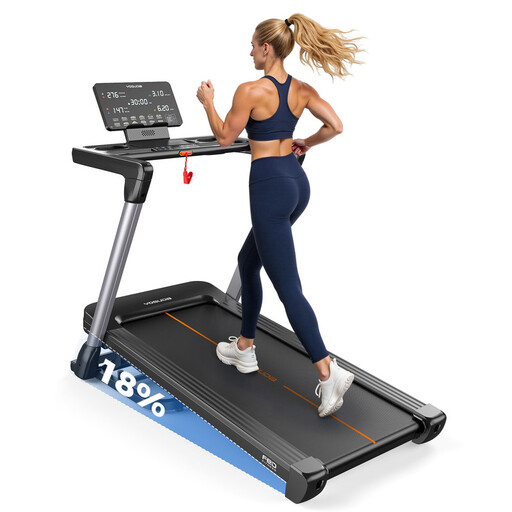
Why this choice suits this profile: This model is designed for those who want to alternate walking and running, thanks to an electrically adjustable incline and a stated maximum load of 172 kg.
The listing distinguishes the maximum load, the 3.0 HP brushless motor, the automatic incline up to 18% and the four-element cushioning system.
Stated steel frame, high-resolution LED display, Bluetooth connectivity and 12 programmes accessible via the app.
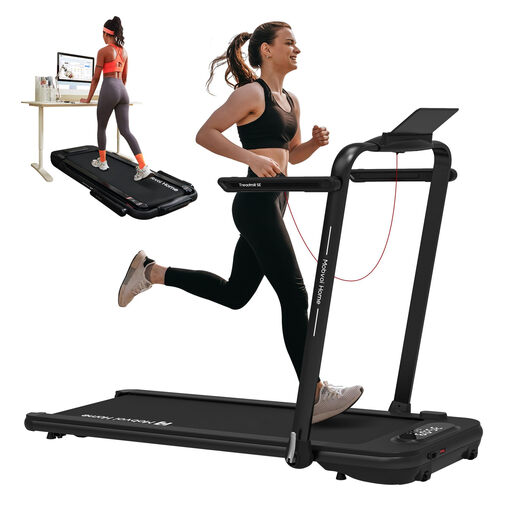
Why this choice suits this profile: Its three modes — walking, desk and running — suit the remote worker who wants to switch between activity under a desk and more intense sessions.
The speed is limited to 1–6 km/h in walking or desk mode and reaches 12 km/h in running mode. This distinction clearly defines the uses rather than just showing a single top speed.
Five-layer belt, remote control, built-in wheels, TicSports app and stated maximum load of 120 kg.
We've put together a comprehensive list, updated in real time, of products that meet these demanding selection criteria and European safety regulations.
Before first use, set up the treadmill on a flat, stable and clear floor. Leave enough space around the machine, especially at the rear, and always use the safety key. After each session, remove any dust from the belt and check its alignment.
Lubrication must follow the instructions in the manufacturer's manual: too much product can also disrupt operation. If you store the treadmill upright or under furniture, let the motor cool down and make sure the folding mechanism is properly locked. For a purchase in the UK, also check the warranty conditions, the contact details of the responsible party established in the European Union and the instructions in English when available.
Yes, provided you check the stated noise level, vibrations and floor stability. A compact model or walking pad is generally easier to store, but its running surface and speed may be limited. A treadmill placed on a suitable shock-absorbing mat can reduce some vibrations, but won't eliminate mechanical noise.
Consumption depends on the motor power, speed, incline, user weight and session duration. To estimate it, note the electrical power in watts, convert it to kilowatts, then multiply by the number of hours of use and the price per kilowatt-hour on your electricity tariff.
It varies according to frequency of use, load, maintenance and belt quality. Sticking to the maximum load, keeping the surface clean, checking alignment and lubricating the machine as per the manual all help to limit wear. Daily running will put more strain on the motor and belt than a few occasional walking sessions under a desk.