
Livraison le jour même ou le lendemain

Qualité garantie

Débloquez vos offres de bienvenue: Livraison GRATUITE | Jusqu'à -80 % | 30 jours d'essai gratuits à JoyPlus
Téléchargez l'application
Shopping, bags of compost, camping gear or boxes to carry up the stairs: a folding transport trolley can make many everyday tasks much easier. But you need to know what the advertised features really mean. A volume expressed in litres doesn't necessarily tell you about the weight it can support, while wheels described as "all-terrain" might not perform well on sand or cobbles.
Here are the criteria to consider before placing your order, along with a selection of models suited to different uses.
A large-capacity folding wagon can hold plenty of bulky items without necessarily being designed to carry heavy loads. The litres refer to the interior volume, while the kilograms indicate the maximum weight stated by the manufacturer.
A 200 L model isn't automatically capable of supporting 200 kg. For shopping, tools or provisions, check these two figures separately. Never exceed the stated maximum load, even if the structure looks particularly sturdy.
Wide wheels make it easier to move across grass, dirt tracks and uneven ground. However, they can make the trolley more cumbersome in a hallway, lift or car boot.
In town, a compact wheeled trolley will often be more manoeuvrable. For camping, festivals or gardening, wide tyres with bearings and a brake will provide greater stability, especially when stopping on a slope.
A product described as foldable doesn't necessarily fold away in an instant. Measure the space available in your boot, cellar or cupboard. Also check whether the wheels, canopy or handle can be removed, and whether the mechanism can be operated without tools.
A heavy trolley that's difficult to unfold or has an uncomfortable handle is likely to end up at the back of the garage, even if it boasts a high maximum load.
For everyday shopping, a folding shopping trolley of around 60 L and 35 kg maximum load may be sufficient. For gardening, camping or family outings, a volume of 150 to 300 L will offer more flexibility.
The structure also deserves careful attention:
Place the heaviest items at the bottom and in the centre. This will reduce the risk of tipping and the pressure on the handle.
On smooth surfaces, swivel wheels or those with bearings make changing direction easier. For a folding garden trolley or a camping trolley, it's best to opt for wide wheels that are sufficiently spaced apart.
A trolley with a brake is useful if you need to stop regularly, load the trolley on a slope or use it near a vehicle. The brake should be engaged when stationary, but it doesn't replace careful handling or adherence to the stated maximum load.
An adjustable telescopic handle allows you to adapt the height to the user's build. A non-slip coating improves grip, especially when hands are wet or the journey is a long one.
For seniors and people with reduced mobility, prioritise the empty weight, ease of folding, stability and the ability to keep the trolley stationary. An ergonomic model won't necessarily be suitable for every situation: the environment in which you plan to use it remains the deciding factor.
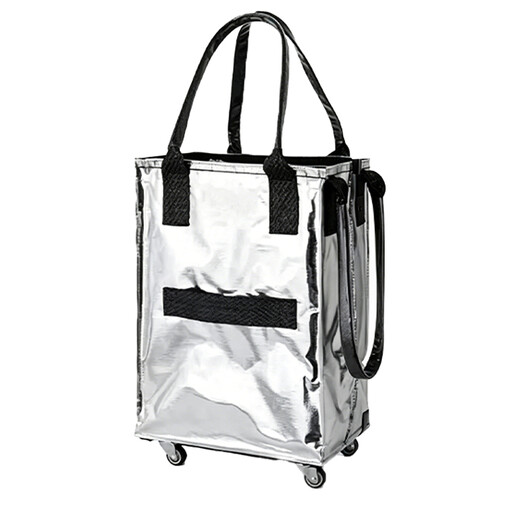
Why this model suits this profile: With around 60 L of volume and a stated maximum load of 35 kg, this trolley handles grocery shopping and regular trips around town with ease.
The volume and maximum weight are clearly distinguished, so you won't compare models based on litres alone.
A design made for shopping, a thick woven bag and a stated maximum load of 35 kg.
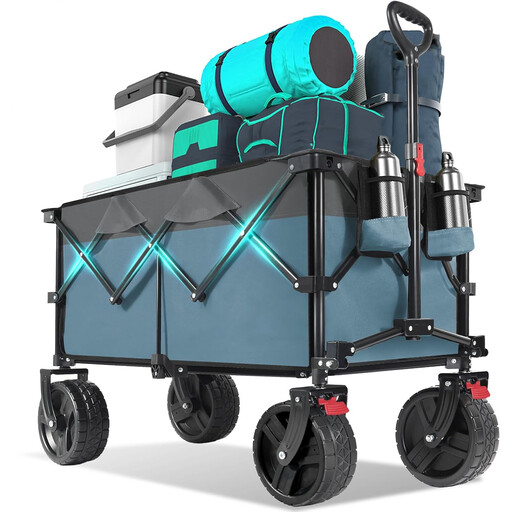
Why this model suits this profile: This large format is ideal for families, campers and festival-goers who need to transport bulky items across grass, mud or uneven paths.
Its 7-inch all-terrain wheels and securing straps overcome the limitations of smaller trolleys on soft ground.
A 200 L volume, a stated load of 200 kg, tool-free folding and an adjustable handle.
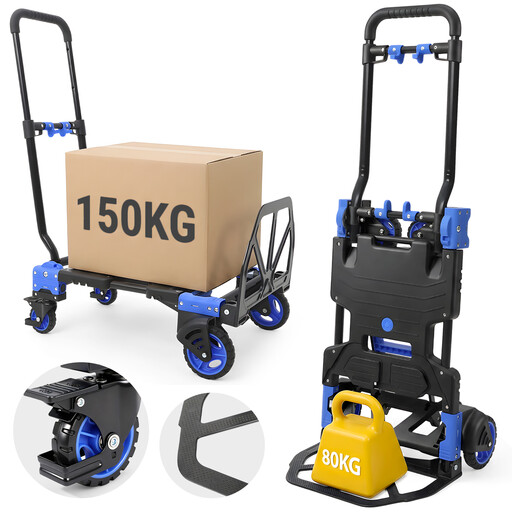
Why this model suits this profile: Its dual configuration allows you to transport boxes, crates and parcels, whether at home or in a professional setting.
The maximum load varies by configuration: 80 kg as a sack truck and 150 kg as a platform trolley.
An aluminium frame, TPR dual-bearing wheels, a parking brake and an adjustable handle.
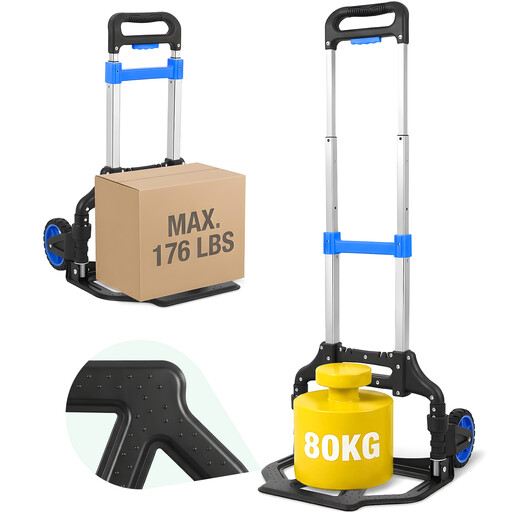
Why this model suits this profile: At just 3.5 kg empty, this folding sack truck is ideal for those who need a compact device for moving parcels and boxes occasionally.
Its low weight and stated folded width of 5.7 cm minimise bulk, a point often overlooked on heavier models.
A stated load of 80 kg, three handle heights and TPR dual-bearing wheels with a brake.
We've put together a comprehensive, real-time updated selection of products that meet these demanding criteria, as well as European safety standards.
To extend the life of a folding trolley, remove any debris caught in the wheels after a trip to the garden or beach. Clean the fabric with a damp cloth, then let it dry completely before folding the trolley away. Avoid leaving it out in the rain for long periods, even if the fabric is described as waterproof.
Regularly inspect the wheels, axles, welds and braking system. An unusual noise, a buckled wheel or a sticking mechanism are all signs that warrant a check before you use it again.
It depends entirely on the model and its configuration. The products featured here have stated capacities ranging from 35 kg for a shopping trolley to 300 kg for a metal-framed wagon. Always adhere to the value stated by the manufacturer and distribute the load evenly.
Yes, some models have wide wheels designed for uneven surfaces. However, they will still be harder to pull through deep sand than on a compacted path. For camping or the beach, look for wide tyres, an adjustable handle and a brake.
Clean the wheels and dry the fabric thoroughly before folding it away. Store the trolley in a dry place and avoid placing heavy objects on top of it. If you plan to transport it in a car boot or store it in a small flat, check the folded dimensions and the empty weight before ordering.