
Livraison le jour même ou le lendemain

Qualité garantie

Débloquez vos offres de bienvenue: Livraison GRATUITE | Jusqu'à -80 % | 30 jours d'essai gratuits à JoyPlus
Téléchargez l'application
Carrying several bags after a trip to the market, loading bottles into the boot, or hauling equipment to a campsite can quickly become a chore. A folding shopping trolley reduces the effort and is far easier to store than a traditional cart. But you still need to choose a structure that suits your needs.
Some marketing claims are also worth checking before you buy. Here are the main pitfalls to avoid, followed by a selection of models suited to different needs.
A roomy bag isn't necessarily designed to carry heavy loads. Capacity, expressed in litres, tells you the volume available, while the maximum load in kilograms indicates the strength of the frame, bag and wheels. For everyday shopping, a large bag may be sufficient. However, for carrying bottles, tins or equipment, the load capacity becomes the priority criterion.
A lightweight and compact trolley needs to fit into a cupboard, car boot or tight storage space. So check its width, height and depth when folded. A mechanism marketed as compact can still be surprisingly bulky if the wheels or handle don't fold away properly.
Two, three or four wheels don't automatically guarantee better manoeuvrability. Their diameter, width, material and whether they have bearings all affect how the trolley behaves on pavements, gravel and uneven ground. For a city market, a classic shopping trolley on wheels can work perfectly. For stairs or tricky terrain, a multi-wheel model may be more suitable, provided you check its stability.
A large-capacity market trolley is handy for the weekly big shop. A model around 60 L can hold more items, but it will also be heavier when full. The JORDAN&JUDY model featured below claims an approximate volume of 60 L and a maximum load of 35 kg. These figures should be compared with your actual habits, rather than just the bag's size.
Also examine the closure system, the fabric's durability, how easy it is to clean, and the number of pockets. A wide opening makes packing your shopping simpler, while a separate pocket keeps keys or documents within easy reach.
For regular use, choose a frame that's sufficiently rigid and a handle that's comfortable to hold. An adjustable-height handle lets you adapt the folding transport trolley to your height. Wheels with bearings, when mentioned on the spec sheet, can make movement smoother and reduce jolts.
Older people or those who want to avoid complicated handling will generally appreciate an ergonomic handle and intuitive folding. Also remember to check the empty weight: a trolley that's too heavy loses much of its appeal for daily shopping.
A wheeled bag is primarily for carrying provisions. A 2-in-1 trolley can also be used to move boxes, crates or equipment. In this case, it's essential to distinguish the load limits for each configuration.
An aluminium folding sack truck becomes particularly useful when transport goes beyond just food shopping. However, check its stability, whether it has a brake, and the dimensions of its platform.
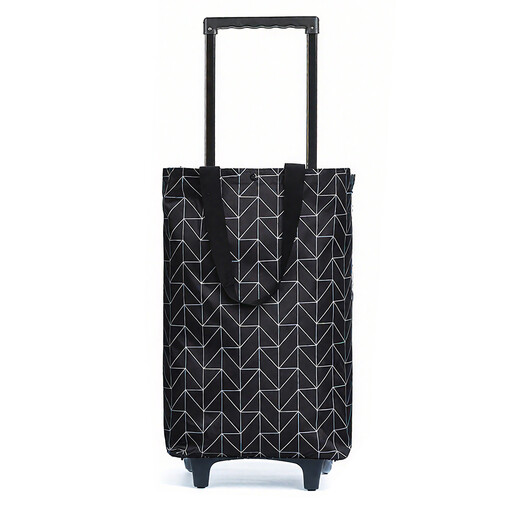
Why this suits this profile: Its foldable format and lightweight design are ideal for anyone looking for a first trolley for everyday shopping or compact storage.
The listing highlights lightness and folding, two key points when storage space is limited. However, the maximum load should be checked before doing a big shop.
Foldable format, black colour and design intended for easy pulling.
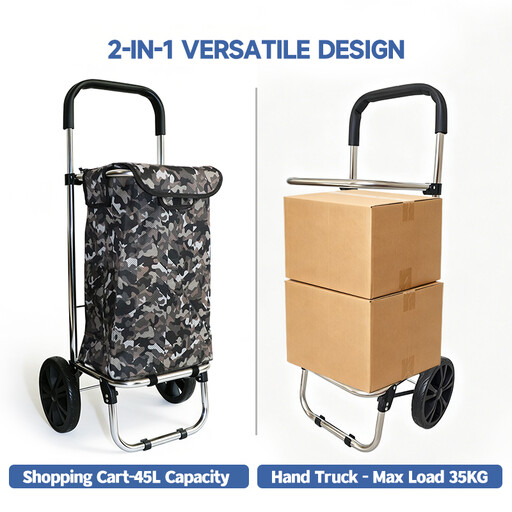
Why this suits this profile: Its stainless steel construction and ergonomic handle appeal to users who care about materials and build quality.
The stated material provides a concrete criterion, rather than relying on a vague promise of durability. Also remember to check the folded dimensions and the maximum load.
Stainless steel construction, practical folding and ergonomic handle.
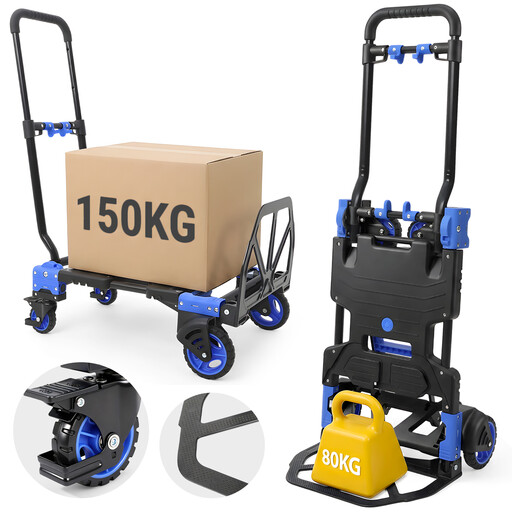
Why this suits this profile: This model is for those who switch between shopping, small moves, storage and transporting boxes.
The limits vary depending on the mode used: 80 kg as a sack truck and 150 kg as a platform, according to the product listing. You must respect the chosen configuration and never exceed these values.
Aluminium frame, two configurations, TPR dual-bearing wheels and integrated parking brake.
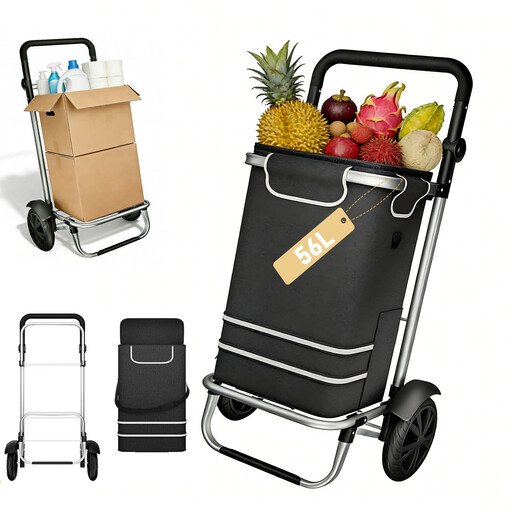
Why this suits this profile: Its stated 56 L volume and convertible design can suit big shops, picnics and camping alike.
The stated capacity is clearly given in litres. Before carrying a heavy load, however, check the weight limit in kilograms and the trolley's stability in the chosen configuration.
Stated 56 L volume, practical folding and can be used as a backpack or a trolley.
Regularly remove dust and small debris that build up around the wheels and joints. Clean the bag following the instructions on its product listing, then wipe the frame with a slightly damp cloth. Before folding it, make sure it's completely dry to minimise odours and material wear.
For everyday purchases, a compact model will generally be easier to carry and store. For a family or weekly market shopping, a volume of 50 to 60 L could be useful. However, the capacity should always be considered alongside the maximum load and the trolley's empty weight.
A classic shopping trolley isn't necessarily designed to carry boxes or crates. For this use, choose a model with an explicitly stated maximum load, such as a folding sack truck or a 2-in-1 trolley. Respect the limit for each mode of use and use the brake when the model has one, especially on a slope.