
Livraison le jour même ou le lendemain

Qualité garantie

Débloquez vos offres de bienvenue: Livraison GRATUITE | Jusqu'à -80 % | 30 jours d'essai gratuits à JoyPlus
Téléchargez l'application
A folding shopping trolley makes trips to the supermarket, transporting parcels and storage in a small flat much easier. However, just because it looks compact does not necessarily mean it will be stable or comfortable to use. Between a folding shopping trolley, folding transport trolley and folding sack truck, the main differences lie in the frame, wheels and maximum load capacity.
Before placing your order, take the time to look beyond the main marketing claims and check a few genuinely important specifications.
A bag described as having a “large capacity” may be spacious without being able to support a heavy load. A 60 L shopping basket, for example, provides plenty of room for groceries, but that does not mean the frame, wheels or stitching will withstand several dozen kilograms.
Check each of the following separately:
A folding trolley can be very practical in a shop, then become particularly awkward in a car boot, cupboard or hallway. In small spaces, pay particular attention to its width when folded. Also check the handle height and whether it has a carrying handle.
Three wheels do not automatically make a trolley easier to manoeuvre, just as four wheels do not guarantee perfect stability. Their diameter, spacing and material are far more important. On uneven pavements, small wheels transmit more vibrations and are less able to get over thresholds.
For everyday shopping, a 40 to 60 L bag is generally a good compromise between capacity and size. Families and people who regularly transport bottles may prefer a large-capacity shopping trolley, provided they check the maximum load and the rigidity of the base.
Aluminium helps to reduce weight, while a reinforced frame is better suited to intensive use. However, the material alone is not enough to assess a trolley’s durability: also inspect the joints, bag fixings and wheel assembly.
A lightweight shopping trolley is easier to pull on public transport or load into a car boot. On the other hand, an extremely lightweight model may lack rigidity, depending on its design. For a shopping trolley for older people, prioritise:
Adjustable handles can also help prevent excessive bending. However, they are not a medical guarantee.
For journeys between home and the supermarket, sufficiently wide and securely attached wheels make it easier to travel across pavements. A parking brake is useful on slopes or while loading.
Considering a 2-in-1 multifunction trolley? Check the specifications for each configuration. The maximum load in sack-truck mode may differ from that allowed in platform mode. Always follow the manufacturer’s instructions and never exceed the stated limit.
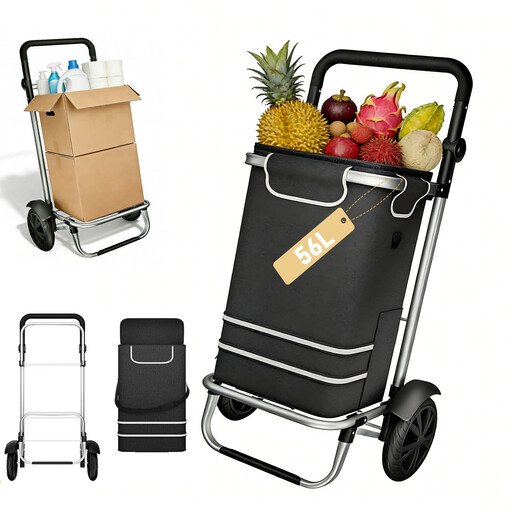
Why this choice suits this profile : With its advertised 56 L capacity, this model is suitable for everyday shopping as well as picnics and camping. Its design allows it to be used as a rucksack or trolley.
Its capacity is clearly stated, allowing you to compare it with your needs instead of relying on an imprecise phrase such as “large size”.
Advertised 56 L capacity, folding design described as simple, and the option to use it as a rucksack or trolley.
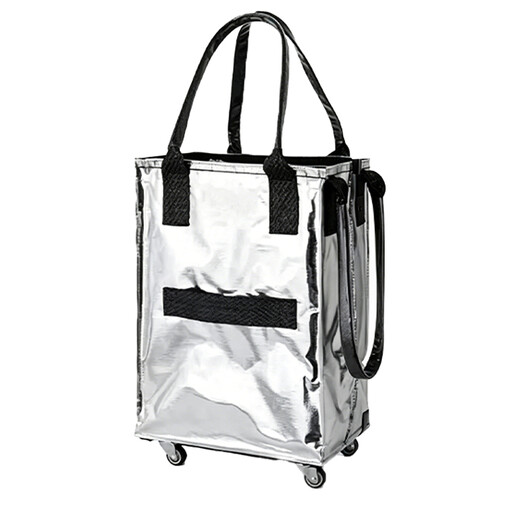
Why this choice suits this profile : This model is designed for users looking for a thick woven bag and generous capacity for their regular shopping.
The advertised capacity of around 60 L and stated maximum load of 35 kg provide clear reference points before you buy.
Thick woven bag, capacity of around 60 L and advertised maximum load of 35 kg.
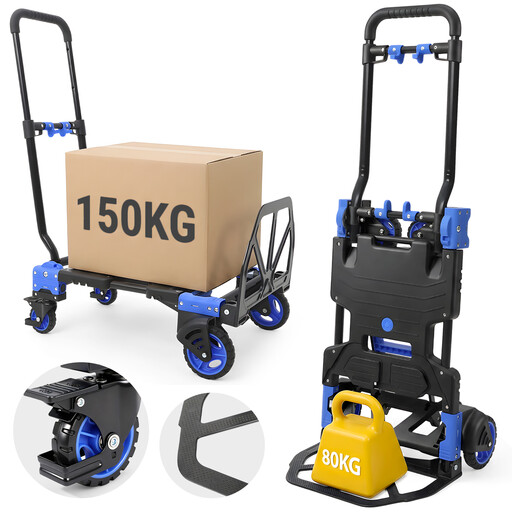
Why this choice suits this profile : It is suitable for transporting parcels, crates or loads that are too bulky for a simple wheeled shopping bag.
The loads are stated separately for each mode: 80 kg as a sack truck and 150 kg as a platform trolley. Both limits must be observed.
Advertised conversion between two modes, TPR twin-bearing wheels, parking brake and adjustable handle.
Compare the product listings on the following points:
For versatile use, a sturdy shopping trolley with a reinforced frame is suitable for frequent journeys. If space is limited, prioritise its folded width and weight over maximum capacity. Campers and families may prefer a convertible or large-capacity model.
We have put together a complete, real-time updated list of products that meet these demanding selection criteria and European safety requirements.
A capacity of 40 to 60 L may be enough for regular shopping, depending on the size of your household and how often you shop. If you often transport bottles or heavy products, focus above all on the maximum load and frame stability.
Regularly remove dirt caught in the wheels and joints, then clean the bag according to the instructions in the product listing. For the frame, a slightly damp cloth is usually sufficient. Dry the metal parts before storing the trolley in a dry place, and never force the folding mechanism if it is jammed.
A shopping trolley is generally designed around a bag intended for groceries. A folding sack truck is mainly used to transport boxes, parcels or crates on a platform or vertical support. A 2-in-1 model can combine both functions, but you should check its load limits and stability in each configuration.