
Livraison le jour même ou le lendemain

Qualité garantie

Débloquez vos offres de bienvenue: Livraison GRATUITE | Jusqu'à -80 % | 30 jours d'essai gratuits à JoyPlus
Téléchargez l'application
With the rise of remote work, a sedentary lifestyle is a growing concern. Being glued to your chair for hours has consequences, and many are looking for a solution. This is where the foldable walking pad comes in?: the ideal way to get moving without cluttering up your living room.
The problem?: the market is flooded with models making often-vague marketing promises. To avoid buyer's remorse, it's crucial to know how to separate real benefits from pure advertising hype. This guide is here to help you navigate the traps and find the walking pad that truly meets your needs.
A tempting price or an endless spec sheet can quickly turn your head... and lead to a purchase you'll bitterly regret. To avoid disappointment, here are the three classic mistakes to steer clear of.
The motor is the heart of the machine. Don't be fooled by the "peak" horsepower (HP Peak) advertised on entry-level models?: it only reflects maximum effort for a tiny amount of time. The only figure that matters is the continuous horsepower (CHP or HP). Anything below 0.75?CHP means you can expect a motor that struggles, fails to maintain a stable speed, overheats, and, most importantly, turns your work-while-walking session into an auditory nightmare for you and everyone around you.
Be careful; the term "foldable" is often a catch-all marketing buzzword. Some walking pads do fold, but they remain so thick or heavy that storing them becomes a real headache. You can't slide them under a bed, let alone store them vertically in a closet. For an under-desk walking pad to be truly practical for daily use, especially in an apartment, it must be ultra-slim (ideally under 15?cm thick) and absolutely must have wheels to move it without breaking your back.
Unreliable Bluetooth, a poorly designed mobile app, incomprehensible workout programs... Beware of gimmicky features that inflate the price without adding any real value. Most of the time, they're forgotten after a couple of uses. Good home office fitness equipment should be simple, reliable, and effective. An easy-to-reach remote and a clear display showing the essentials (speed, distance, time, calories) will always be more valuable than a buggy app that never gets updated.
To make the right choice, focus on this checklist of technical points. These are what will make all the difference in terms of comfort, safety, and durability.
We can't say it enough?: aim for a continuous horsepower of at least 0.75?HP for regular use. As for speed, don't be impressed by big numbers. For walking pad use (slow walking while working), a maximum speed of 6 to 9?km/h is more than enough. Paying more for a model that goes up to 12?km/h or higher makes no sense if you never plan to run on it.
This is a detail that changes everything for comfort and safety. A belt that's too narrow or too short will force you to constantly look at your feet instead of focusing on your work. For a compact walking pad, aim for a surface of at least 100?cm long by 38?cm wide. Anything smaller will result in an unnatural stride and a very real risk of misstepping.
Carefully check the folded dimensions of the pad (length x width x thickness) to ensure it will fit in your space. As mentioned, transport wheels aren't an option?: they are essential for moving it without throwing out your back. Finally, take a look at the supported maximum user weight. Give yourself some leeway?: choose a model that can handle at least 10 to 15?kg more than your own weight. This is a crucial safety margin for you and a guarantee of longevity for the motor.
Rather than an endless catalogue, we've chosen to focus on one product that checks all the boxes for a typical user, avoiding the pitfalls mentioned above.
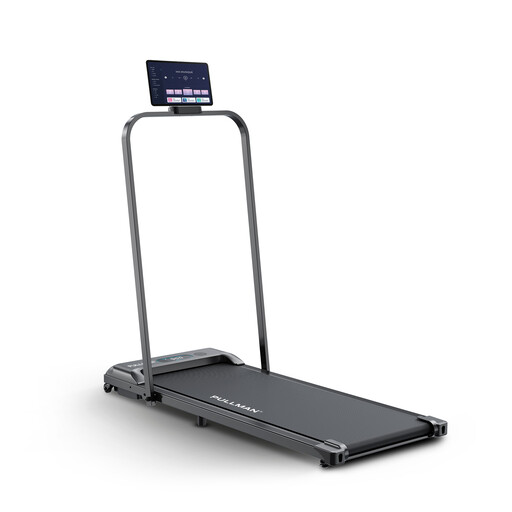
The Verdict : This model gets straight to the point. It's perfect for remote work because it isn't bogged down with useless gimmicks. It represents excellent value for money for anyone looking to integrate walking into their daily routine without breaking the bank.
This model skips the superfluous gadgets to focus on what matters. With its 0.75 HP motor, it's perfectly calibrated for walking. Its folded dimensions (134 x 54 x 11 cm) make it a truly compact device, easy to slide under furniture.
What sets it apart is its ultra-slim design when folded, and its wheels that make storage genuinely easy. The speed of up to 9 km/h is ideal for brisk walking, and the Bluetooth for music is a nice little bonus that doesn't overcomplicate its use.
Explore our full selection of walking pads that meet our quality criteria and current safety standards.
The lifespan of a foldable walking pad for apartments depends on three factors?: the quality of the motor, the durability of the frame, and, of course, your maintenance routine. A quality model that is regularly lubricated and cleaned can easily last for many years. A good indicator?? The length of the manufacturer's warranty on the motor and frame is often very telling of the product's reliability.
Let's be clear?: no walking pad is completely silent. The noise comes from both the motor and the friction of the belt. However, models designed for "under-desk" use are engineered to be as discreet as possible. They typically operate between 45 and 60 decibels, which is comparable to the ambient noise in a library or a modern dishwasher. Pro tip?: a suitable floor mat will absorb some of the vibrations and noise transmitted to the floor.
That's an excellent question. Rest assured, a foldable walking pad is far from an energy hog. When used at a slow speed (between 2 and 4?km/h), its consumption is very reasonable. To give you an idea, a 690W (0.75?HP) motor running at half speed consumes about as much as a desktop computer and its monitor. Even with daily use, the impact on your electricity bill will be minimal.