
Livraison le jour même ou le lendemain

Qualité garantie

Débloquez vos offres de bienvenue: Livraison GRATUITE | Jusqu'à -80 % | 30 jours d'essai gratuits à JoyPlus
Téléchargez l'application
Camping weekends, beach days, grocery runs, or gardening... hauling heavy and bulky items is a chore we all know too well. A foldable wagon emerges as the ideal solution. The problem? The market is flooded with models making tempting promises, but they often prove disappointing in practice.
As the Head of Product Recommendations at Joybuy, my mission is to help you navigate the options. We've analyzed the market and identified the common pitfalls to ensure your choice is genuinely suited to your needs, not just dictated by marketing hype.
The 3 Pitfalls to Avoid When Buying a Foldable Wagon:
To avoid falling into these traps, focus on a few key technical specifications.
Load capacity, expressed in kilograms (kg), indicates the maximum weight the frame and wheels can support without buckling. A 150 kg or 200 kg foldable wagon is already a good sign of sturdiness.
But be aware, volume, expressed in litres (L), is just as crucial. It corresponds to the actual storage space. A wagon might support 150 kg but offer only 100 L of volume, which will quickly prove insufficient for bulky but lightweight items like duvets or camping chairs. It's up to you to assess your needs to find the right balance between a high-capacity foldable wagon in terms of volume and a suitable payload.
The type of wheels literally determines where and how you can use your wagon.
The frame is the skeleton of your wagon. Opt for models made of alloy steel or carbon steel for foolproof durability. The fabric must be equally resistant to wear and tear. 600D Oxford fabric is a reliable choice, often lined with a waterproof coating that makes cleaning easier and protects your belongings from a surprise shower.
To illustrate these criteria in practice, here are a few use cases and the models that best meet their demands.
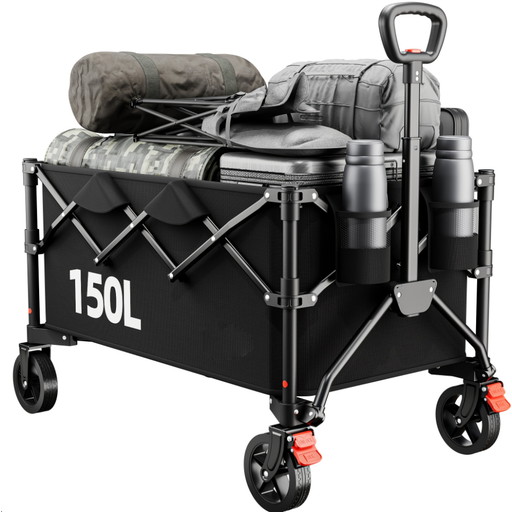
The perfect compromise: It offers an excellent balance for versatile use. Its 120 kg capacity and 150 L volume are perfect for carrying grocery bags, picnic supplies, or kids' toys to the park.
Its alloy steel frame prevents warping, while its all-terrain wheels with brakes keep it from getting stuck in grass or on gravel—a common weakness of entry-level models.
Its four-way folding mechanism and "one-click" handle make it ultra-compact and easy to manage, even with one hand.
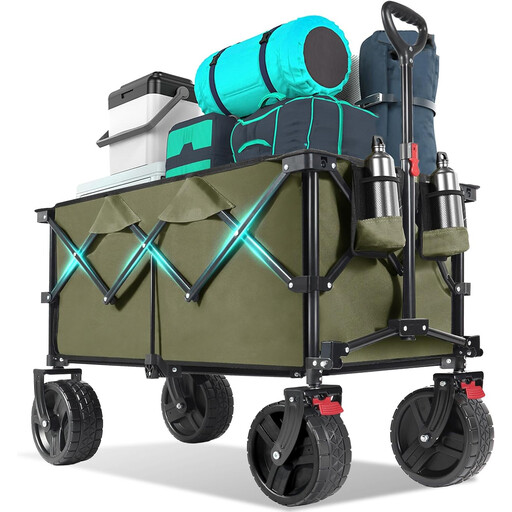
The Long-Hauler: For camping or festivals, volume is king. With 200 L of space and a 200 kg capacity, it can swallow a tent, sleeping bags, a cooler, and chairs in a single trip.
It directly tackles the pitfall of unsuitable wheels. Its extra-wide 7-inch all-terrain tires are designed to roll over mud and grass without getting bogged down.
Its XXL capacity (200 kg / 200 L) and patented four-way folding mechanism make it an ally that's as high-performing in the field as it is easy to store in a car trunk.
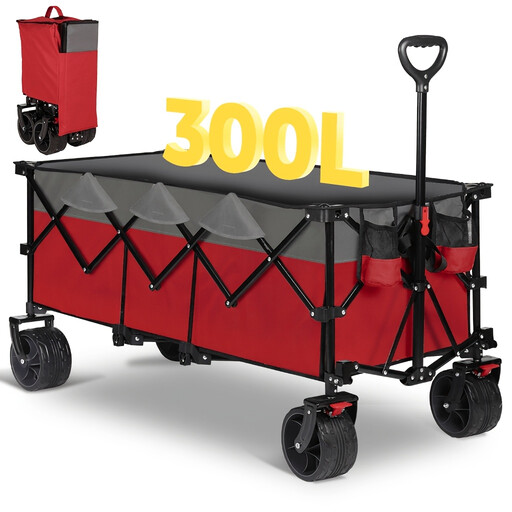
The Workhorse: Perfect as a foldable garden wagon, it combines a 200 kg payload with an impressive 300 L volume and an extendable length. Ideal for transporting bags of soil, long tools, wood, or green waste.
It avoids the fragile frame pitfall with a sturdy structure certified for 200 kg and a 600D Oxford fabric designed to withstand heavy loads and sharp objects.
Its 300 L volume and extendable design allow it to transport items that standard wagons simply cannot accommodate.
Explore our full selection of products that meet our quality criteria and current safety standards.
Load capacity (kg) is the maximum weight the wagon can safely support. Volume (L) corresponds to the internal storage space. For dense, heavy items (bottles, books), prioritize load capacity. For lightweight but bulky items (beach gear, comforters), volume is the key factor.
After each use, especially outdoors, clean the wheels to remove mud or sand. A wipe with a damp cloth is usually enough for the fabric. Make sure the wagon is completely dry before folding it for storage—this will prevent rust on the frame and mildew on the fabric.
If you only plan to use your wagon on hard, smooth surfaces (pavements, car parks), standard wheels may be sufficient. However, for any use on grass, sand, gravel, or dirt paths, large all-terrain wheels are more than recommended—they are essential. They provide better grip, greater stability, and require far less effort to pull.