
Livraison le jour même ou le lendemain

Qualité garantie

Débloquez vos offres de bienvenue: Livraison GRATUITE | Jusqu'à -80 % | 30 jours d'essai gratuits à JoyPlus
Téléchargez l'application
Family picnics, beach days, gardening sessions, or grocery runs?: the foldable utility wagon has become the essential accessory for making life easier. It's practical, saves us from heavy loads, and knows how to stay out of the way once stored. But be warned, the market is flooded with models making tempting promises that often hide critical flaws. One bad choice, and your helpful ally quickly turns into a burden.
As a product recommendation expert at Joybuy, my mission is to help you see things more clearly. Together, let's break down the pitfalls to avoid and the criteria that truly matter, so you can choose a wagon that will last, without failing you at the first hurdle.
Before being swayed by an attractive colour or price, it's crucial to understand the structural weaknesses that plague many low-end models.
To avoid these disappointments, it's better to focus on objective technical specifications. They are the true guarantors of your future wagon's quality and longevity.
Don't just rely on the displayed maximum weight. Look into the frame's material?: a chassis made of alloy steel or high-carbon steel will offer much better resistance to twisting than simple "metal". For the fabric, 600D Oxford fabric is a safe bet, known for its durability and tear resistance. A large volume in litres is great, but only if the structure can support the corresponding heavy load without buckling.
This is THE non-negotiable point for outdoor use. Opt for large, wide wheels (typically 18?cm / 7?inches or more), preferably made of PVC or TPR, materials that better absorb shocks. These all-terrain wheels are key to crossing sand, grass, and small obstacles without straining. The presence of ball bearings ensures a smooth and quiet rotation, while brakes on at least two wheels are a real plus for safety, especially for securing the wagon on a slope.
A good foldable wagon should fold and unfold in seconds, ideally with one hand. Central folding systems (where you pull a tab in the middle of the bin) are often the most effective. Once folded, the wagon should be compact enough to slip into a car trunk or a closet without having to remove the wheels.
To illustrate these criteria in practice, here is a selection of models suited for different needs.
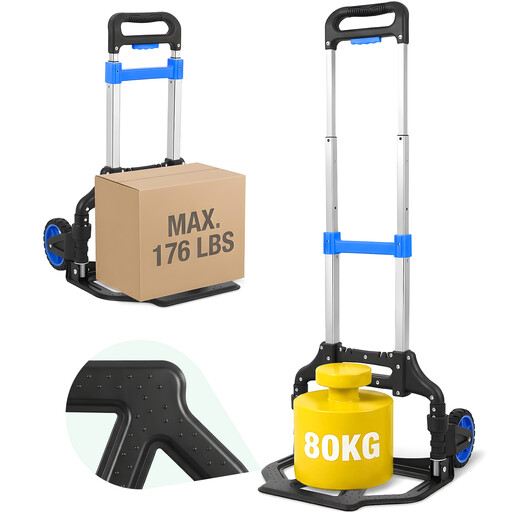
Why this model : Perfect for carrying water packs, parcels, or crates in the city. Its "hand truck" format is much more agile in tight spaces (public transport, elevators) than a classic wagon-style cart.
Its secret? A minimal footprint. At just 5.7 cm thick when folded and with a feather-light weight of 3.5 kg, it fits anywhere and is never a burden, even when empty.
Its instant folding and 3-level adjustable telescopic handle offer impressive ergonomics and everyday convenience.
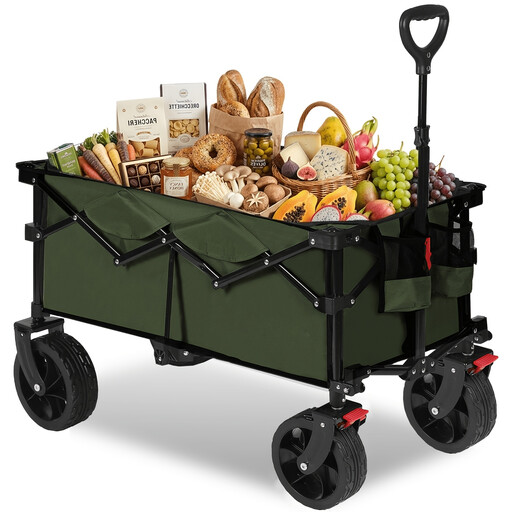
Why this model : This is the ultimate all-purpose wagon. Spacious enough for beach gear, garden tools, or picnic supplies, it offers an excellent balance between capacity and manoeuvrability.
Its answer to the unsuitable wheel problem. Its wide 7-inch (18 cm) tyres allow it to roll over grass and compact sand without getting stuck, where standard models would give up.
Its design exudes durability : a welded high-carbon steel frame and 600D Oxford fabric handle the advertised 150 kg load with ease.
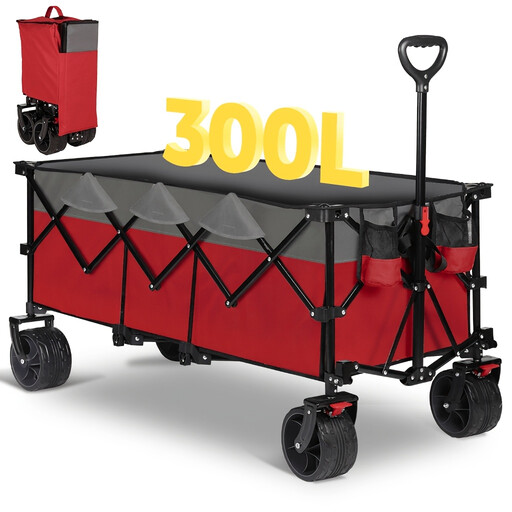
Why this model : When volume is THE priority. Ideal for transporting a tent, chairs, a cooler, and camping gear in a single trip, or for major gardening tasks.
No more unkept promises about load capacity. With a true 200 kg capacity and a 300 L volume, its structure is designed to handle very heavy and bulky items without ever buckling.
Its length of over 1.2 m allows for transporting long items that are impossible to fit in a standard wagon. Its wide wheels with brakes ensure perfect stability and control, even at full capacity.
We have selected a full range of products that meet our quality criteria and current safety standards.
The utility wagon, often just called a wagon, has four wheels and a fabric bin. It's designed to carry a multitude of loose items (bags, toys, camping gear). The foldable hand truck has two wheels and a small platform. It is better suited for transporting stackable, boxy items like cartons, crates, or luggage. The choice, therefore, depends on what you transport most often.
Maintenance is simple but crucial. After a trip to the beach or garden, it's essential to clean the wheels to remove sand and dirt that could jam the bearings. A damp cloth on the frame and fabric, and you're done. Just make sure everything is completely dry before folding it up and storing it away from moisture to prevent rust and mildew.
If you only use it on hard, smooth surfaces (pavements, car parks, asphalt), standard wheels can do the job. However, as soon as you venture onto grass, sand, gravel, or a dirt path, wide, all-terrain wheels become non-negotiable. They distribute the weight better, prevent the wagon from sinking, and drastically reduce the pulling effort. For versatile use, it's a more than wise investment.