
Livraison le jour même ou le lendemain

Qualité garantie

Débloquez vos offres de bienvenue: Livraison GRATUITE | Jusqu'à -80 % | 30 jours d'essai gratuits à JoyPlus
Téléchargez l'application
Hauling groceries from the supermarket, lugging a tent to the far end of a festival, or simply moving a few boxes without breaking your back: the foldable utility cart has become an indispensable tool in our daily lives. The problem? The market is flooded with models making tempting promises that often fall short. Make the wrong choice, and your super-ally turns into a bulky, useless gadget collecting dust in the garage.
Our editorial team has analysed the market to help you avoid the pitfalls and identify the criteria that really matter. Follow this guide to find the cart that's perfectly suited to your needs, not to marketing hype.
A poor-quality cart is worse than useless: it's a source of constant frustration. Here are the three critical design flaws that turn a good idea into a bad investment.
To avoid these disappointments, forget the marketing and focus on objective technical specifications. These, and only these, guarantee the quality and longevity of your future cart.
Beyond the maximum heavy load figure, the real question is about your actual needs and the usable volume.
The terrain dictates the choice of wheels. This is non-negotiable.
Durability and everyday convenience are decided here.
To illustrate these criteria in practice, here are three models that caught our attention, each excelling in a specific category.
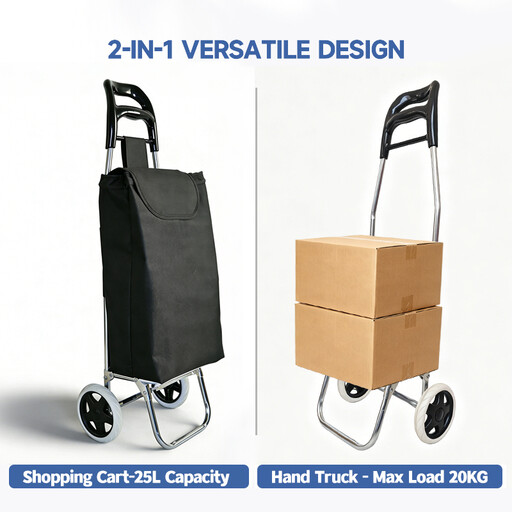
Our Editor's Verdict: Specifically designed as a modern shopping trolley, it focuses entirely on comfort for trips to the supermarket. Its vertical structure is perfect for grocery bags, and its manoeuvrability makes it a valuable ally for everyone, including seniors.
Its wheels are perfectly calibrated for city use (pavements, shops) and its ergonomic handle prevents fatigue, whereas basic handles dig into your hands over time.
A robust design and good volume for groceries, while remaining a lightweight that's easy to manoeuvre and store.
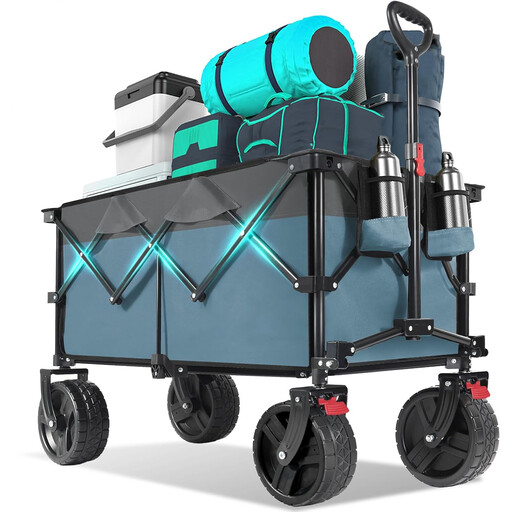
Our Editor's Verdict: This is the road-trip companion for those who need to transport everything (tent, chairs, cooler...) over tricky terrain. Its "wagon" style structure offers XXL volume and rock-solid stability for mixed loads.
It tackles the #1 problem: the wheels. Its huge all-terrain wide wheels (7-inch) are designed to "float" over soft ground and clear obstacles effortlessly, where a classic cart would get stuck.
The numbers speak for themselves: 200 kg load capacity and 200 L volume. Its steel frame and waterproof 600D Oxford fabric are built for adventure.
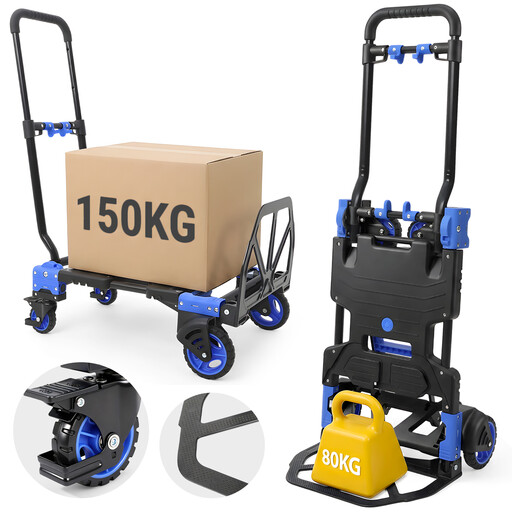
Our Editor's Verdict: Its versatility is its greatest asset. In seconds, it converts from a foldable hand truck (perfect for boxes or appliances) to a platform cart (for wider items). It's a true pro-grade tool for home use.
No more fear of a bending frame. Its structure of reinforced aluminium is designed to handle a heavy load (up to 150 kg in platform mode) without flinching. Its folding mechanism is built to be used dozens of times without failing.
Its 2-in-1 design, its quiet, shock-absorbing TPR rubber wheels, and its parking brake to secure loads on slopes.
Our complete selection includes dozens of models that have all successfully passed our tests for durability and practicality.
Q1: How do I maintain my cart to make it last? After a trip through muddy or sandy terrain, a simple rinse with a hose or a wipe-down of the wheels with a damp cloth is enough to remove debris. This prevents dirt from seizing the axles. Also, remember to check that the screws are tight from time to time. That's the secret to keeping it for years!
Q2: Foldable hand truck or garden wagon, what's the difference? A foldable hand truck is vertical. It's unbeatable for transporting tall, stacked items like boxes, crates, or drink packs. A garden wagon (or festival cart) is shaped like a wagon. It's designed to carry a large volume of loose items (bags, tools, camping gear) over difficult terrain.
Q3: Is an 80 kg capacity enough for everyday use? Yes, easily! For groceries, luggage, or a few boxes, 80 kg provides an excellent safety margin. However, for a full house move or for transporting heavy materials (bags of cement, tiles), it's better to opt for a heavy-duty model that can handle 150 kg or more.