
Livraison le jour même ou le lendemain

Qualité garantie

Débloquez vos offres de bienvenue: Livraison GRATUITE | Jusqu'à -80 % | 30 jours d'essai gratuits à JoyPlus
Téléchargez l'application
A foldable trolley can make transporting your shopping, parcels, boxes or gardening equipment much easier. But you need to choose the right model. A compact design intended for everyday shopping won't behave the same way as a foldable hand truck designed for moving heavy loads over uneven ground.
So before you place an order, it's worth looking beyond the price and the marketing promises. Here are the criteria to examine when comparing models available in the UK, so you can avoid any nasty surprises.
A maximum load expressed in kilograms doesn't tell you whether the trolley can actually accommodate bulky items. A model advertised at 150 kg might be suitable for transporting boxes or crates, but its platform, wheels and centre of gravity also need to be suited to what you plan to carry.
Conversely, a foldable shopping trolley with a large bag can hold plenty of lightweight items without being designed for heavy materials. Check each of the following separately:
Three wheels, four wheels or two large wheels don't serve the same purposes. Small swivel wheels are handy in a shop or corridor, whereas wider wheels will cope better with gravel, grass or door thresholds.
For a hand truck with all-terrain wheels, look at their diameter, the material they're made from and whether there's a brake. A parking brake can be useful on a slope, but it doesn't replace careful handling or a properly balanced load.
The word "foldable" doesn't guarantee practical storage. Some models remain relatively thick once folded, while others require you to remove the bag or the wheels. Measure the space available in your boot, cellar or cupboard.
The mechanism also needs to be simple to lock. A trolley that's awkward to unfold will probably end up at the back of a cupboard, even if its features look good on paper.
For shopping, small parcels or bottles, a capacity of 35 to 80 kg may be enough, depending on the weight you actually carry. For DIY, moving house or gardening, models of 120 kg or 150 kg give you more leeway, as long as you respect the limit specified for each configuration.
An aluminium frame makes the trolley lighter and easier to move. A lightweight aluminium trolley should, however, be examined carefully on the following points:
On a 2-in-1 trolley, the maximum load can vary between hand truck mode and platform mode. Always check the manufacturer's instructions for each position.
Wheels made of TPR, PVC or another material should be assessed based on the surface you'll be using the trolley on. Bearings can improve the smoothness of movement, but manoeuvrability also depends on the width of the axle and the weight of the load.
An adjustable handle allows the height to be adapted for different users, particularly in the case of a shopping trolley for elderly people. This feature is only genuinely useful if the handle locks properly and offers a grip that doesn't slip.
A coated fabric bag protects your shopping from light splashes and can generally be cleaned with a damp cloth. For rigid loads, a non-slip platform with straps will often be more practical. Models used outdoors should be dried before being stored to limit wear on the textiles and metal parts.
Compliance information, the identity of the manufacturer or the responsible person in the European Union, and the usage instructions should all be available on the product page. They don't replace carefully reading the load limits and assembly precautions.
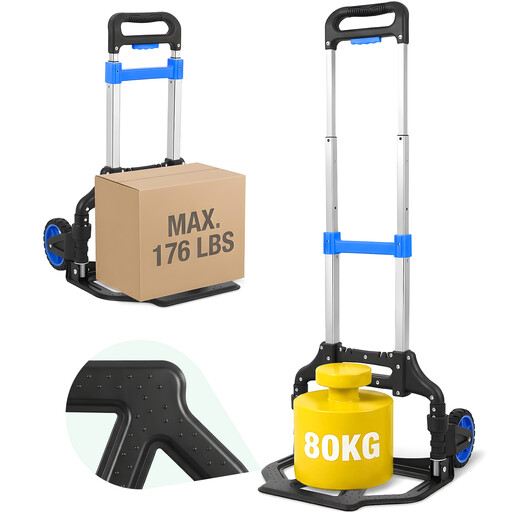
Why this choice suits this profile: With a net weight of 3.5 kg, an advertised load of 80 kg and quick folding, this model is suitable for carrying shopping, parcels and crates of drinks when storage space is limited.
Once folded, it measures just 5.7 cm thick, making it easy to check whether it will fit in a cupboard or boot.
Aluminium frame, handle adjustable to three heights, TPR wheels with double bearings and integrated brake.
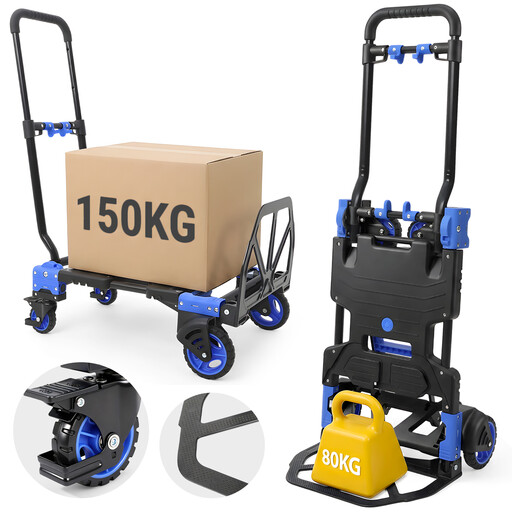
Why this choice suits this profile: Its ability to convert between a hand truck and a platform trolley means you can switch from moving boxes to carrying flat loads without needing multiple pieces of equipment.
The capacities are distinguished by mode: 80 kg in hand truck position and 150 kg in platform position. This precision avoids any misinterpretation.
Aluminium frame, adjustable handle, TPR wheels with double bearings, parking brake and one-handed folding.
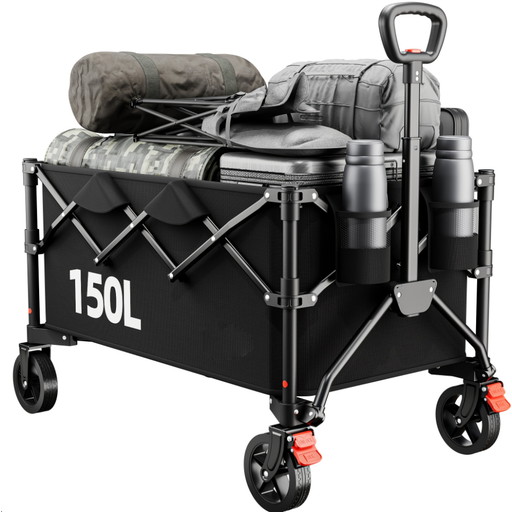
Why this choice suits this profile: Its 150 l bag, steel alloy chassis and all-terrain wheels are built for camping, gardening and moving across various surfaces.
The 120 kg load and 150 l volume are stated separately. This means you can compare them against your own needs rather than relying on a single claim.
600D Oxford fabric bag with PE coating, folds on four sides, wheels with brakes and removable parts for easy cleaning.
We've put together a comprehensive list, updated in real time, of products that meet these demanding selection criteria and European safety regulations.
For regular shopping, go for a lightweight model with a closed bag, an adjustable handle and wheels suited to pavements. Above all, check the maximum load actually allowed and the usable volume. A bag of 35 to 60 l may be enough for everyday purchases, while a larger model will also be more cumbersome on public transport or on stairs.
After each use, remove any debris caught around the wheels and joints. Clean the frame with a slightly damp cloth, then dry it before folding it away. If the trolley has a bag, follow the removal instructions and avoid storing it while still damp. Also remember to check the screws, straps and locking mechanism before transporting a load.
It all depends on the weight carried, how often you use it, the terrain and the storage conditions. Respecting the maximum load, avoiding repeated knocks against kerbs and regularly cleaning the wheels all help to preserve the mechanism. For heavy-duty use, choose a reinforced structure, accessible joints and parts that the seller clearly states can be replaced.