
Livraison le jour même ou le lendemain

Qualité garantie

Débloquez vos offres de bienvenue: Livraison GRATUITE | Jusqu'à -80 % | 30 jours d'essai gratuits à JoyPlus
Téléchargez l'application
A foldable trolley promises a simpler life, whether you're carrying groceries, gardening supplies, or beach gear. The reality is often less rosy: many models end up gathering dust in the garage after just a few uses. A chassis that bends, wheels that jam on the first bit of gravel, or a folding mechanism that becomes a nightmare—disappointments are common.
To ensure your investment doesn't turn into a regret, let's review the pitfalls to avoid.
To avoid falling into these traps, it's crucial to focus on objective technical specifications that go far beyond marketing claims.
Forget about the colour and don't rely solely on the price. Three fundamental parameters determine the true utility and lifespan of your future trolley.
Load capacity is the maximum weight the trolley can theoretically support. But be warned, the actual durability of the chassis is an equally decisive criterion. A heavy-duty trolley must have a solid frame, typically made of alloy steel or reinforced aluminium, to ensure it won't deform under weight. For intensive use with heavy items (logs, bags of soil, concrete blocks…), opt for structures with square-section tubes and check the quality of the welds. Finally, the volume, expressed in litres (L), will give you a clear idea of the loading space.
The choice of wheels should be dictated by your primary use.
The key advantage of a foldable trolley is, of course, its small footprint when stored. Check its folded dimensions carefully to ensure it will fit in your car boot or cupboard. The cleverest systems allow for one-handed folding, often by pulling a central tab. Make sure the mechanism is not only simple but also well-protected from dirt to prevent it from jamming.
To help you make an informed decision, our editorial team has selected a few models that meet specific needs while respecting our criteria for durability and practicality.
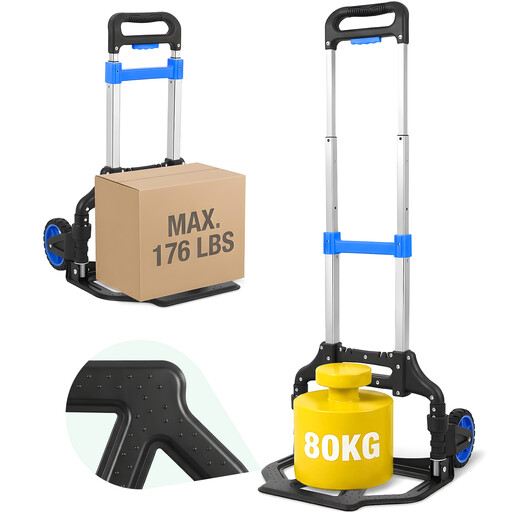
Why it stands out: Perfect for transporting water packs, parcels, or a few crates in the city. Its hand truck design is optimised for concentrated loads, and its feather-light weight (3.5 kg) makes it easy to handle on public transport or stairs.
Its instant folding and record-breaking 5.7 cm thickness when folded solve the problem of storage space. The aluminium frame combines lightness with durability for loads up to 80 kg, without risk of bending.
Ultra-compact and lightweight: it slips behind a door or into a small car boot. Its 3-level adjustable telescopic handle adapts to all heights for optimal comfort.
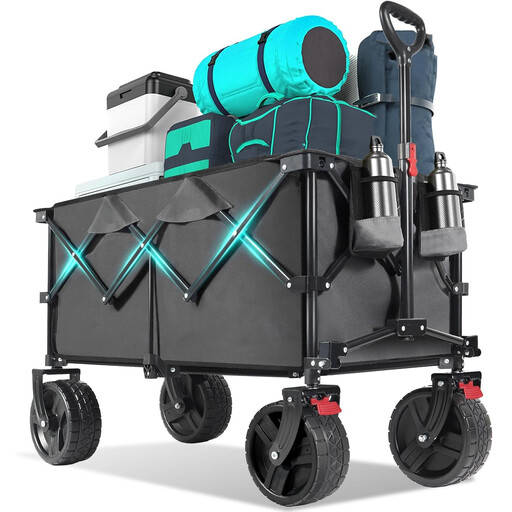
Why it stands out: This is the ideal companion for transporting camping gear, gardening tools, or supplies for a family picnic. Its generous 200 L capacity and 200 kg payload allow you to carry everything in a single trip.
Its extra-wide wheels are specifically designed not to sink into grass or sand, thus avoiding the trap of unsuitable wheels. Its alloy steel frame handles heavy loads without flinching.
Capacity and versatility: its XXL 200 L volume and all-terrain wheels make it the perfect partner for all your outdoor adventures. The 600D Oxford fabric is both durable and waterproof.
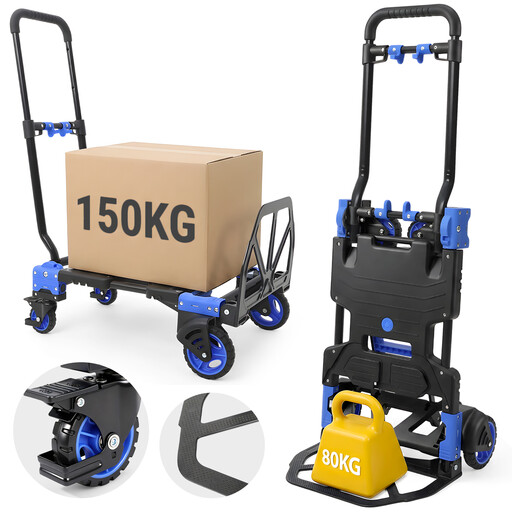
Why it stands out: Its 2-in-1 design makes it ultra-versatile. Use it in hand truck mode for boxes (up to 80 kg), or switch it to platform cart mode for bulkier items (up to 150 kg). A valuable asset for moving house or for DIY projects.
It saves you from investing in two separate pieces of equipment. Its reinforced, rust-proof aluminium frame ensures excellent durability, even under heavy loads where low-end models would bend.
2-in-1 versatility: it switches from hand truck to platform mode in seconds. Its dual-bearing TPR wheels are quiet, won't damage floors, and feature a parking brake for added safety.
We have compiled a complete selection of products that meet our strict selection criteria and current safety standards.
A foldable wagon, often called a "cart," has four wheels and a fabric bin. It's perfect for transporting various loose items (beach gear, garden tools, groceries). In contrast, a folding hand truck is a two-wheeled vertical trolley with a small platform. It's optimised for moving stable, stacked loads like boxes, crates, or appliances. The choice, therefore, depends on the nature of the items you transport most often.
Maintenance is simple but crucial. After each use, especially at the beach or in the garden, clean the wheels thoroughly to remove sand, dirt, or debris that could jam the bearings. A damp cloth is sufficient for the frame and fabric. Finally, make sure the trolley is completely dry before folding and storing it away from moisture to prevent rust.
If your usual terrain is limited to hard, smooth surfaces (pavements, car parks, shopping centres), standard wheels will do the job. However, as soon as you venture onto grass, sand, gravel, or a dirt path, a trolley with large wheels becomes non-negotiable. It distributes the weight much better, prevents sinking, and significantly reduces the effort required to pull it.