
Livraison le jour même ou le lendemain

Qualité garantie

Débloquez vos offres de bienvenue: Livraison GRATUITE | Jusqu'à -80 % | 30 jours d'essai gratuits à JoyPlus
Téléchargez l'application
Whether you're bringing home groceries, moving gardening equipment, packing for a day at the beach, or even simplifying a house move, a foldable trolley promises to be the perfect companion. However, the wrong choice can quickly turn that promise into a real headache. A wheel that jams, a frame that bends under a moderate load... these disappointments are often the result of well-honed marketing traps.
As a product specialist at Joybuy, my mission is to help you see things more clearly. Let's forget the marketing jargon and focus on the facts. Here are the two most common mistakes to avoid and the objective criteria for choosing a trolley that will truly go the distance.
Trap #1: Overstated Load Capacity. Many manufacturers advertise a maximum load capacity (e.g., 150?kg) that, in reality, only applies to a static weight, perfectly distributed on a flat surface. In real-world conditions (a dirt path, an unbalanced load), the actual dynamic capacity plummets.
Trap #2: "All-Terrain" Wheels That Aren't. The term "all-terrain" is often misused, referring to simple hard plastic wheels that are barely wider than standard ones. The result: on sand, mud, or wet grass, they sink and get stuck, rendering the trolley useless.
To make the right choice, three technical specifications must be scrutinised. These are what determine the real-world performance and durability of your trolley.
It's crucial not to confuse volume with load capacity. A 200?Lfolding trolley might offer generous space, but if its frame is flimsy, it will buckle under a heavy 150?kg load.
The type of wheels defines where you can actually use your trolley.
Ease of folding should never come at the expense of sturdiness. A good mechanism is simple to operate, locks securely in the open position, and doesn't weaken the structure. As for the frame, it should be made of alloy steel for maximum robustness, or high-grade aluminium for the best weight-to-strength ratio.
To illustrate these criteria in practice, here are three models that caught our eye, each suited for a specific use case.
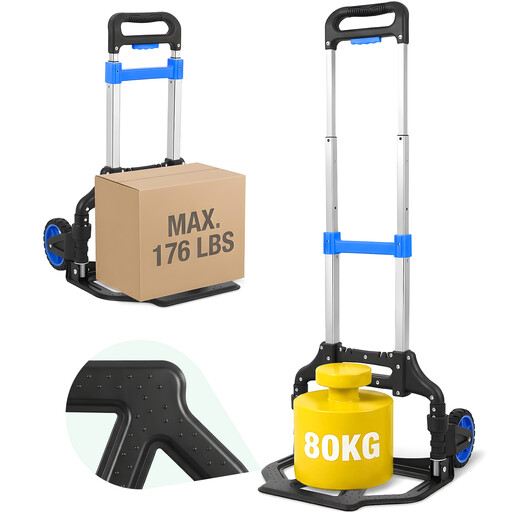
Why we chose it: This folding hand truck is tailor-made for city life. Ultralight (3.5 kg) and ultra-compact (5.7 cm thick when folded), it slips into a cupboard or car boot. It's perfect for carrying water bottle packs, parcels, or the weekly shop.
Its 80 kg capacity is consistent with its aluminium frame and intended use on flat ground. It doesn't over-promise on its capabilities, focusing instead on compactness and low weight.
Its instant-fold mechanism and 3-level adjustable telescopic handle provide optimal comfort, regardless of your height.
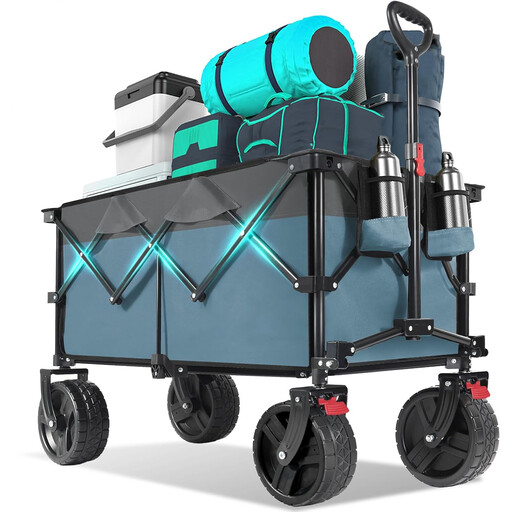
Why we chose it: This wagon-style trolley is built for outdoor adventures. Its large 200 L volume and 200 kg capacity allow you to effortlessly transport camping gear, beach toys, or festival supplies. It also makes an excellent folding garden cart for larger properties.
It tackles the trap of inadequate wheels head-on. Its extra-wide 7-inch (approx. 18 cm) tyres are designed not to sink into sand or mud, ensuring true versatility.
The winning trio: a large volume (200 L), high payload (200 kg), and genuine all-terrain wheels. All this, and it folds without any tools.
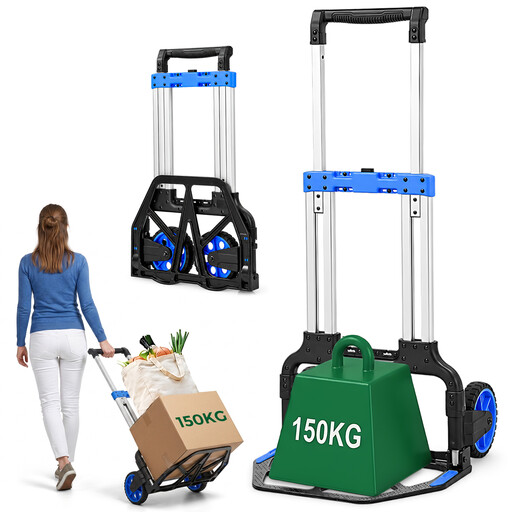
Why we chose it: This materials handling trolley is a quiet powerhouse, built for performance. With its 150 kg capacity and reinforced aluminium structure, it's perfect for house moves, construction sites, or transporting heavy materials (cement bags, toolboxes...).
Here, the load capacity isn't a marketing gimmick: it's guaranteed by thick reinforcements and bolted connection points for foolproof sturdiness.
Its large TPR wheels, mounted on ball bearings, are not only more durable but also 30% quieter than conventional wheels, even on uneven ground.
Discover our full selection of products that meet our demanding standards for quality and safety.
It all depends on what you're transporting.
A little maintenance goes a long way in extending their lifespan. After each use on sand, dirt, or mud, clean the wheels with a brush or a jet of water to remove debris. Check that nothing is stuck in the axle or bearings. Before storing it, make sure the trolley is completely dry to prevent rust on any metal parts.
Both are important, but they address different needs. The payload (in kg) is the number one safety criterion: it guarantees that the frame and wheels will support the weight. The volume (in L) tells you about the available space. A trolley with a large volume but a low payload will be no help for transporting heavy items. First, assess the maximum weight you'll need to carry, then choose a volume that suits the size of your items.