
Livraison le jour même ou le lendemain

Qualité garantie

Débloquez vos offres de bienvenue: Livraison GRATUITE | Jusqu'à -80 % | 30 jours d'essai gratuits à JoyPlus
Téléchargez l'application
Balancing a fitness routine with a busy schedule, especially in an apartment, can feel like an uphill battle. The foldable treadmill seems like the perfect solution. However, the market is saturated with marketing promises that too often lead to buyer's remorse. A model advertised as "compact" can be impossible to store, and a "silent" motor can quickly become a source of conflict with your neighbours.
As the Head of Product Recommendations at Joybuy, my mission is to bring you clarity. This guide breaks down the most common pitfalls and gives you the keys to choosing a model that truly fits your needs and your home.
Before you fall for a tempting product page, it's crucial to read between the lines and spot the hidden flaws.
To avoid these traps, there's nothing better than relying on objective technical specifications.
Don't just trust the marketing photos. Always check three key measurements:
The motor's power, expressed in horsepower (CV or HP), guarantees the device's smoothness and longevity.
A smart treadmill is a real plus for staying motivated. Compatibility with apps like Zwift or Kinomap transforms a potentially monotonous session into an immersive virtual race. An incline feature, even a manual one, is also a significant advantage: it allows you to intensify your workout and engage different muscles without having to increase your speed.
Because every user is unique, here is our selection of models that meet specific needs, all while avoiding the pitfalls we've just discussed.
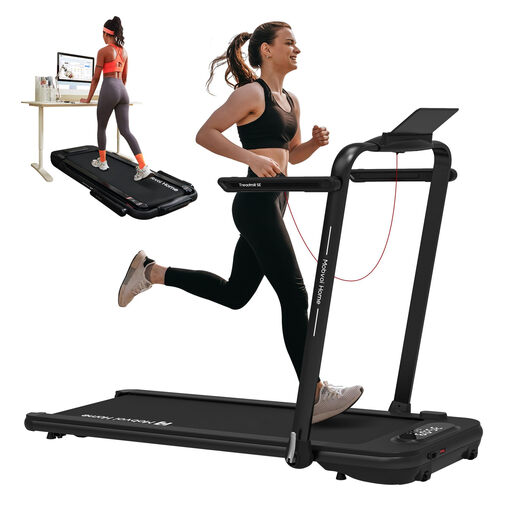
Editor's Pick: Perfect for integrating physical activity into a remote workday. Its 'walk' mode (up to 6 km/h) allows it to be used under a standing desk, while its run mode (up to 12 km/h) is suitable for more intense workouts.
With a folded height of just 13 cm, it genuinely slides under furniture. Goodbye to the 'not-so-foldable' trap that clutters up the living room.
Its 3-in-1 versatility (walk, desk, run) and coaching via the TicSports app for personalised tracking.
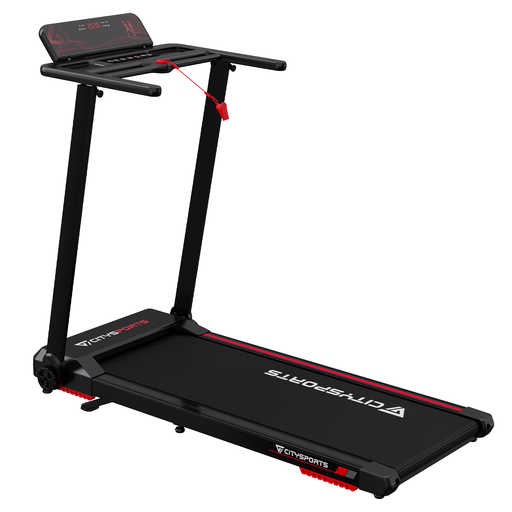
Editor's Pick: Designed for those who want a complete workout (walking, jogging, running) without sacrificing their living space. Its speed of up to 12 km/h and manual incline allow for varied session intensity.
Its motor is rated at under 45 dB, a quantified figure that directly addresses the pitfall of 'deceptively silent' motors.
Its manual incline (0% and 8%) for a more demanding workout and its 1400W motor, which is both powerful and discreet.
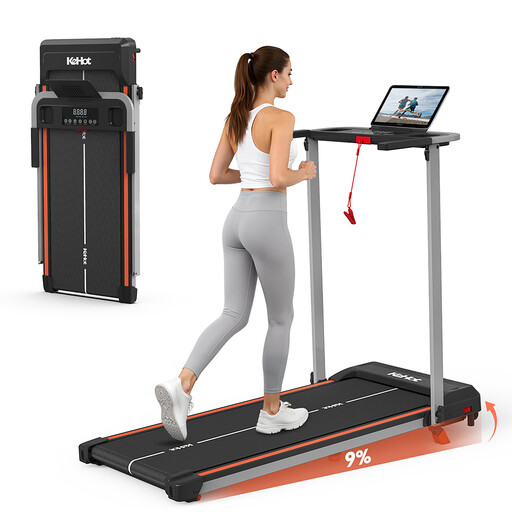
Editor's Pick: An accessible option for getting started with at-home fitness without breaking the bank. It offers a surprisingly comprehensive feature set for its price, with speeds up to 12 km/h, an incline, and connectivity with fitness apps.
It offers a running surface of 38 x 100 cm. This is a decent size for walking and light jogging, avoiding the trap of overly narrow and unsafe running belts.
Excellent value for money, with a 9% incline and compatibility with the Zwift and Kinomap apps.
We have compiled a complete and up-to-date selection of products that meet our strict selection criteria and current safety standards.
Stability depends on the frame's sturdiness and the maximum supported weight. For running, opt for a model with a solid steel frame and a weight capacity of at least 110-120?kg. Lighter models, often simple walking pads, may lack stability at high speeds.
A noise level below 65 decibels (dB) at walking speed is generally considered discreet. For running, the impact noise from your footsteps will inevitably be louder than the motor. Using a suitable floor mat is a good way to absorb some of the vibrations and noise.
Maintenance is simple but essential for your device's lifespan. It mainly involves: