
Same-day & Next-day Delivery

Quality Guaranteed

Unlock Your Welcome Offers: FREE Delivery | Up to 80% OFF | Free 30-day JoyPlus trial
Download the APP
Shopping, parcels, camping gear or gardening tools: a foldable transport trolley can make moving things around much easier, provided you choose a model suited to the load and the terrain. Price alone isn't enough to separate the different products. Stated volume, maximum weight, wheels and folding mechanism all need to be considered together.
A 200-litre trolley might look ideal for heavy-duty use, but that doesn't mean it can carry 200 kg. Some models have a large basket yet a much more limited maximum load. Always check these two details separately:
Weight also needs to be spread across the bottom of the basket. A load concentrated on one side can destabilise the trolley and accelerate wheel wear.
A trolley fitted with all-terrain wheels won't behave the same way on a pavement, damp grass, gravel or sand. Wide 7-inch wheels will generally handle bumps better than a small set of wheels designed mainly for shop aisles.
For outdoor use, look closely at:
A bulky trolley is likely to end up in the cupboard if it doesn't fit in the boot or the house. The folding mechanism should be simple enough to operate without tools, while the handle needs to remain comfortable at the user's height.
For a shopping trolley for seniors, an adjustable handle, good stability and a reasonable weight can matter more than a very high capacity. However, the term "ergonomic" doesn't replace concrete details: check the height, the empty weight and the type of handle on the product page.
For everyday shopping, a foldable shopping trolley with a medium capacity can be perfectly adequate. A model stated as 56 L will suit shopping trips and occasional outings better than carrying bags of compost or heavy crates.
For more demanding uses, compare the stated loads directly:
An aluminium transport trolley often appeals thanks to its lighter weight and resistance to corrosion. A lacquered steel frame, on the other hand, may be better suited to heavy loads, but it will generally be heavier. Material alone isn't enough to judge durability: also check the quality of the joints, wheels and folding mechanism.
A telescopic or adjustable handle stops you from pulling the trolley in an awkward position. For a two-in-one model, check the maximum loads for each configuration, both in sack truck mode and platform mode. A parking brake is handy on a ramp, but it doesn't turn the trolley into a restraint system suitable for steep slopes.
Swivel wheels make changing direction easier on a smooth surface. For the beach, grassy paths or soft ground, wide wheels are generally more suitable. However, no model lets you ignore the maximum load or neglect keeping the wheels clean.
A quick-folding mechanism is especially useful in a flat, cellar or car boot. Before ordering, check:
After use on sand, mud or damp grass, remove any debris and dry the trolley before folding it. This simple step helps protect the joints, fabric and wheels.
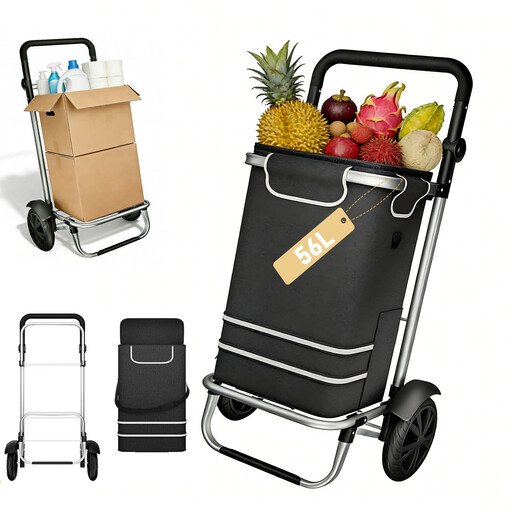
Why this choice suits this profile: Its compact size is ideal for shopping, picnics and short trips. It offers a stated capacity of 56 L and several wheel configurations.
The capacity in litres is clearly stated, which avoids confusing the available volume for shopping with the maximum load.
Portable format, stated folding design and combination of backpack and trolley.
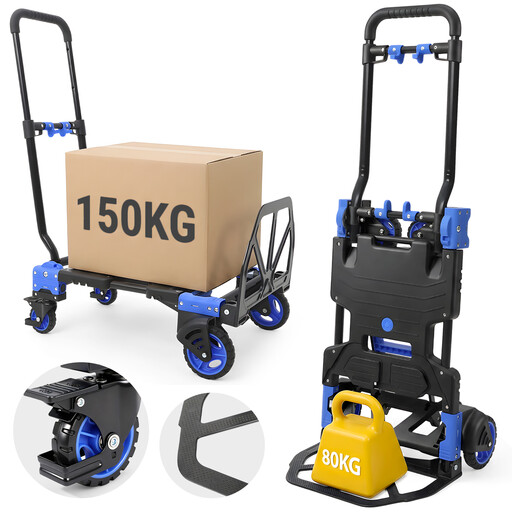
Why this choice suits this profile: Its conversion into a sack truck or platform is ideal for small moves, storage and regular parcel transport.
The loads are differentiated by mode: 80 kg in sack truck mode and 150 kg in platform mode. This clarity avoids any guesswork.
Aluminium frame, dual-bearing TPR wheels, brake and adjustable handle.
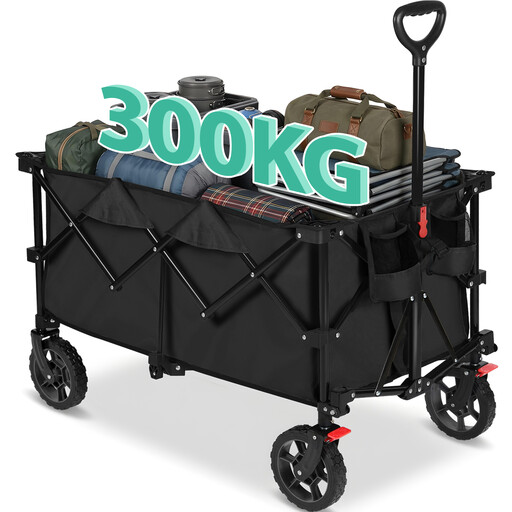
Why this choice suits this profile: Its large volume is designed for camping, gardening and transporting bulky equipment on different types of ground.
The product page clearly distinguishes the 200 L volume from the stated maximum load of 300 kg. The trolley must be unfolded and used on ground compatible with this load.
Lacquered steel frame, adjustable handle, swivel wheels and one-hand folding stated.
We've put together a complete, real-time updated selection of products that meet these demanding criteria and European safety standards.
A folding trailer is generally designed to be towed behind a bike or other compatible equipment. A handled trolley is pulled or pushed by hand and is easier to store at home. For everyday shopping, a compact model is often enough. For gardening or camping gear, a wagon with wide wheels will be more suitable.
For trips between home and the shop, go for a lightweight, compact model with a comfortable handle and a clearly stated volume. A 56 L shopping trolley can work when loads are moderate. For carrying heavy packs or tackling stairs, a foldable sack truck is often more practical.
It depends on the weight actually carried, how often you use it, the terrain and how well you maintain it. Sticking to the stated maximum load, cleaning the wheels and drying the fabric before storing the trolley reduces stress on the frame and joints.
No. These figures correspond to the stated specifications for certain models and don't replace the usage instructions. The trolley's weight, its folded dimensions, the wheel width and ease of manoeuvring all need to suit your environment and your pulling strength.