
Livraison le jour même ou le lendemain

Qualité garantie

Débloquez vos offres de bienvenue: Livraison GRATUITE | Jusqu'à -80 % | 30 jours d'essai gratuits à JoyPlus
Téléchargez l'application
A well-organised home depends on more than the number of cupboards available. In a student bedroom, a small flat or a family home, foldable storage boxes help you make the most of shelves, wardrobes, under-bed space and awkward corners. The key is choosing a model suited to the intended use.
Before placing your order, check the dimensions, structural rigidity and quality of the closure. An attractive price can conceal a box that collapses, an impractical lid or a stated capacity with no clear indication of the supported load.
An 84-litre storage box may appear spacious on paper. However, its shape may not suit a narrow shelf or a low under-bed space. Volume alone is therefore not enough to assess its usefulness: also measure the length, width and height you actually have available.
For bulky clothing, a large-capacity storage box may be the right choice. For small accessories, toys or folded laundry, several more compact containers often make sorting easier and provide quicker access to the contents.
Fabric storage boxes are lightweight and fold away easily when not in use. However, a structure that is too flexible may lose its shape once the box is filled. Check for a rigid base, cardboard panels or an equivalent form of reinforcement.
A box intended for an open shelf does not require the same level of rigidity as a container stacked inside a cupboard. The manufacturer’s stated maximum load remains an important specification to review before buying.
A zipped closure protects textiles from dust, but it must remain easy to access once the box is in place. Under a bed, a front handle or castors can make handling much easier. In a high cupboard, side handles simplify lowering the container.
Also be wary of photos that do not clearly show the opening, stitching or handles. A storage box with a lid should be selected according to how often you will use its contents—not solely for its appearance.
Start by measuring the available space, leaving a few centimetres so you can remove the box without difficulty. For under-bed storage, measure the height between the floor and the bed frame, taking any potential irregularities into account.
Non-woven fabric is widely used for textile storage boxes. It can be reinforced with cardboard to help maintain the shape of the walls. Where the information is available, check the fabric density as well as the maximum static load supported by each box.
A stated load of 3 or 5 kg does not mean that the container is designed for very heavy items. These figures generally refer to a stationary load distributed evenly throughout the box. For books or files, stackable storage boxes must be sufficiently rigid and should not be overloaded.
A zip running along several sides allows the top to open wide, which is particularly useful for stacks of laundry. Sewn-in or integrated handles should be positioned according to the intended use: a front handle for pulling the box from a shelf, and side handles for carrying it.
For care instructions, refer to the manufacturer’s recommendations. Some fabric models can only be cleaned with a slightly damp cloth and must be left to air-dry. If the box has a manufacturing odour, leave it to air out before storing textiles inside.
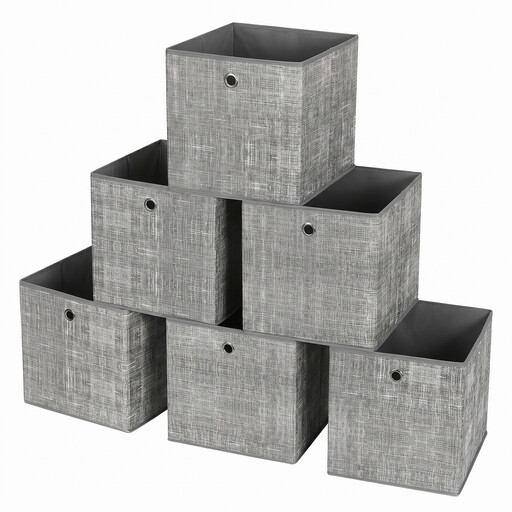
Why this model suits this profile: its 30 × 30 × 30 cm cube format fits cube storage units with compartments measuring more than 30.5 cm, whether in a bedroom, living room or home office.
The dimensions and maximum load of 5 kg per box are clearly stated. The base is fitted before use, and the boxes can then be folded flat.
Set of 6, 80 g/m² non-woven fabric, grommet handles and a format designed for cube storage units.
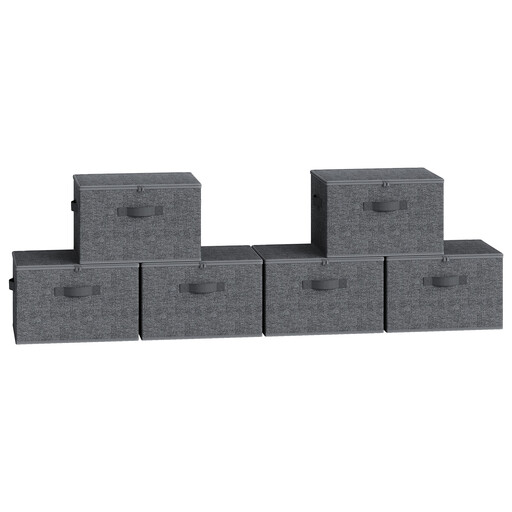
Why this model suits this profile: its zipped lids and linen-look finish make it suitable for storing textiles in a wardrobe, on a shelf or under a bed.
The 40 × 30 × 25 cm format is clearly specified, as is the maximum static load of 3 kg per box. Three handles make removal and carrying easier.
A zipped lid opening on three sides, a stated capacity of 30 L and a flat-fold design when not in use.
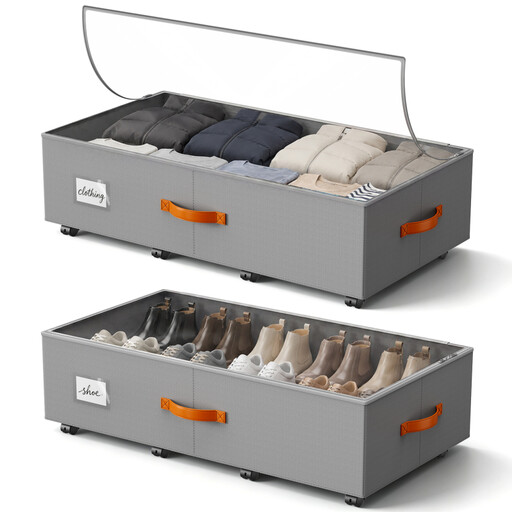
Why this model suits this profile: the castors and transparent window are practical for storing seasonal clothing, duvets and textiles that are rarely used.
Its design is dedicated to under-bed storage, while the transparent window lets you identify the contents without removing each box.
Two zipped units with castors, designed to make use of space that is often left empty.
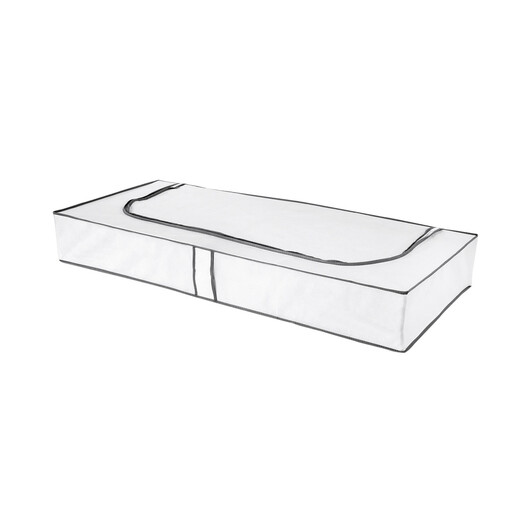
Why this model suits this profile: at 15 cm high and measuring 108 × 45 cm, it is designed for duvets, blankets and clothing stored under the bed.
The height is specified precisely, making it easy to check compatibility with the bed. The manufacturer recommends not overfilling the bag and avoiding sharp objects.
Non-woven polypropylene fibre, sliding opening and a slim format designed to make use of the space beneath the bed.
For a clothing organiser, group items by season, person or frequency of use. Label every box, even if its fabric is transparent or light in colour. Clothing that is rarely worn can be stored high up or under the bed, while laundry used every week should remain within easy reach.
In a wardrobe, boxes with handles are easier to remove. In cube shelving, storage cubes create a visually consistent look while keeping accessories separate. For a family, several boxes in the same format make it easier to organise toys, bed linen and children’s clothing.
Before stacking containers, place the heaviest ones at the bottom and respect the stated maximum load. A foldable box is designed to take up less space when empty—not to be compressed or deformed once loaded.
Browse an updated selection of storage boxes for organising clothing, laundry, toys and everyday items according to the space available.
Yes, provided you choose a model with suitable dimensions and a lid or closure. Fold clothing when it is clean and completely dry, then avoid filling the box so tightly that the textiles are compressed or the zip is strained.
Yes, if the structure, base and maximum load allow it. The boxes should be of a similar size, with the heaviest placed at the bottom. For dense items such as books, check the stated static load carefully.
Consult the care instructions for the model. For fabric boxes that cannot be machine-washed, a slightly damp cloth is generally recommended, followed by thorough air-drying. Never store damp laundry inside, and air out the container before first use if necessary.