
Livraison le jour même ou le lendemain

Qualité garantie

Débloquez vos offres de bienvenue: Livraison GRATUITE | Jusqu'à -80 % | 30 jours d'essai gratuits à JoyPlus
Téléchargez l'application
A wardrobe that’s bursting at the seams, seasonal clothes that are hard to find, or a suitcase that simply won’t close: foldable storage boxes can solve many everyday problems. But you need to choose the right model. One that’s the wrong size or overstuffed can quickly become bulky and impractical.
Before buying a set, watch out for these three common pitfalls:
To avoid disappointing purchases, compare the product’s features with your available space and your storage habits.
Measure the width, depth and height you have available, leaving a few centimetres of clearance so you can easily pull the box out. In a wardrobe, cubic sizes of 30 × 30 × 30 cm generally work well for compartments designed for fabric storage cubes. For a deep shelf or under-bed space, a longer model of 40 × 30 × 25 cm can be more practical.
Always consider the stated capacity alongside the external dimensions. A 30-litre box might be fine for bulky clothes, but that doesn’t mean it will fit into a narrow shelf. Also check the maximum static load specified by the manufacturer, to prevent the sides from buckling.
Non-woven fabric boxes are lightweight and fold away easily. When they have a cardboard base and panels, they hold their shape better for storing clothes, linen or toys. Oxford fabric can be suitable for regular use, as long as you follow the care instructions and don’t overload the container.
Models with handles should also have sturdy stitching and grip areas. For frequent use, choose a front handle that lets you pull the box off a shelf, as well as side handles for moving it around.
A zipped lid protects clothes from dust better than a simple open bin. An opening on several sides makes it easier to fill and access the contents, especially when the box is placed under a bed or at the top of a wardrobe.
For compressible items, vacuum storage bags are another option: they reduce bulk, but they don’t replace a rigid or semi-rigid box for organising and stacking your belongings. In a suitcase, choose packing cubes based on their weight, closure and range of sizes.
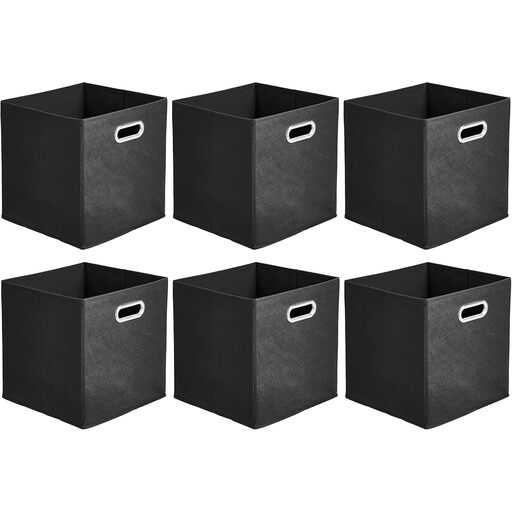
Why this choice suits this profile: this set of six cubes is ideal for starting to organise a wardrobe, shelf or cube storage unit. Their 10.5 × 10.5 × 11 inch size lets you sort clothes, toys or small items by category.
The size and quantity are clearly stated, making it easy to plan for a cube storage unit. Just avoid overloading them and clean with a damp cloth.
A set of 6 pieces, a foldable design, handles and a black finish that blends easily into several rooms in the house.
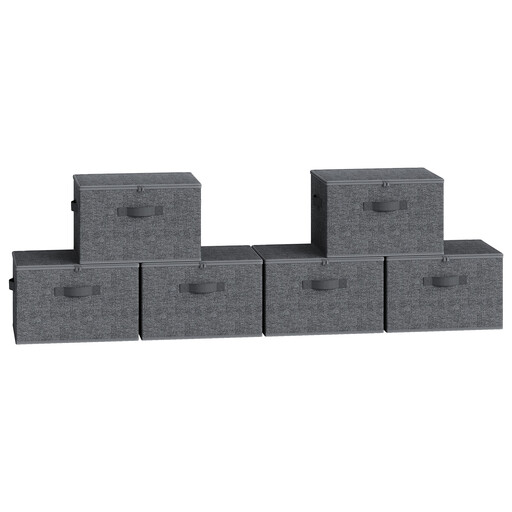
Why this choice suits this profile: this model combines a zipped lid, three handles per box and a size of 40 × 30 × 25 cm. It can find a place in a bedroom, dressing room or under a bed, provided the available depth is sufficient.
The dimensions, maximum static load of 3 kg per box and closure system are all specified. This information lets you match the contents to the container, rather than relying solely on the stated volume.
A set of 6 boxes, zip closures, three handles and flat storage when not in use.
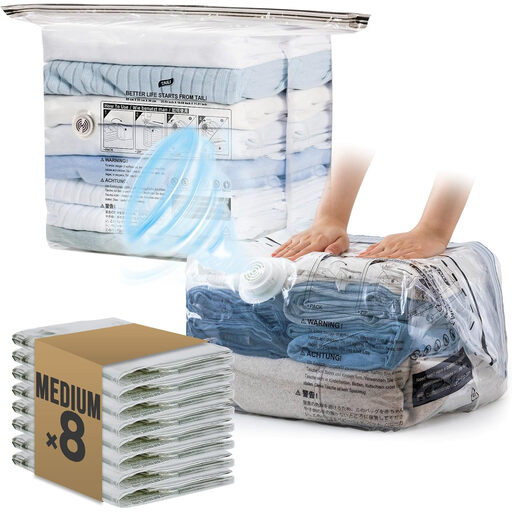
Why this choice suits this profile: these bags are designed for families, travellers and anyone looking to reduce the volume of clothes, blankets or baby items. They can complement standard boxes in a wardrobe or suitcase.
The manual compression system requires no pump. The double zip closure and valve must be properly sealed, and sharp objects should be avoided.
A set of 8 bags, PA + PE material specified, a transparent design and a construction suitable for storage at home and for travel.
We’ve put together a comprehensive, real-time updated list of products that fully meet these strict selection criteria and European safety regulations.
Yes, as long as you check the available height, whether there are castors and the depth of the bed. A model with a zipped lid offers better protection against dust. Also measure the space needed to pull the box out by its handle.
A fabric box keeps its shape and makes it easier to organise items on a shelf. A vacuum bag is primarily used to reduce the volume of soft items. In a dressing room, the two solutions can complement each other: bags for duvets or bulky clothes, and boxes for categories you access regularly.
Their lifespan depends on the material, how often they’re handled, the weight stored and the humidity level. Sticking to the stated load, avoiding sharp objects and not moving an overfilled box all help to preserve the stitching, handles and structure.