
Livraison le jour même ou le lendemain

Qualité garantie

Débloquez vos offres de bienvenue: Livraison GRATUITE | Jusqu'à -80 % | 30 jours d'essai gratuits à JoyPlus
Téléchargez l'application
A foldable shopping trolley makes trips to the supermarket, the market or the launderette much easier. It lets you carry several items without having to lug everything by hand, then folds away neatly in a cupboard, car boot or under a bed.
Yet product listings don't always give you the essential information. A large claimed capacity doesn't necessarily guarantee good stability, and a system described as "stair-climbing" doesn't mean you can skip checking the trolley's manoeuvrability and safety on your own staircase. Here are the criteria to examine before choosing a foldable shopping caddy.
A roomy bag can hold plenty of shopping, but the frame, wheels and hinges still need to support the corresponding weight. Product listings don't always state the maximum load in kilograms. In that case, don't assume the trolley's capacity from the bag volume alone.
For carrying heavy shopping, look at:
A stair-climbing shopping trolley can be useful in a building without a lift, but this feature doesn't remove the effort. Narrow steps, short landings or a winding staircase can make the climb trickier. Using a loaded trolley on an escalator is also not recommended.
So take a good look at the layout of your home and how the wheels handle the steps. Even when the bag is only partly full, the trolley should remain easy to control.
A trolley described as foldable can still be bulky if its frame doesn't collapse enough. Compare its folded dimensions with the space you have at home. A handle that's too low or too upright can also make your posture uncomfortable on longer trips.
An ergonomic handle, a wide enough grip and easy-to-steer wheels are often more useful than a purely aesthetic feature.
For regular use, choose a trolley whose frame is clearly described. Aluminium alloy generally offers a good balance of lightness and rigidity, while steel will suit those who prefer a sturdier build. However, the trolley's total weight must still be manageable for you.
A lightweight yet robust shopping trolley should also have properly protected hinges. On a folding model, make sure the locks are fully engaged before loading the bag. When folding, keep your fingers away from the hinges.
A shopping trolley on wheels should roll without putting too much strain on your wrist. 360° swivel wheels make it easier to change direction in aisles and narrow corridors. For outdoor use, their diameter, durability and ability to absorb uneven ground are key.
If you're looking for a supermarket trolley, also think about its overall width. A model that's too wide can become difficult to manoeuvre between checkouts or on public transport.
A compact shopping trolley is particularly well suited to a flat or a small car. The product page for the compact model shown below gives approximate dimensions of 45 × 35 × 5 cm when folded, and 95 × 35 × 45 cm when unfolded. Compare these measurements with the space you have for storage.
For a large-capacity shopping trolley, look at the bag's shape, how easy it is to access the contents and how the weight is distributed. A large volume is handy for families, but can make the trolley harder to control when it's full.
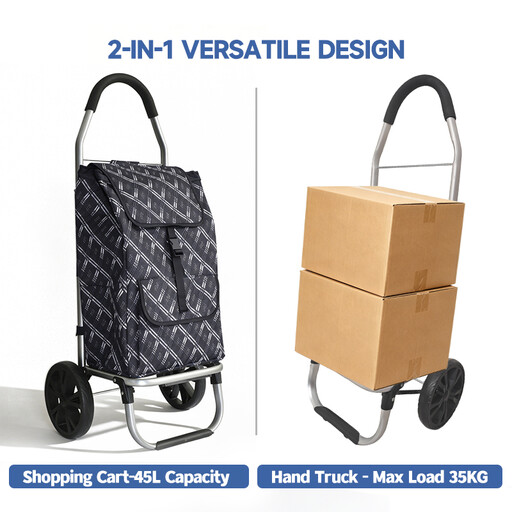
Why this choice suits this profile: Its foldable design and aluminium alloy frame are ideal for everyday shopping and storage in a small space.
The listing focuses on the folding mechanism and frame material, rather than a specific capacity that isn't documented. Still, check the permitted load before use.
Aluminium alloy frame and foldable design for everyday trips.
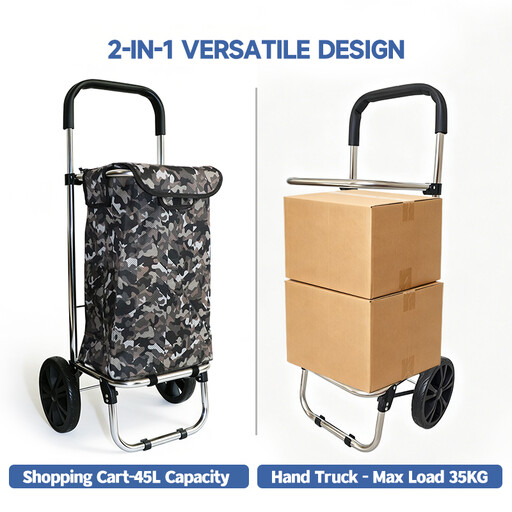
Why this choice suits this profile: It's aimed at those who prefer a metal frame and an ergonomic handle for frequent trips.
The metal structure provides the rigidity you're after, but you still need to check the trolley's total weight and the maximum load stated on the listing.
Stainless steel, ergonomic handle and foldable design.
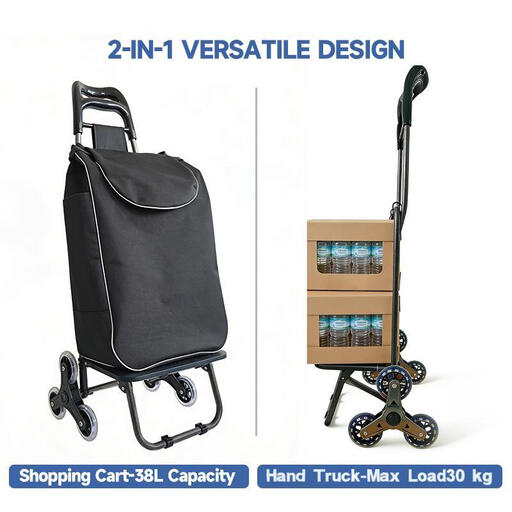
Why this choice suits this profile: Its design, intended for tackling steps, can suit those living in a block of flats or people who regularly carry heavy items.
The stair-climbing feature is clearly stated, but it should be seen as an aid to pulling, not as an effortless system.
Foldable design, ergonomic handle and design intended for stairs.
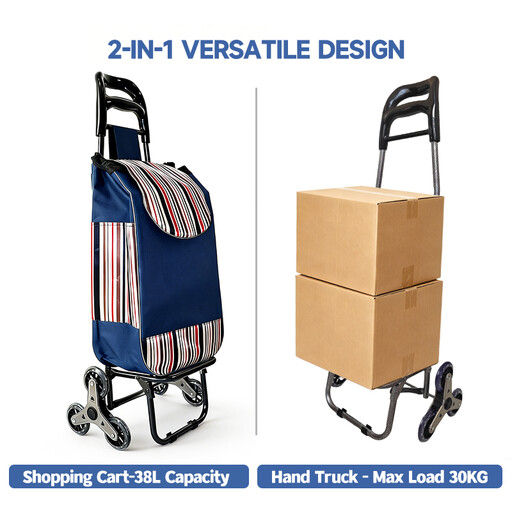
Why this choice suits this profile: Its folded size, described as particularly slim, makes it easy to store in a flat, car boot or cupboard.
The folded and unfolded dimensions are given as approximate. Compare them with the space you have available before buying.
Compact format, ergonomic handle and swivel wheels as stated.
We've put together a comprehensive, real-time updated selection of products that meet these demanding criteria, as well as European safety standards.
To extend the life of your foldable shopping trolley:
Elderly people or those with reduced mobility should prioritise a comfortable handle, a suitable height and a model that's light enough when empty. Trying it out in a clear space also lets you check the handling before using it outdoors.
Some models have a stair-climbing design, but they generally require careful pulling and control of the load. Check the width of the steps, the trolley's stability and the manufacturer's recommendations. Never use an escalator with a loaded trolley.
For one person, a compact model can be enough for everyday purchases. A family would be better off comparing the bag volume and frame sturdiness of a large-capacity trolley. In any case, don't rely solely on the stated number of litres: also check the maximum load and wheel stability.
Start by checking its dimensions when folded, then choose a dry spot that's protected from knocks. After using it in the rain, let the bag and frame dry before folding the trolley away. This will help prevent odours and premature wear of the materials.