
Livraison le jour même ou le lendemain

Qualité garantie

Débloquez vos offres de bienvenue: Livraison GRATUITE | Jusqu'à -80 % | 30 jours d'essai gratuits à JoyPlus
Téléchargez l'application
Doing your shopping on foot, carrying groceries on public transport or stashing your gear in a small home calls for the right equipment. A foldable shopping trolley can significantly cut down the effort of lugging bags – provided you check a few key points before buying.
Photos and product descriptions alone aren’t always enough to make the right choice. Here are the main pitfalls to avoid, the features to look out for, and a selection of models suited to different needs.
A large bag isn’t necessarily practical. A capacity of 56 L or 60 L gives you an idea of the volume available, but it doesn’t always tell you about the maximum load, the shape of the compartment or how easy it is to access.
To compare two models properly, check each of the following separately:
A large-capacity shopping trolley is great for the weekly shop. However, it can become awkward on stairs or in the boot of a small car.
The number of wheels directly affects manoeuvrability. A two-wheeled trolley is generally easy to pull on a smooth surface. A three-wheeled model can help you get over certain obstacles, but its size and handling are worth a close look.
Before choosing a foldable shopping caddy, pay particular attention to:
A wheel that glides perfectly down supermarket aisles won’t necessarily perform the same way on a campsite path or an uneven road.
Folding is only useful if it stays simple after repeated use. Check the trolley’s dimensions when folded, its total weight and how the bag attaches to the frame.
For a lightweight shopping trolley, a low weight makes it easier to carry up stairs. On the other hand, a robust shopping trolley may have a heavier frame, but one that’s better suited to regular heavy loads. The trick is finding the right balance between mobility, capacity and ease of storage.
A 56 L model is a good compromise for everyday shopping. A 60 L shopping trolley will suit a family or someone who prefers to combine several trips into one. In any case, the available volume shouldn’t lead you to exceed the recommended load.
Place heavy items at the bottom of the bag and fragile products on top. This distribution reduces the risk of tipping and lessens the strain on the handle and wheels.
A metal or stainless steel frame generally offers more rigidity, while a woven or fabric bag is easier to fold. Also remember to check:
Claims like “sturdy” or “large capacity” should be weighed against concrete details, such as the stated maximum load or the material used.
For frequent trips, a comfortable handle and the right height make pulling the trolley much more pleasant. Older shoppers may prefer a shopping trolley for the elderly with a simple grip, good stability and an easy-to-understand folding mechanism.
However, no spec sheet can replace a real-world trial: the trolley should be easy to pull without excessive effort, able to turn in a narrow space and remain stable when stationary.
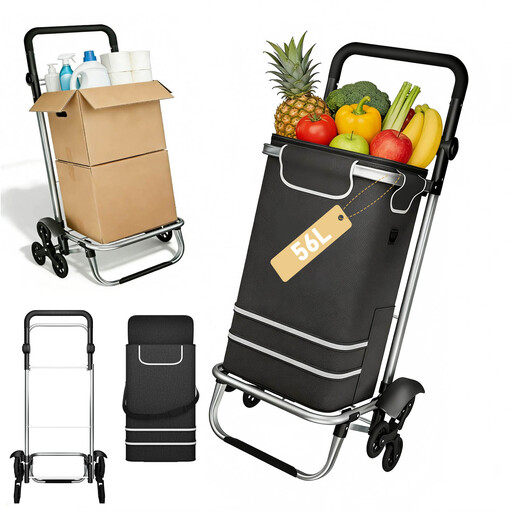
Why this choice suits this profile: Its 2-in-1 design, both trolley and backpack, makes it a good option for a first purchase intended for shopping, picnics or camping.
The 56 L capacity is clearly stated, and the folding design makes storage simple between uses.
56 L volume, foldable design and dual use as backpack/trolley.
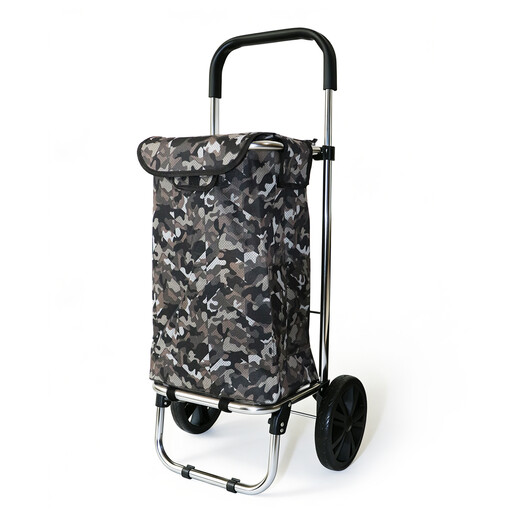
Why this choice suits this profile: Its stainless steel frame and ergonomic handle are aimed at users who want a rigid chassis for regular shopping trips.
The frame material is specified, making it easier to compare with models whose composition remains unclear.
Stainless steel frame, ergonomic handle and folding design for easy storage.
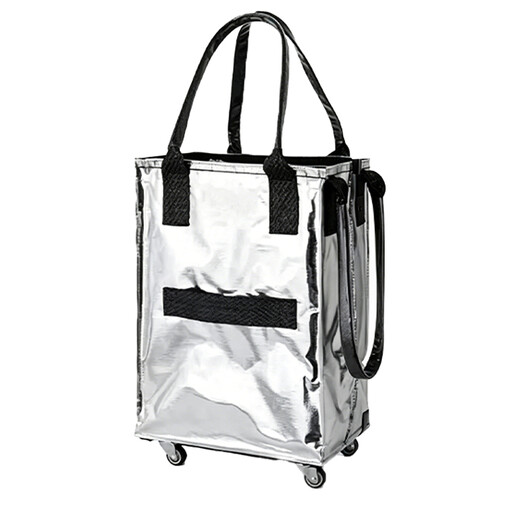
Why this choice suits this profile: Its thick woven bag and roughly 60 L capacity are ideal for big shops and repeated use.
The stated maximum load of 35 kg gives you a concrete benchmark to follow, depending on how you distribute your shopping and the conditions of use.
Approx. 60 L volume, stated maximum load of 35 kg and thick woven bag.
Even a robust shopping trolley should be used within the limits set by its manufacturer. To keep the wheels and joints in good condition:
Before ordering, also check the trolley’s dimensions when unfolded and folded, the delivery options, the return policy and any information about the responsible party established in the European Union, where shown on the product page.
We’ve put together a comprehensive, real-time updated list of products that fully meet these strict selection criteria and European safety regulations.
A 56 L model can be enough for the regular shopping of one person or a small household. For larger shops, a 60 L shopping trolley offers greater capacity, but it will also be bulkier when full.
Compare its empty weight, its dimensions when folded, its wheel system and the height of its handle. Also check that the folding mechanism is clearly described and that the bag stays properly attached to the frame.
It depends on the load carried, how often you use it, the surfaces you travel over and how well you maintain it. Sticking to the stated maximum load, avoiding stairs with an overloaded bag and cleaning the wheels regularly all help to prevent premature wear.