
Livraison le jour même ou le lendemain

Qualité garantie

Débloquez vos offres de bienvenue: Livraison GRATUITE | Jusqu'à -80 % | 30 jours d'essai gratuits à JoyPlus
Téléchargez l'application
Doing your grocery shopping on foot, taking public transport or carrying boxes to your car becomes much easier with a foldable shopping trolley. The key is choosing a model that genuinely suits your day-to-day routine. Behind claims of “large capacity”, durability and ergonomic design, construction differences can be significant.
A trolley that is too heavy quickly becomes awkward on stairs. Poorly suited wheels may catch on pavements or cobblestones. And a large but poorly supported bag can lose its shape and make the trolley unstable. Here are the criteria to assess before buying, along with a selection of models suited to different uses.
A bag advertised as 56 L or 60 L can hold a substantial amount of groceries, but that does not mean the frame can support a heavy load. Between bottles, canned goods and household products, the weight can quickly add up.
Check each of the following separately:
For everyday shopping, a wheeled shopping trolley with a 56–60 L bag can be perfectly suitable. For moving boxes or crates, however, a foldable aluminium hand truck with a platform is generally the better choice.
Small wheels perform well on the even floors of a shop, but quickly reach their limits on cobblestones, damaged pavements and thresholds. TPR wheels, when listed in the technical specifications, often provide smoother contact with the ground and reduce noise compared with rigid wheels.
Also consider the number of wheels. A two-wheeled model is easy to pull behind you. A three-wheeled version may handle certain obstacles more easily, but it can take up more space and require a short adjustment period.
A lightweight shopping trolley is easier to lift onto a bus or carry up the stairs. However, low weight should not come at the expense of frame rigidity, the strength of the fittings or the handle. Ideally, the product listing should specify the unloaded weight, frame material and maximum load.
For grocery shopping, look for the best balance between unloaded weight and durability. An aluminium frame makes transport and handling easier. If you need to move heavier loads, a sturdy trolley with a reinforced platform and securing straps will be far more suitable than a simple wheeled bag.
For example, the foldable hand truck featured below weighs 3.5 kg and supports a maximum load of 80 kg, while another model lists 7 kg and 150 kg. These figures are not merely indicative: respect the maximum load and place heavy items in the centre of the platform to maintain balance.
Measure the available space in your hallway, car boot or cupboard. A quick-folding mechanism is useful, but make sure the trolley locks securely in the open position and that no component obstructs the closing mechanism.
On public transport, a narrow profile and telescopic handle make it easier to store the trolley between two seats or in a luggage compartment. At home, a few extra centimetres may be acceptable if stability and capacity matter more than compactness.
An ergonomic handle should provide a secure grip without forcing you to bend forward. Adjustable telescopic handles are particularly practical when several people use the trolley or when their heights differ.
Also check the turning radius, how easily the trolley handles low kerbs and whether it has a brake. For older users or anyone who finds lifting difficult, manoeuvrability matters just as much as bag capacity.
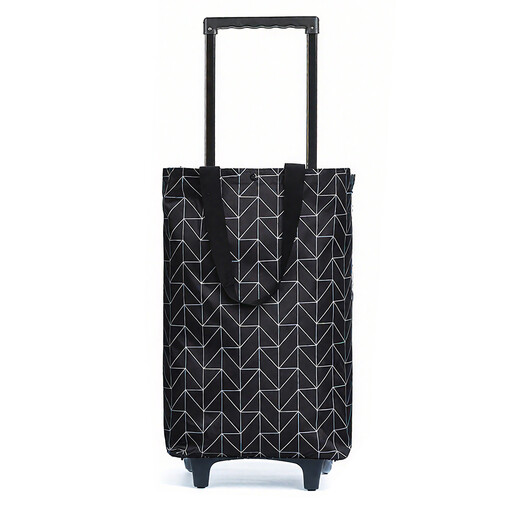
Why this choice suits this profile: Its foldable format and lightweight design make it ideal for anyone looking for a straightforward trolley for everyday shopping that can be stored easily in a small space.
It prioritises simplicity and easy folding rather than promoting capacity without further detail. Check the product listing to confirm the load it can safely handle for your intended use.
Foldable design, black finish and pull handle. An option worth considering for short trips and discreet storage at home.
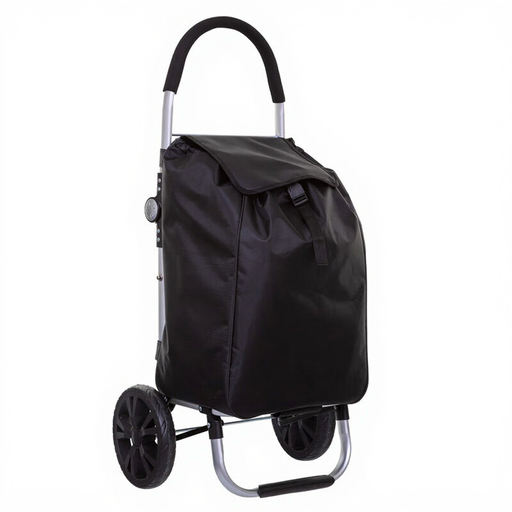
Why this choice suits this profile: Its aluminium frame, spacious main bag and folding mechanism meet the needs of regular trips to the market, supermarket or home.
The frame material is clearly specified, making it possible to assess the structure beyond capacity or styling claims alone.
Aluminium frame, foldable storage and a design suited to shopping, gardening and transporting items around the home.
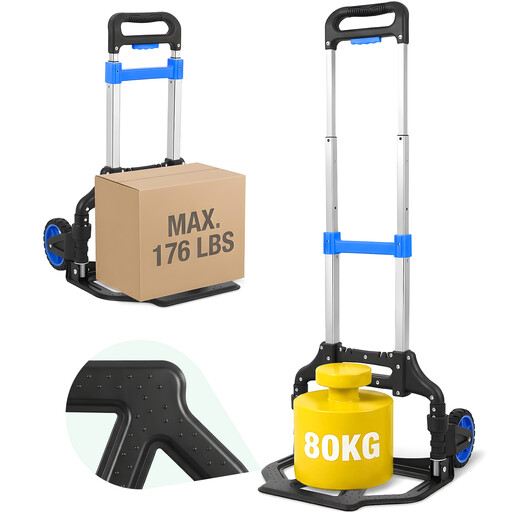
Why this choice suits this profile: This foldable transport trolley is designed for boxes, crates and heavy loads, particularly when moving house, working in the garden or making occasional deliveries.
Its stated maximum load is 80 kg, while its net weight is 3.5 kg. These specifications clearly distinguish it from a shopping trolley intended solely for groceries.
Aluminium frame, handle adjustable to three heights, TPR wheels with dual bearings and a folded width of just 5.7 cm.
A 30–45 L model is sufficient for light or frequent shopping trips. For larger weekly shops, a 56 L or 60 L bag provides more space, provided the wheels, base and frame are designed to support the corresponding weight.
Yes, provided the handle is easy to grip, the trolley remains stable and the wheels roll smoothly. Choose a suitable handle height, a reasonable weight and a simple folding mechanism. For carrying substantial loads, a platform model will often be more appropriate than a trolley fitted with a conventional bag.
Respect the maximum load, avoid pulling the trolley at an angle over long distances, and regularly remove hair, threads and debris that can become trapped in the wheels. Storing it away from moisture also helps protect the metal components and the bag’s seams.