
Same-day & Next-day Delivery

Quality Guaranteed

Unlock Your Welcome Offers: FREE Delivery | Up to 80% OFF | Free 30-day JoyPlus trial
Download the APP
A foldable sack truck makes light work of moving boxes, shopping, crates or gardening equipment. But you still need to pick a model that suits how you’ll actually use it. A flattering maximum load, wheels advertised as quiet or a quick-folding mechanism aren’t enough on their own to guarantee a smart purchase.
Before you compare different foldable transport trolleys, make sure you check three points that are often overlooked:
Here are the criteria to run through so you can avoid nasty surprises and find a model that genuinely fits into your daily routine.
A 150 kg sack truck won’t necessarily carry 150 kg in every configuration. On some 2-in-1 models, the capacity changes depending on whether you use it upright or as a platform trolley. Weight distribution, slopes and the type of surface all directly affect how easy it is to manoeuvre.
Always check the authorised load for each mode of use. A model rated at 80 kg in sack-truck mode and 150 kg in platform mode must be used within those exact limits.
Compact wheels make storage easier, but they can be less comfortable on cobbles, door thresholds or uneven ground. On the other hand, wider wheels mounted on bearings make it easier to move a loaded trolley, at the cost of slightly more bulk.
If you mainly move around a flat-floored flat, garage or warehouse, compact TPR wheels can work perfectly. For a garden, paved courtyard or building site, go for a stable chassis and wheels that are robust enough.
Foldable doesn’t automatically mean easy to slide into a car boot. Check the width when folded, the empty weight and whether there’s a telescopic handle. A lightweight 80 kg sack truck can often be far more practical day to day than a heavier model that ends up stuck at the back of the garage.
An aluminium foldable sack truck generally combines lightness with corrosion resistance. That’s a real advantage for domestic, professional or sheltered outdoor use. However, the stated load capacity needs careful examination – it often depends on the position of the platform and the stability of the load.
For moving parcels or crates, look in particular for:
A wheeled sack truck needs to stay easy to control when the load is near its limit. Double-bearing wheels give a smoother ride, while a parking brake can hold the trolley steady on a slope or while you’re loading.
The brake obviously doesn’t replace careful handling. Don’t exceed the stated load and check that the wheels spin freely before each use.
A 2-in-1 trolley can switch from an upright position to a platform position. This is a handy option if you carry both stacked boxes and bulky, low-height loads. Check the conversion mechanism, the handle height and the width of the trolley when folded.
For the weekly shop, a foldable shopping trolley with a large-capacity bag answers a completely different need: it focuses on storage, pulling comfort and carrying groceries rather than heavy loads.
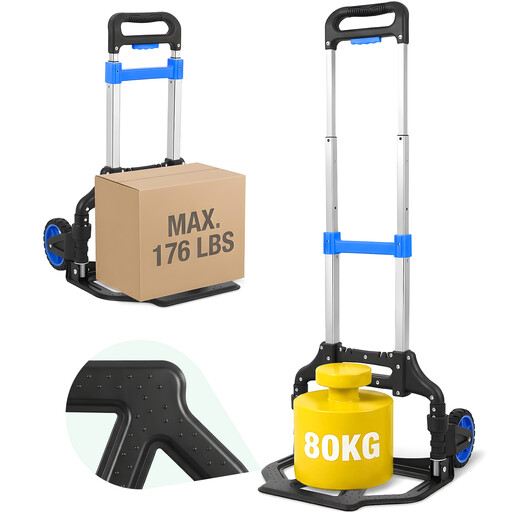
Why this choice suits this profile: With a net weight of 3.5 kg, an 80 kg capacity and a handle adjustable to three heights, this model is ideal for small transport jobs, parcels and crates of drinks.
Its maximum load and its own weight are clearly distinguished, so you won’t confuse high capacity with ease of transport.
Aluminium frame, quick folding, stated folded width of 5.7 cm, double-bearing TPR wheels and brake.
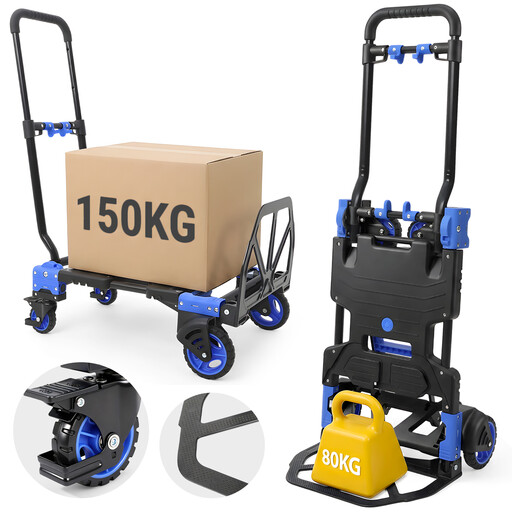
Why this choice suits this profile: Its conversion from an 80 kg sack truck into a 150 kg platform trolley lets you adapt the format to boxes, furniture and bulky loads.
The two capacities are stated separately depending on the configuration, which reduces the risk of misinterpretation.
Aluminium frame, swivel double-bearing TPR wheels, parking brake and adjustable handle.
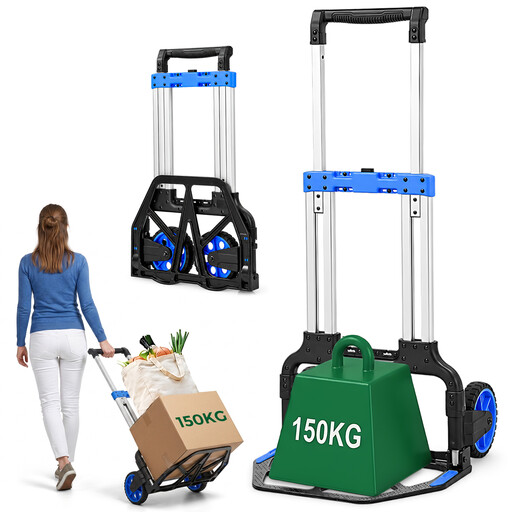
Why this choice suits this profile: This model is designed for house moves, workshops, warehouses, building sites and gardening jobs that require moving loads of up to 150 kg.
The XXL non-slip platform and two extension straps help stabilise tall or bulky loads.
Stated load of 150 kg, telescopic handle at 77 or 107 cm, TPR wheels on bearings and reinforced aluminium frame.
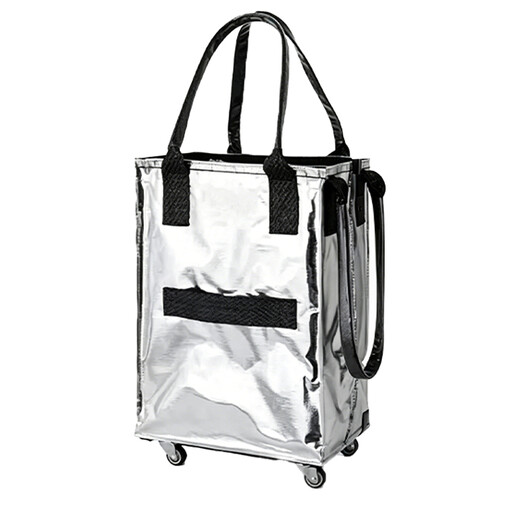
Why this choice suits this profile: This foldable trolley is designed for supermarket trips and carrying groceries, with a stated capacity of around 60 L.
Its stated capacity and maximum load – around 60 L and 35 kg – clearly set it apart from a sack truck intended for heavy materials.
Thick woven bag, volume of around 60 L and stated maximum load of 35 kg.
We’ve put together a full selection, updated in real time, of products that meet these demanding criteria as well as European safety regulations.
Yes, provided the platform, wheels and maximum load are suitable. For a wardrobe or tall piece of furniture, use straps and check the centre of gravity. For wide, low loads, a platform trolley can be more stable than an upright model.
Regularly remove dust and debris that builds up around the wheels, then wipe the frame with a slightly damp cloth. Store the trolley in a dry place. Before moving a heavy load, inspect the screws, handle, folding mechanism and brake.
For parcels, shopping and crates, a capacity of 35 to 80 kg is usually enough. House moves, workshop jobs or gardening may justify a 150 kg sack truck, provided you have a suitable surface to work on and you respect the authorised load in each configuration.