
Livraison le jour même ou le lendemain

Qualité garantie

Débloquez vos offres de bienvenue: Livraison GRATUITE | Jusqu'à -80 % | 30 jours d'essai gratuits à JoyPlus
Téléchargez l'application
A foldable incline treadmill can turn an unused corner into a genuine workout space. But you still need to choose the right model. Some disappoint from the very first sessions: the machine is too bulky, the running belt is too narrow, the motor is noisy or the incline is advertised as automatic when it actually has to be adjusted manually.
To avoid unpleasant surprises, compare the features that really matter for your needs: walking under a desk, regular jogging, hill training or storage in a flat. Here are the key points to check before making your choice.
A 9 % or 14 % incline does not necessarily mean that it can be adjusted from the console. On some models, you need to lift the treadmill and reposition a mechanical component. This may be sufficient for occasional use, but it does not allow you to change the incline during a session.
By contrast, an automatic incline treadmill has a dedicated motor. This is the most convenient option for alternating between flat sections and uphill stretches, but this feature generally increases the machine’s price, weight and size.
Power stated in horsepower, such as “2.5 HP” or “3.0 HP”, is not enough to assess how comfortable the machine will be to use. Also look at the maximum speed, frame stability, belt width and maximum supported weight.
A motor designed for gentle walking will not necessarily meet the needs of someone who wants to run several times a week. If you are looking for a quiet treadmill, also check the stated noise level. However, bear in mind that noise depends on the floor, the user’s weight and the speed.
A machine can be marketed as compact while still requiring a considerable amount of clear space when in use. Measure the available space in length, width and height, then allow enough room to get on and off without having to contort yourself.
For use under a desk, height is crucial. An under-desk walking pad should slide beneath your furniture without forcing you to change your posture. Transport wheels and total weight also play an important role if you need to put it away after every use.
A 38 × 94 cm belt is mainly suitable for walking. With 38 × 100 cm, you get a little more room for jogging, but taller users should consider a longer and wider running surface.
The speed range already gives you a good indication of the intended use:
Always observe the maximum load specified by the manufacturer. For a high-capacity treadmill, compare this figure with your weight, without forgetting to account for movement and acceleration. A sufficient margin can make the machine more stable and comfortable to use.
Also examine the rigidity of the structure, the handles, the safety key and the cushioning system. None of these features replaces following the manufacturer’s recommendations, but they all contribute to safer, more controlled exercise.
A Bluetooth treadmill can play music or send your data to an app. However, advertised compatibility with Zwift, Kinomap or EQI SPORTS does not mean that every feature will be available on every smartphone or with every subscription.
Before ordering, check:
The models below are presented based on their stated features. Check the product page for full dimensions, delivery terms, any assembly requirements and safety instructions.

Why this choice suits this profile: With its 9 % incline and stated maximum load of 130 kg, this model is suitable for your first experience of incline walking at home. The speed can be adjusted remotely using the remote control.
The product listing clearly states a 9 % incline and a maximum load of 130 kg: two essential details to check before ordering.
Foldable design, speed remote control, stated 9 % incline and maximum load of 130 kg.
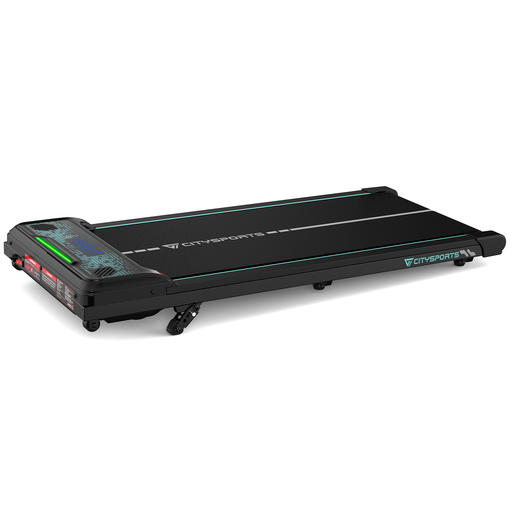
Why this choice suits this profile: Its speed range of 1 to 6 km/h is suitable for walking under a desk. With a stated noise level below 45 dB, it fits more easily into a flat or workspace.
The four incline levels are adjusted manually, so it cannot be confused with a motorised incline model.
Manual incline from 0 to 14 %, belt measuring approximately 40 × 102 cm, maximum load of 120 kg and Bluetooth speaker.
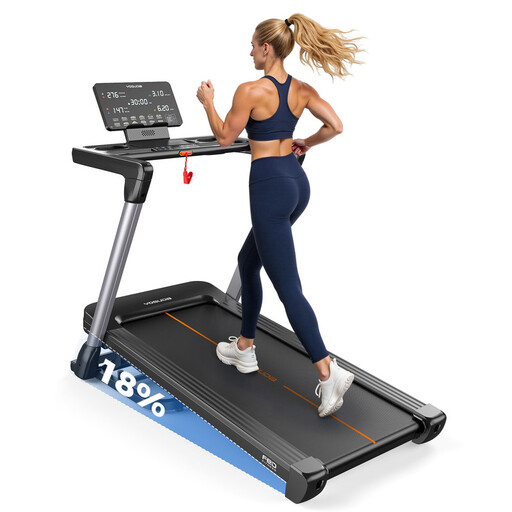
Why this choice suits this profile: This configuration is designed for users looking for a foldable machine with a motorised incline, high-resolution LED display and Bluetooth app connectivity.
The incline is advertised as automatic and can reach 18 %, clearly distinguishing it from manually adjusted inclines.
Stated maximum load of 172 kg, 3.0 HP brushless motor, four-part cushioning system and Bluetooth compatibility.
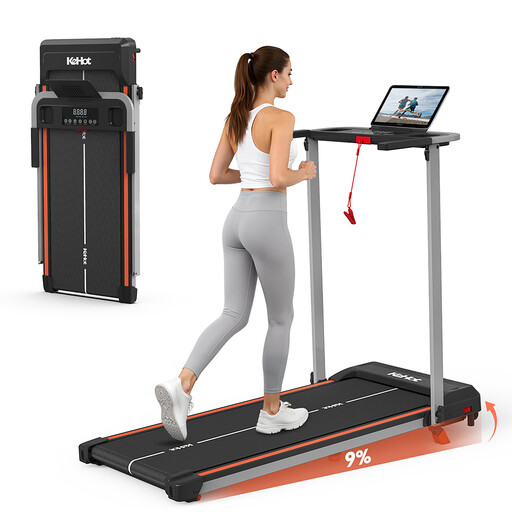
Why this choice suits this profile: Its stated speed range of 1 to 12 km/h, maximum load of 150 kg and compatibility with Zwift, Kinomap and EQI SPORTS make it an appealing option for more varied home workouts.
The product listing specifies that the 9 % incline is manual, so there is no risk of confusing it with an automatically adjusted incline.
Speed of up to 12 km/h, 38 × 100 cm running surface, LED display, Bluetooth and stated maximum load of 150 kg.
We have selected a complete, real-time updated range of products that meet these strict criteria while complying with European safety regulations.
Set up the treadmill on a flat, stable floor, leaving enough space around it to move freely and use the safety key. In a flat, a protective mat can reduce vibrations transmitted to the floor, but it will not eliminate mechanical noise or the impact caused by walking.
After every session, remove any dust from the belt and check that it remains properly centred. Lubricate the treadmill in accordance with the manufacturer’s recommendations. Also avoid storing the machine somewhere damp and never exceed the stated maximum load.
With a connected model, test the Bluetooth connection with your phone before starting your workout. Depending on the treadmill and the plan you choose, apps may offer very different features.
A fixed 9 % incline may be suitable for incline walking, while higher levels allow you to vary your workouts more. If you want to change the incline during your workout, choose an automatic incline model and check that it is genuinely motorised.
The stated noise level, below 45 dB on some models, provides an initial reference point but does not reflect every situation. Speed, the user’s weight, the type of floor and vibrations also affect the noise you hear. Walking is generally quieter than running.
Consumption mainly depends on the motor’s power, usage time, speed and incline. To estimate it, check the electrical power shown in the technical specifications, then multiply it by the number of hours of use and the tariff charged by your electricity supplier. Regular cleaning and lubrication can also help the machine continue operating efficiently.