
Livraison le jour même ou le lendemain

Qualité garantie

Débloquez vos offres de bienvenue: Livraison GRATUITE | Jusqu'à -80 % | 30 jours d'essai gratuits à JoyPlus
Téléchargez l'application
A foldable home treadmill can transform a spare room, home office or corner of the living room into a genuine workout space. However, product descriptions do not always reflect the realities of everyday use. A motor advertised as powerful, a steep incline or a compact design do not necessarily guarantee that the machine will suit your home.
Here are the main criteria to consider before choosing an electric treadmill for walking, jogging or running at home.
A model displaying 12 km/h is generally suitable for brisk walking, jogging and moderate running. However, this figure says nothing about how comfortable the machine will feel over time, or how much freedom of movement the running surface provides.
A foldable walking treadmill designed for gentle use may have a relatively short belt. If you plan to run regularly, check its width and length, without overlooking the stability of the frame.
The advertised power may refer to a maximum figure rather than the motor’s continuous power. When comparing two treadmills, consider the speed you intend to use, the user’s weight, how often you will train and the type of workouts you plan to do.
A heavier user or someone who enjoys longer sessions should consider a high-capacity treadmill with a stable frame and suitable motor. The manufacturer’s stated maximum user weight must never be exceeded.
A quiet treadmill is never completely silent. Noise comes from the motor, the moving belt, foot impact and vibrations transferred to the floor. In a flat, a machine placed directly on a wooden floor may therefore be noisier than expected.
Also measure the machine when it is unfolded and when it is stored. Even a compact model may need extra space for moving around it, raising the frame or reaching the power socket.
For walking and jogging, a belt measuring around 38 × 100 cm may suit some users. Taller people or those with a longer stride will generally be more comfortable with a longer and wider running surface.
The load capacity should be compared with your weight, but also with the intensity of your workouts. A sufficient margin helps ensure more stable use. Also check the machine’s weight: a very lightweight treadmill is easy to move, but may be less stable when running.
A treadmill with incline allows you to increase the intensity without necessarily speeding up. An automatic incline can be adjusted from the console or remote control, whereas a manual setting will generally require you to stop the machine before changing its position.
Advertised percentages, such as 8 %, 9 %, 15 %, 18 % or 20 %, refer to the maximum incline specified by the manufacturer. Before using a high setting, check the mechanism, the machine’s stability and the safety instructions.
A Bluetooth treadmill, or one that is compatible with an app, can display speed, distance, duration and calories burned, and may also offer workout programmes. However, check that it is compatible with your smartphone and the apps you actually use.
To keep the machine in good condition over time, clean it regularly, inspect the belt and lubricate it according to the instructions. Always use the safety key, install the treadmill on a level surface and keep children and pets away during workouts.
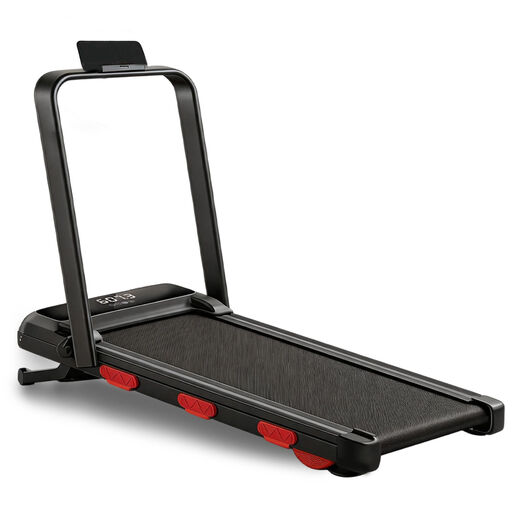
Why this choice suits this profile : With an advertised maximum speed of 12 km/h, automatic incline of up to 20 % and a maximum load of 160 kg, this model could provide a versatile first treadmill for home use.
The automatic incline means your workout is not limited to a fixed pace. You should still check the dimensions and noise level before ordering.
Automatic incline of up to 20 % and remote control with LED display, according to the product listing.
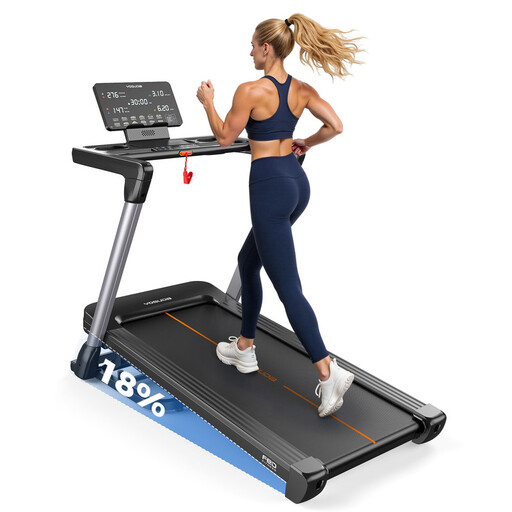
Why this choice suits this profile : Its steel frame, stated load capacity of up to 172 kg and connected features are suited to users who want to track varied, regular workouts.
The listing provides details of the frame, cushioning system and connectivity. This makes for a more meaningful comparison than simply looking at the power rating.
Advertised 3.0 HP motor, automatic incline of up to 18 %, Bluetooth and 12 pre-set programmes.
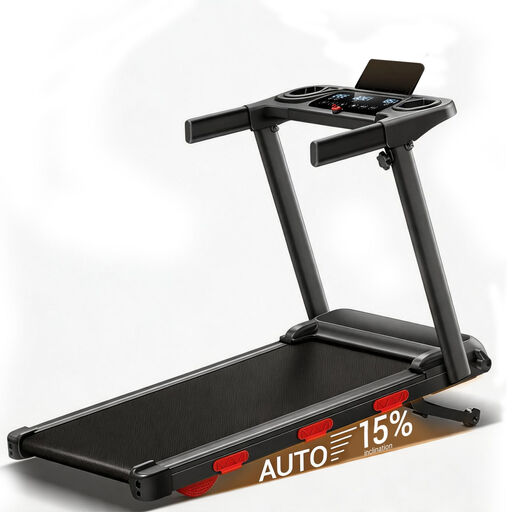
Why this choice suits this profile : Users looking for automatic incline and a high load capacity may wish to consider this model, advertised with an incline of up to 15 % and a maximum load of 400 lb, or approximately 181 kg.
The load capacity and incline are listed separately. Check their conversion into kilograms, the machine’s dimensions and the conditions of use in the manual.
Advertised maximum speed of 12 km/h, automatic incline of up to 15 % and LED display.
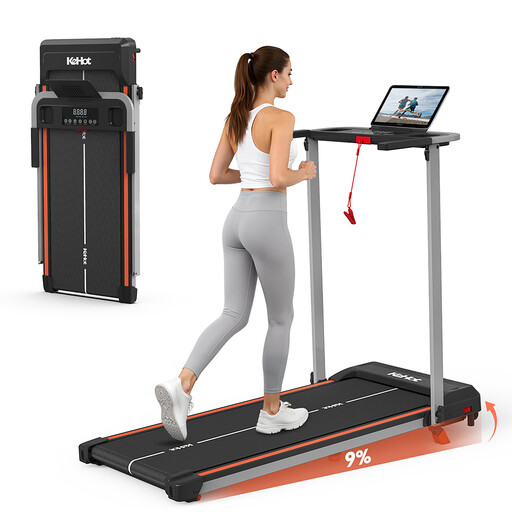
Why this choice suits this profile : Its advertised dimensions of 115 × 48 × 91 cm, adjustable speed from 1 to 12 km/h and compatibility with several apps could make it suitable for a flat.
The listing specifies a running surface of 38 × 100 cm and a maximum load of 150 kg. These are two figures to compare with your build and the space available.
Manual incline of 9 %, Bluetooth, compatibility with EQI SPORTS, Zwift and Kinomap, plus an LED display.
We have compiled a complete, real-time updated list of products that meet these demanding selection criteria and European safety standards.
Before your first workout, make sure there is enough clearance around the machine, particularly behind it and at the sides. Set it up on a stable floor and place a suitable protective mat underneath to reduce vibrations. In a flat, avoid times when the noise could disturb your neighbours and consult the building’s rules, if necessary.
The power socket must be suitable for the product’s specifications. For a model intended for the European market, check the stated voltage, usually 220–240 V, as well as the presence of an instruction manual and safety key. Once assembly is complete, check that the belt is aligned before starting at a low speed.
Allow for the machine’s footprint when unfolded, the space needed to get on it and a clear area behind it. Also include the room required for folding and moving it. The dimensions when stored do not replace the space needed when the machine is in use.
Consumption depends on the motor’s power, speed, user weight, incline and workout duration. To estimate it, check the electrical power in watts, multiply it by the usage time, then apply the tariff set out in your contract. The horsepower rating alone is not enough to calculate the cost accurately.
This depends on build quality, frequency of use, supported load, maintenance and the quality of the installation. Clean the belt regularly, lubricate it according to the manual and never exceed the stated load capacity. For frequent use, choose a stable frame, a belt suited to your stride and a clearly identified after-sales service.