
Livraison le jour même ou le lendemain

Qualité garantie

Débloquez vos offres de bienvenue: Livraison GRATUITE | Jusqu'à -80 % | 30 jours d'essai gratuits à JoyPlus
Téléchargez l'application
By the Joybuy Editorial Team, August 26, 2026
Transporting camping gear, beach supplies, or gardening tools can quickly turn a relaxing day into a chore. The foldable camping wagon has emerged as the go-to solution to lighten the load. However, the market is flooded with models that make tempting promises but often fail to deliver.
To avoid buyer's remorse, it's best to know the most common traps. An unsuitable wagon isn't just a waste of money; it also risks ruining a family outing or a productive afternoon of gardening.
Many models look identical in photos, but their real-world performance is often a different story. Here are the weak points frequently hidden behind slick marketing:
To find a reliable model that will last, focus on a few objective technical specifications rather than marketing claims.
The supported heavy load is directly linked to the quality of the frame. Opt for frames made of carbon steel or alloy steel, with sufficiently thick tubes and clean welds. The fabric also plays a role: 600D Oxford fabric is a benchmark for wear and tear resistance. Ensure the load capacity (in kg) is consistent with the apparent sturdiness of the structure.
For true versatility, wide wheels are essential. They distribute weight more evenly, allowing the wagon to roll over soft surfaces like sand, grass, or gravel. PVC or solid rubber wheels are more durable than hollow plastic ones. For added safety, especially on sloped terrain, choose a model with brakes on the front wheels. Quality bearings also ensure smoother, quieter traction.
A wagon's large capacity is measured in litres (L). A volume of 150 L to 200 L is comfortable for a family or for a garden cart. However, this capacity shouldn't come at the expense of compactness. Compare the wagon's dimensions when folded to ensure it will easily fit in your car trunk or a closet. Some models offer a highly efficient "accordion-style" fold.
Rather than searching for a one-size-fits-all model, it's better to choose a wagon suited to your primary use.
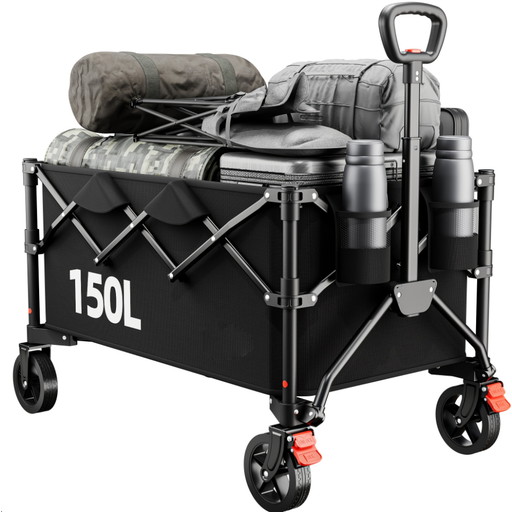
Why this model is a good fit: Ideal for occasional outings, trips to the market, or picnics in the park. Its balanced design makes it easy to manoeuvre in the city and through parks.
Its 120 kg capacity is realistic and sufficient for everyday use, without the exaggerated promises of entry-level models that buckle under weight.
Compact 4-sided folding and removable wheels for optimised storage, even in small spaces.
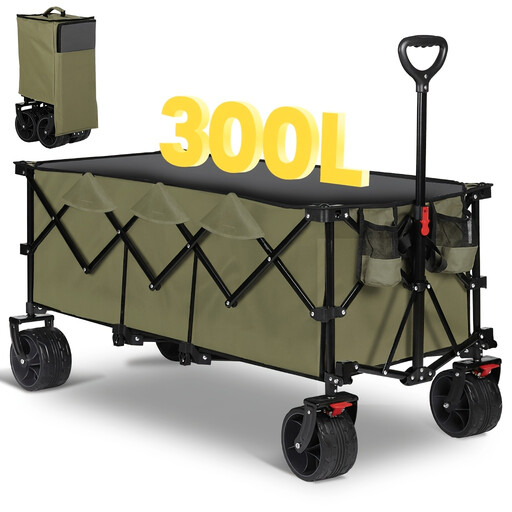
Why this model is a good fit: Perfect for families heading to the campsite or a festival, with generous space for a tent, cooler, and sleeping bags.
Its wide 18 cm wheels and certified 200 kg load capacity allow it to carry heavy loads over sand or dirt paths without the frame bending.
Extra-large 300 L capacity and a unique extendable design, practical for transporting long items like parasols or tents.
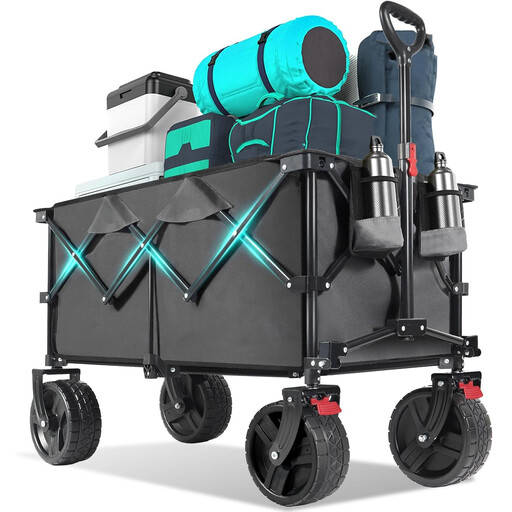
Why this model is a good fit: Designed for regular, demanding tasks like transporting tools, bags of soil, or firewood. Its robustness makes it an excellent garden cart.
The robust alloy steel frame and integrated brakes provide the durability and safety needed for heavy-duty use, unlike lighter models that wear out quickly.
Durable alloy steel structure and wheel brakes for full control on slopes or when loading heavy items.
We have selected other products for you that meet our quality criteria and current safety standards.
While both are used to transport loads, their design is different. A foldable hand truck is vertical and designed for stackable items like boxes. A camping wagon, also known as a hand cart, is a horizontal tub on four wheels, ideal for carrying loose gear (bags, coolers, chairs) over varied terrain.
After each use, especially at the beach or on muddy ground, clean the wheels to remove sand and debris. Wipe the fabric with a damp cloth if necessary. Make sure the wagon is completely dry before folding it to prevent rust on the frame and mould on the fabric. Store it in a dry place.
Yes, absolutely. It's the most important criterion for a beach wagon. Thin wheels sink into dry sand, turning transport into a real test of strength. Wide wheels "float" more on top of the sand, making it much easier to move, even with a heavily loaded wagon.