
Same-day & Next-day Delivery

Quality Guaranteed

Unlock Your Welcome Offers: FREE Delivery | Up to 80% OFF | Free 30-day JoyPlus trial
Download the APP
Transporting boxes, drinks crates or professional equipment should not turn every journey into an ordeal. Yet buying a foldable aluminium hand truck can come with a few unwelcome surprises: a stated capacity without clarifying how it should be used, wheels that are poorly suited to uneven surfaces or a flimsy folding mechanism.
To avoid making the wrong choice, it is best to compare the information that really matters: trolley weight, load capacity, folded dimensions, handle adjustment and wheel type. Here are the criteria to consider before choosing a foldable transport trolley.
A stated maximum capacity does not necessarily mean that the trolley will be suitable for every situation. A hand truck used vertically will generally not support the same load as a model converted into a platform. The weight must also be distributed evenly across the platform, without exceeding the limit specified by the manufacturer.
An 80 kg aluminium hand truck can be perfectly suitable for transporting parcels, boxes or small items of equipment. For larger objects, a 2-in-1 platform hand truck with a separate capacity in horizontal mode will offer greater versatility.
In photos, a folding trolley can look particularly compact. In practice, its folded dimensions will determine whether it can easily fit in a car boot, storeroom or office. In particular, check:
A very lightweight model that is awkward to fold will ultimately be less practical for everyday use than a trolley with a simple, clearly documented mechanism.
Your choice of wheels has a direct impact on manoeuvrability. TPR wheels, or thermoplastic rubber wheels, are popular because they operate more quietly and can absorb some of the vibrations. TPR wheels with double bearings can make it easier to move across different types of surface, but you should still take care on stairs and very badly damaged floors.
A foldable trolley with a brake provides valuable extra safety when stopping on a slope. The brake should be engaged before releasing the handle and must never be used to compensate for an excessive load.
The unladen weight is an essential consideration for delivery drivers, office workers and private individuals who need to carry the trolley before they even use it. A lightweight hand truck weighing just a few kilograms will be easier to take out of the boot or carry up stairs.
Load capacity must be interpreted according to how the trolley is used. For example, a model may support 80 kg in the vertical position and 150 kg in platform mode. These two figures are not interchangeable: the load must remain stable and comply with the configuration specified by the manufacturer.
An adjustable handle allows you to set the height according to the user’s size and the position adopted while transporting a load. Several adjustment levels are particularly useful when the same trolley is used by several employees or members of a family.
Choose a non-slip handle that is sufficiently wide and has a secure locking mechanism. Once adjusted, it should not force you to lean too far forwards when the trolley is loaded.
Aluminium offers an appealing balance between low weight and corrosion resistance. However, you should take a close look at the frame design, pivot points and platform surface. A reinforced structure will withstand repeated use better, while a mechanism exposed to dust will require more regular cleaning.
After each use, remove any debris that has collected around the wheels and folding system. For routine maintenance, a dry or slightly damp cloth is generally sufficient. Storing the trolley in a dry place will help preserve its metal components and wheels.
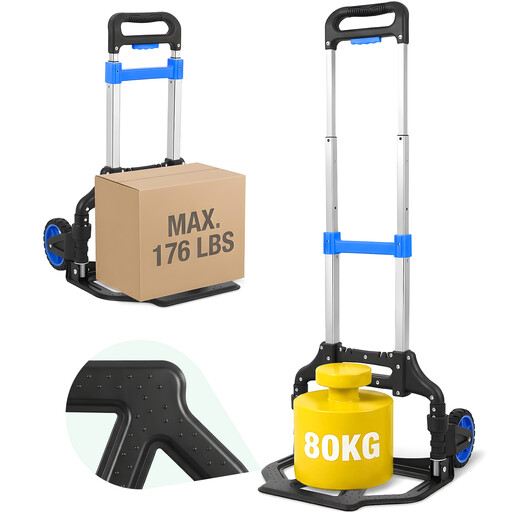
Why this choice suits this user profile : With a net weight of 3.5 kg and a stated capacity of 80 kg, this model is suitable for occasionally transporting parcels, boxes or crates.
The product details clearly distinguish between weight, maximum load and the different handle heights. This means you can compare concrete figures rather than relying on a simple promise of low weight.
Aluminium frame, folding mechanism advertised as taking one second, folded width of 5.7 cm, handle adjustable to 63, 90 or 100 cm, and TPR wheels with double bearings.
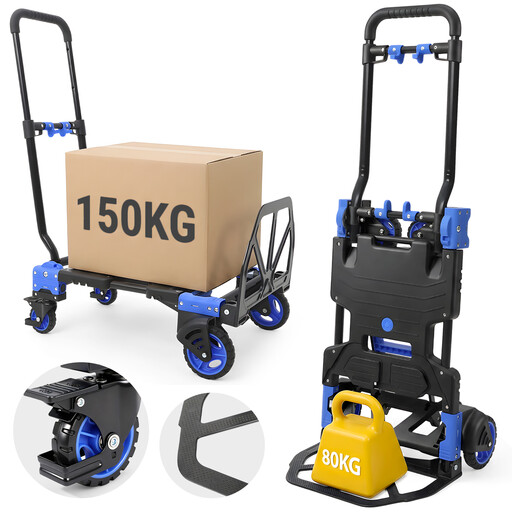
Why this choice suits this user profile : Its convertible design is ideal for anyone looking for a single piece of equipment to transport both vertical loads and bulky objects on a platform.
The capacities are specified for each configuration: 80 kg in hand truck mode and 150 kg in platform mode. This distinction prevents misleading comparisons.
Reinforced aluminium frame, 7 kg net weight, shock-absorbing TPR wheels with double bearings, parking brake and handle adjustable according to the selected mode.
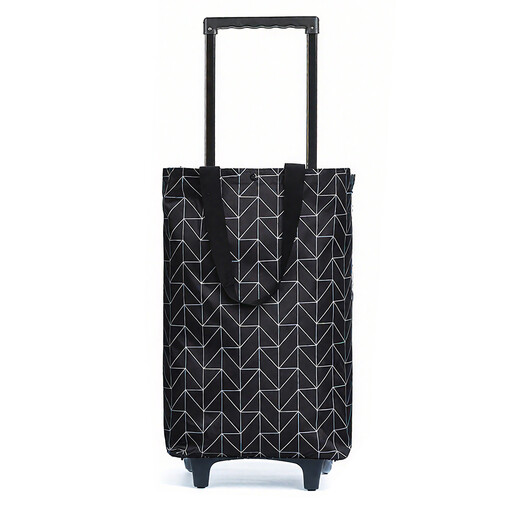
Why this choice suits this user profile : Its foldable trolley design is suitable for users who prioritise compact transport for personal belongings, supplies or lightweight parcels.
The product details describe it as a portable, lightweight and foldable model. Before using it for intensive professional work, check the permissible load stated on the product page.
Foldable design in black. An option to consider when compact storage and mobility matter more than transporting heavy loads.
We have put together a complete, regularly updated list of products that meet these demanding selection criteria and European safety standards.
It depends on the model and the configuration being used. Some trolleys state a capacity of 80 kg in vertical mode, while a model with a platform can carry up to 150 kg in the horizontal position. Always follow the figure that corresponds to the selected mode and distribute the load across the centre of the platform.
TPR wheels with double bearings generally provide quieter, smoother movement on hard floors, in a warehouse, office or home. However, you should still reduce the load on uneven surfaces, high thresholds and stairs.
Clean the wheels and joints regularly, do not exceed the recommended load and engage the brake when stopping on a slope. Store the trolley away from damp and occasionally check that the handle, platform and folding mechanism lock securely.